
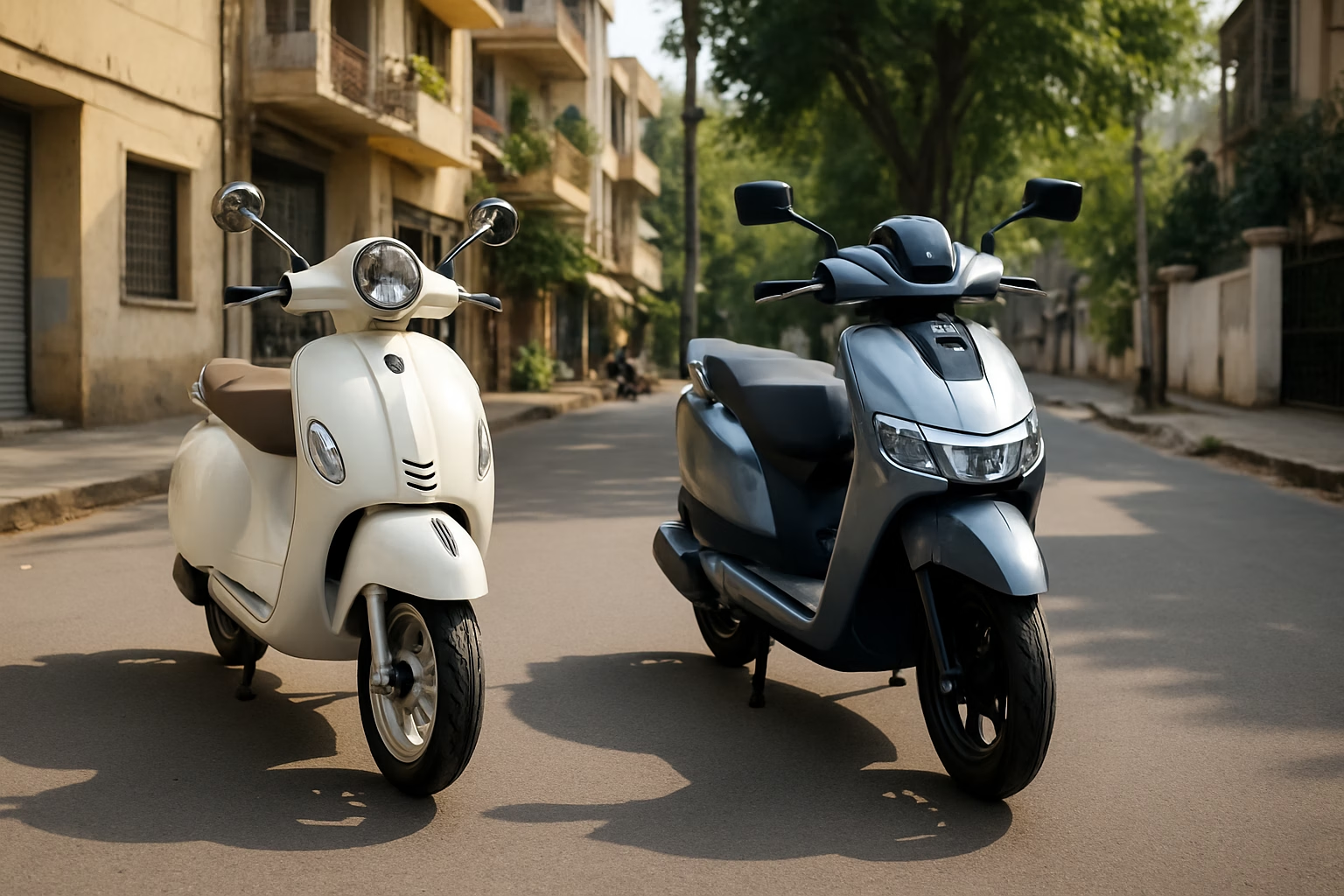
Between the Bajaj Chetak and TVS iQube, you’re choosing between India’s two bestselling electric scooters. They’ve collectively sold over 1.45 million units. They compete head-to-head on price. But they’re genuinely different machines for different buyers.
I’ve gone through every published independent test, long-term review, and owner forum thread I could find for both scooters as of May 2026. This comparison covers real-world range (not just IDC claims), known reliability problems, app quality, and a clear recommendation at each price point.
How I Approached This Comparison
A few ground rules before the specs:
IDC (Indian Driving Cycle) range figures are measured under controlled conditions and always come out higher than what you’ll see in real-world riding. I’ve separated IDC claims from independently tested range throughout. Where no independent test exists, I’ve said so.
Owner reviews on platforms like ZigWheels and BikeDekho often skew positive because happy owners bother to write reviews more than neutral owners. I’ve specifically looked for documented fault patterns, not just star ratings.
The Bajaj Chetak lineup was updated in April 2026 with new names (C2501, C3001, C3501 etc.), higher top speeds, a motor upgrade on the C3501, faster charging on the C3001, and Google Maps integration. I’m using the post-April 2026 specs throughout.
All Variants and Prices (May 2026)
Bajaj Chetak
| Variant | Battery | IDC Range | Top Speed | Ex-showroom (Bengaluru) |
|---|---|---|---|---|
| C2501 | 2.5 kWh | 113 km | 60 km/h | Rs 91,399 |
| C3001 | 3.0 kWh | 127 km | 70 km/h | Rs 1,10,006 |
| C3503 | 3.5 kWh | 151 km | 70 km/h | Rs 1,20,605 |
| C3502 | 3.5 kWh | 153 km | 80 km/h | Rs 1,34,105 |
| C3501 | 3.5 kWh | 153 km | 80 km/h | Rs 1,44,305 |
Source: BikeDekho, May 2026
The C2501 is the entry point — it’s the lightest scooter in the segment at 108 kg and the most affordable at under Rs 92,000. The C3501 at the top sits at Rs 1.44 lakh and gets an onboard charger (950W), 5.5-inch touch TFT display, Google Maps via app, and OTA update capability.
TVS iQube
| Variant | Battery | IDC Range | Top Speed | Ex-showroom (avg) |
|---|---|---|---|---|
| iQube 2.2 kWh | 2.2 kWh | 94 km | 75 km/h | Rs 1,13,244 |
| iQube 3.1 kWh | 3.1 kWh | 123 km | 82 km/h | Rs 1,30,055 |
| iQube 3.5 kWh | 3.5 kWh | 145 km | 78 km/h | Rs 1,36,566 |
| iQube S 3.5 kWh | 3.5 kWh | 145 km | 78 km/h | Rs 1,40,193 |
| iQube ST 3.5 kWh | 3.5 kWh | 145 km | 78 km/h | Rs 1,52,412 |
| iQube S 4.7 kWh | 4.7 kWh | 175 km | 82 km/h | Rs 1,60,475 |
| iQube ST 5.3 kWh | 5.3 kWh | 212 km | 82 km/h | Rs 1,72,307 |
Source: BikeWale , TVS official
Note: TVS official website showed lower prices than BikeWale’s aggregated figures. Verify exact city-specific pricing at your dealership before buying.
The iQube lineup is wider — seven variants spread from Rs 1.13 lakh to Rs 1.72 lakh. The ST variants (3.5 kWh ST and 5.3 kWh ST) are the only ones with fast charging.
Head-to-Head Specs at the Key Price Pairs
There are three natural comparison pairs where both brands compete directly.
Budget pair: C2501 vs iQube 2.2 kWh
| Spec | Bajaj Chetak C2501 | TVS iQube 2.2 kWh |
|---|---|---|
| Ex-showroom | Rs 91,399 | Rs 1,13,244 |
| Battery | 2.5 kWh | 2.2 kWh |
| IDC range | 113 km | 94 km |
| Real-world range | ~90-95 km (ZigWheels first ride estimate) | 76.4 km Eco / 59.1 km Power (Autocar India tested) |
| Motor (peak) | 2.2 kW | 4.4 kW |
| Top speed | 60 km/h | 75 km/h |
| Charging (0-80%) | 2h 25m | 2h 45m |
| Boot space | 25 litres | 32 litres |
| Display | Colour LCD + Bluetooth | 12.7cm TFT |
| Front brake | Disc | Disc |
| Kerb weight | 108 kg | 115 kg |
| Google Maps | No | No |
The C2501 costs Rs 21,845 less, has a larger battery, longer IDC range, and lighter weight. The iQube 2.2 has a bigger boot, a better display, and a faster motor (though capped at 75 km/h). The Chetak C2501 is the better value buy at this tier.
Mid-range pair: C3001 vs iQube 3.5 kWh
| Spec | Bajaj Chetak C3001 | TVS iQube 3.5 kWh |
|---|---|---|
| Ex-showroom | Rs 1,10,006 | Rs 1,36,566 |
| Battery | 3.0 kWh | 3.5 kWh |
| IDC range | 127 km | 145 km |
| Motor (peak) | 4.5 kW | 4.4 kW |
| Top speed | 70 km/h | 78 km/h |
| Charging (0-80%) | 2h 55m (improved in Apr 2026 update) | 4h 30m |
| Boot space | 35 litres | 32 litres |
| Display | Colour LCD + Bluetooth | 12.7cm TFT |
| Hill hold | Yes | No (only on ST) |
At Rs 1.10 lakh, the C3001 gives you 35-litre boot, hill hold, and a 127 km IDC claim for Rs 26,560 less than the iQube 3.5 kWh. The iQube 3.5 has a better display but charges significantly slower (4.5 hours vs 2h 55m to 80%).
Premium mid pair: C3501 vs iQube S 3.5 kWh
| Spec | Bajaj Chetak C3501 | TVS iQube S 3.5 kWh |
|---|---|---|
| Ex-showroom | Rs 1,44,305 | Rs 1,40,193 |
| Battery | 3.5 kWh | 3.5 kWh |
| IDC range | 153 km | 145 km |
| Motor (peak) | 4.8 kW | 4.4 kW |
| Top speed | 80 km/h | 78 km/h |
| Charging (0-80%) | 3h 00m (onboard 950W) | 4h 30m |
| Boot space | 35 L + 5L glove box | 32 litres |
| Display | 5.5" touch TFT | 12.7cm (5") TFT |
| Google Maps | Yes | Yes |
| Navigation | App-based | Yes (SmartXonnect) |
| OTA updates | Yes | Yes |
| Body material | Metal | Plastic |
| Kerb weight | ~125 kg | 118.6 kg |
At this tier the Chetak C3501 costs Rs 4,112 more, but it has faster charging (3h vs 4.5h), a bigger boot, a more powerful motor, and a full metal body. The iQube S 3.5 has slightly better in-built navigation.
Real-World Range: What You Actually Get
The IDC range figures above are lab measurements. Here’s what independent tests show:
TVS iQube 2.2 kWh: Autocar India tested it at 76.4 km in Eco mode and 59.1 km in Power mode — against a 94 km IDC claim. That’s an 18 km shortfall in Eco. In Power mode you’re looking at 37% below the IDC figure.
TVS iQube ST 5.1 kWh: Bike India’s Devashish Puranik tested it at 124 km in Eco mode against TVS’s claimed real-world figure of 150 km. A 26 km gap.
Bajaj Chetak C35 series (153 km IDC): No independent real-world range test has been published for the 2025-2026 C35 variants. A BikeDekho comparison from March 2026 estimates ~120 km for city riding, but that’s editorial, not a formal test. I’ve noted this gap because every other comparison article ignores it. If you’re making a decision partly based on the 153 km claim, that number comes from lab conditions, not Bengaluru traffic.
Owner-reported range: Bajaj Chetak owners on BikeWale report 95-123 km per charge across variants. TVS iQube owners report 85-160 km depending on variant.
The honest summary: both scooters will deliver significantly less range in real city riding than their IDC claims. Plan around 65-75% of the IDC figure as your real-world number, especially in summer heat or at sustained speeds.
Performance
Neither scooter is built for performance, but there are meaningful differences:
The Chetak C2501’s 2.2 kW motor caps you at 60 km/h, which is genuinely limiting on arterial roads and ring roads where traffic flows at 60-70 km/h. The C3001 and above hit 70-80 km/h.
The TVS iQube’s 4.4 kW motor across all variants gives a top speed of 75-82 km/h, which feels adequate in city riding.
In a BikeDekho real-world range test from October 2022, the older Chetak hit 113.89 km vs iQube S at 114.76 km — essentially identical. That test used the previous-generation Chetak (3 kWh variant). The C35 series is meaningfully upgraded but no direct drag race data exists yet for the current lineup.
Braking: the Autocar India long-term reviewer Rishaad Mody flagged iQube’s regenerative braking as too aggressive, noting: “it feels like the iQube is being held back, almost like you are dragging an anchor around.” This is a calibration issue, not a safety fault, but it does take getting used to on the iQube.
Features and Connected Tech
This is where the TVS iQube’s SmartXonnect system vs Bajaj Chetak’s TecPac gets interesting.
Bajaj Chetak connectivity:
- C2501 through C3503: Bluetooth standard, but full app features (turn-by-turn navigation, trip data, Google Maps) require the TecPac add-on at Rs 3,000
- C3502 and C3501: Bluetooth + TecPac standard (no extra cost), Google Maps via app, OTA updates
- The Chetak app has limited public rating data. Available on Android and iOS but has relatively few reviews compared to iQube’s Connect app
TVS iQube SmartXonnect:
- Basic plan: lifetime free on all variants (Bluetooth, basic trip data)
- Advanced plan: first year free on S and ST variants, covers turn-by-turn navigation, Q-Park Assist, ride analytics
- Advanced renewal cost after year 1: not publicly disclosed by TVS. Check with your dealer before buying.
- TVS Connect app on Google Play: 2.7/5 from over 1,10,000 ratings. The most common complaints are Bluetooth disconnection and app crashes. This is a significant red flag that no competitor comparison article mentions. A connected feature is only as good as its app.
If you’re buying the iQube S specifically for SmartXonnect navigation, factor in the TVS Connect app’s poor track record before deciding.
Build Quality and Design
This is a genuine differentiator. The Bajaj Chetak uses a full metal body — the panels, the leg guard, the underbody. The TVS iQube uses plastic panels throughout.
In practical terms:
- Metal body means minor scuffs can be repainted; plastic panels after a fall may need full replacement
- Metal adds weight: Chetak C3502 weighs 134 kg vs iQube S 3.5 kWh at 118.6 kg
- Metal ages better in terms of visible quality. Plastic can develop panel rattle over rough roads, which the Autocar India long-term test noted on the iQube
The Chetak’s retro design is either its biggest strength or irrelevant to you, depending on taste. It looks like a classic Italian scooter. The iQube looks like a modern commuter scooter. Neither is wrong.
Charging
Neither scooter has DC fast charging at the standard variants. Only the TVS iQube ST (3.5 kWh and 5.3 kWh) gets fast charging capability.
Home charging times at each tier:
| Variant | Charging time (0-80%) | Charger type |
|---|---|---|
| Chetak C2501 | 2h 25m | 750W offboard |
| Chetak C3001 | 2h 55m | 750W offboard |
| Chetak C3501 | 3h 00m | 950W onboard |
| iQube 2.2 kWh | 2h 45m | Home charger |
| iQube 3.5 kWh | 4h 30m | Home charger |
| iQube ST 3.5 kWh | 3h 00m | Fast charge capable |
| iQube S 4.7 kWh | 4h 00m | Home charger |
The Chetak C3001 charging faster (2h 55m) than the iQube 3.5 kWh (4h 30m) while costing Rs 26,560 less is a real practical advantage if you’re doing two rides a day or have limited overnight charging time.
For home charging costs: at Rs 7 per kWh (approximate domestic rate in most Indian cities), a full charge on the Chetak C3501 (3.5 kWh) costs roughly Rs 25. The iQube S 4.7 kWh costs around Rs 33 per full charge. Running costs are minimal for both.
Service and Reliability: Known Issues Before You Buy
Both scooters have documented problems. Here they are, without softening.
Bajaj Chetak issues
1. Main battery failure under 500 km (documented pattern) Multiple owners on Team-BHP and BikeDekho have reported the main high-voltage battery failing within 500 km of purchase on C3502 and C3501 variants. One owner documented battery failure at 350 km . Bajaj says the FY23 battery cells were upgraded in Q3 FY24, but the pattern continues to surface in 2025 reviews.
2. Battery swelling in early-production FY23 units (April 2026 scare) Bajaj’s share price dropped 3.6% in April 2026 after reports of battery swelling in older production units. Bajaj confirmed it was limited to early batches and addressed in Q3 FY24 production. No formal recall was announced in India.
3. “D Rated Battery” error causing power derating mid-ride A documented Team-BHP thread with multiple owners reports a “D Rated Battery” error that triggers sudden power derating while riding in traffic. See the thread here.
4. Auxiliary 12V battery discharge making the scooter completely immobile
“The issue is related to Auxiliary battery which becomes fully discharged and the Vehicle becomes immobile, even the unlocking of the handle is impossible.” — Shiba Narayan Nanda, 4.3/5, BikeDekho, May 2025
One owner reported this happening three times within four months on a C3501. The service fix takes about an hour. Bajaj offers 18-month warranty on the auxiliary battery.
5. Service wait times of 15-25 days for battery replacements Multiple owner complaints on consumer forums cite 15-25 day waits for battery-related service. Parts supply has been the primary issue cited.
TVS iQube issues
1. Chassis recall June 2024 (approx. 45,000 units) TVS recalled approximately 45,000 iQube units produced between July and September 2023 for a structural defect in the bridge tube of the chassis. AutoX reported the recall here . TVS contacted affected owners and completed repairs within one business day at no cost. It was a production batch defect, not a design flaw. This is completely absent from every competitor comparison article I found.
2. Battery failure within months of purchase
“In September 2024 scooter totally stops, then I send it to the service centre by towing van, since my scooter is in the service centre, service centre team say there is a battery issue.” — Hiro Kewalramani, 1/5, BikeWale, 9 months / ~8,000 km ownership
TVS honours the warranty, but parts sourced from Chennai mean 20-25 day waits in some cities.
3. Sudden complete power loss while riding (in traffic) Multiple owners report sudden complete power loss mid-ride on the iQube. Service centres diagnose this as a battery fault. The safety implication in dense traffic is serious.
4. Post-warranty battery replacement cost: Rs 56,600-70,700 This is the number TVS doesn’t advertise. After the standard 3-year / 50,000 km warranty expires, an iQube battery replacement costs Rs 56,600-70,700 according to E-vehicleinfo.com . TVS does offer a Lifetime Battery Assurance (LBA) program in select markets — confirm at your dealer before buying.
5. TVS Connect app: 2.7/5 with 1,10,000+ ratings If you’re buying the iQube S or ST partly for SmartXonnect connectivity, this app rating matters. Bluetooth disconnection and app crashes are the most common complaints. Check the Play Store rating yourself.
What Real Owners Say
Bajaj Chetak — positive:
“Chetak has the best comfort and best breaking among all other ev scooters it has a decent range of 105 km” — Rushank, 5/5, ZigWheels, April 2025
“It is the only EV scooter which has direct drive motor, which ensures smooth power delivery” — Ronaldo, 5/5, BikeDekho, March 2026
Bajaj Chetak — negative:
“battery is main area of concern. my chetak (3502) battery got replaced with in 6 month of purchase (after 2400km)” — Farman Jafri (Top ZW Voice), ZigWheels, November 2025
TVS iQube — positive:
“This is the best scooter i have ever purchased i purchased this scooter a year ago and till now it is working properly” — UG, 5/5, ZigWheels, February 2024
TVS iQube — negative:
“Please don’t buy tvs iqube. Their customer service is not good. They don’t care about customer’s emotions and problems.” — Jagruti, 2.6/5, ZigWheels, December 2023
Platform ratings summary:
| Platform | Bajaj Chetak | TVS iQube |
|---|---|---|
| 91Wheels | 4.2/5 (309 reviews) | 4.3/5 (417 reviews) |
| ZigWheels | 4.8/5 (28 reviews) | 4.0/5 (367 reviews) |
| BikeDekho | 4.6/5 (140 reviews) | 4.4/5 (483 reviews) |
| App (Play Store) | Limited data | 2.7/5 (1,10,000+ ratings) |
The iQube has more total reviews — it sells more units — and its rating is marginally higher on 91Wheels. But the ZigWheels and BikeDekho ratings favour the Chetak. Neither scooter has a clearly better satisfaction record.
Sales and Market Position
TVS iQube outsells Bajaj Chetak by about 35% on a monthly basis. In January 2026: iQube sold 34,440 units vs Chetak’s 25,520 units , giving the iQube a 28% market share in the electric two-wheeler segment.
Bajaj Chetak crossed 727,779 cumulative units by May 6, 2026. TVS iQube has crossed 8.5 lakh cumulative units. Both are genuine bestsellers.
Why does this matter beyond bragging rights? Higher sales volumes mean more dealers stocking parts, shorter service wait times, and a larger owner community for troubleshooting. The iQube’s larger base gives it an edge here.
PM e-DRIVE Subsidy
Both scooters are eligible for the PM e-DRIVE subsidy of Rs 2,500 per kWh, capped at Rs 5,000 per vehicle, currently extended until July 31, 2026 (fund-limited, may close earlier).
What this means in practice:
- Chetak C2501 (2.5 kWh): Rs 5,000 subsidy (hits the cap)
- Chetak C3001 and above (3.0-3.5 kWh): Rs 5,000 subsidy (hits the cap)
- iQube 2.2 kWh: Rs 5,000 subsidy (hits the cap at Rs 5,500 theoretical, capped at Rs 5,000)
- All iQube variants: Rs 5,000 subsidy
The subsidy is deducted at the dealership via Aadhaar-linked e-KYC. You don’t need to claim it separately.
Source: PM e-DRIVE portal , Cleartax guide
Which Variant Should You Buy at Each Budget
Under Rs 1 lakh: Bajaj Chetak C2501 is the only option from either brand. Rs 91,399 for a 2.5 kWh, 113 km IDC, 108 kg scooter with a front disc brake and metal body. No iQube exists below Rs 1.13 lakh.
Rs 1 lakh to Rs 1.15 lakh: Bajaj Chetak C3001 (Rs 1,10,006). Get the 3 kWh battery, 35-litre boot, and 127 km IDC range. The only iQube option in this range starts at Rs 1,13,244 with a smaller battery and less range.
Rs 1.15 lakh to Rs 1.40 lakh: Both brands compete directly. Chetak C3503 (Rs 1,20,605) gives you a 3.5 kWh battery and 151 km IDC range. iQube S 3.5 kWh (Rs 1,40,193) gives you full SmartXonnect navigation and in-built connected features. Choose Chetak if you want the metal build and faster charging. Choose iQube S if the navigation and connected tech matter more.
Rs 1.40 lakh to Rs 1.60 lakh: Chetak C3501 (Rs 1,44,305) vs iQube ST 3.5 kWh (Rs 1,52,412). The iQube ST at this tier is the only variant with fast charging from TVS. If you ride long distances occasionally and want faster top-up capability, that matters. If fast charging isn’t a priority, the Chetak C3501 saves you Rs 8,107 with a more powerful motor and faster home charging.
Above Rs 1.60 lakh: Only TVS iQube variants exist here (S 4.7 kWh and ST 5.3 kWh). No Chetak at this price.
My Verdict
Buy the Bajaj Chetak if:
- Your daily commute is 60-80 km and you charge overnight at home
- You prefer a metal body that won’t crack or rattle in Bengaluru or Mumbai potholes
- You want the fastest home charging time for your budget (especially C3001 vs iQube 3.5 kWh — 2h 55m vs 4h 30m is a real difference)
- The retro design genuinely appeals to you and you’ll see it as a reason to love the scooter every morning
- You’re buying under Rs 1.10 lakh and want the best value at that tier
Buy the TVS iQube if:
- You want SmartXonnect navigation as a built-in feature (not app-dependent like the Chetak’s Google Maps)
- Your budget stretches to the ST variants and fast charging is important on long-usage days
- You want the widest variant choice, including the 5.3 kWh range leader
- Service centre proximity to your home or office is more accessible with TVS’s 900+ dealers vs Chetak’s 390 exclusive stores
The one thing I’d flag to both camps: check the TVS Connect app’s 2.7/5 Play Store rating if connectivity is a reason you’re choosing the iQube. And check with your Chetak dealer on parts availability for battery service in your city before buying, given the documented wait times.
Frequently Asked Questions
Which scooter has better real-world range — Bajaj Chetak or TVS iQube?
It depends on the variant. Autocar India tested the iQube 2.2 kWh at 76.4 km in Eco mode (IDC: 94 km). No independent range test exists yet for the Bajaj Chetak C35 series (IDC: 153 km). Owner reports for the C35 range from 95-120 km in mixed riding. The iQube’s larger variants (4.7 kWh, 5.3 kWh) have a meaningful range advantage over the Chetak C3501.
Which is cheaper to maintain?
Both charge about Rs 25-33 per full charge at home. Periodic service costs are similar. The bigger concern is post-warranty battery replacement: TVS iQube battery replacement costs Rs 56,600-70,700 after the standard warranty. Bajaj Chetak motor circuit board replacement is around Rs 18,000 post-warranty. Both brands offer extended warranties.
Does the Bajaj Chetak have fast charging?
No. No Bajaj Chetak variant has DC fast charging as of May 2026. Only the TVS iQube ST variants (3.5 kWh ST and 5.3 kWh ST) have fast charging capability.
What happened to TVS iQube’s recall in 2024?
TVS recalled approximately 45,000 iQube units produced between July and September 2023 for a structural defect in the bridge tube of the chassis. Affected owners were contacted through dealers, and repairs were completed within one business day at no cost to owners. The defect was a production batch issue, not a fundamental design flaw.
Is the PM e-DRIVE subsidy available on both scooters?
Yes. Both are eligible for the Rs 5,000 PM e-DRIVE subsidy (Rs 2,500 per kWh, capped at Rs 5,000), currently extended to July 31, 2026. The subsidy is applied at the dealership at the time of purchase.
Which scooter has better app connectivity?
Neither has a great app, but the TVS iQube’s Connect app is significantly worse. The TVS Connect app sits at 2.7/5 on the Play Store from over 1,10,000 ratings, with widespread complaints about Bluetooth disconnection. The Bajaj Chetak app has far fewer ratings to judge from. If app connectivity is a key buying criterion, both have room for improvement.
What is the waiting period for each scooter?
As of May 2026, both scooters are available with minimal waiting periods at most dealerships — typically 1-2 weeks depending on colour and variant. Confirm with your local dealer for the specific variant you want.
Specs and prices based on manufacturer data, BikeDekho, BikeWale, and Autocar India as of May 2026. Prices are ex-showroom and vary by city and dealer. Always do a test ride before purchasing.