
Researched by Vignesh (EVBlogs.in). Specs verified from ARAI data. Prices are on-road, not ex-showroom. Range figures adjusted for Indian city driving — not ideal test conditions.
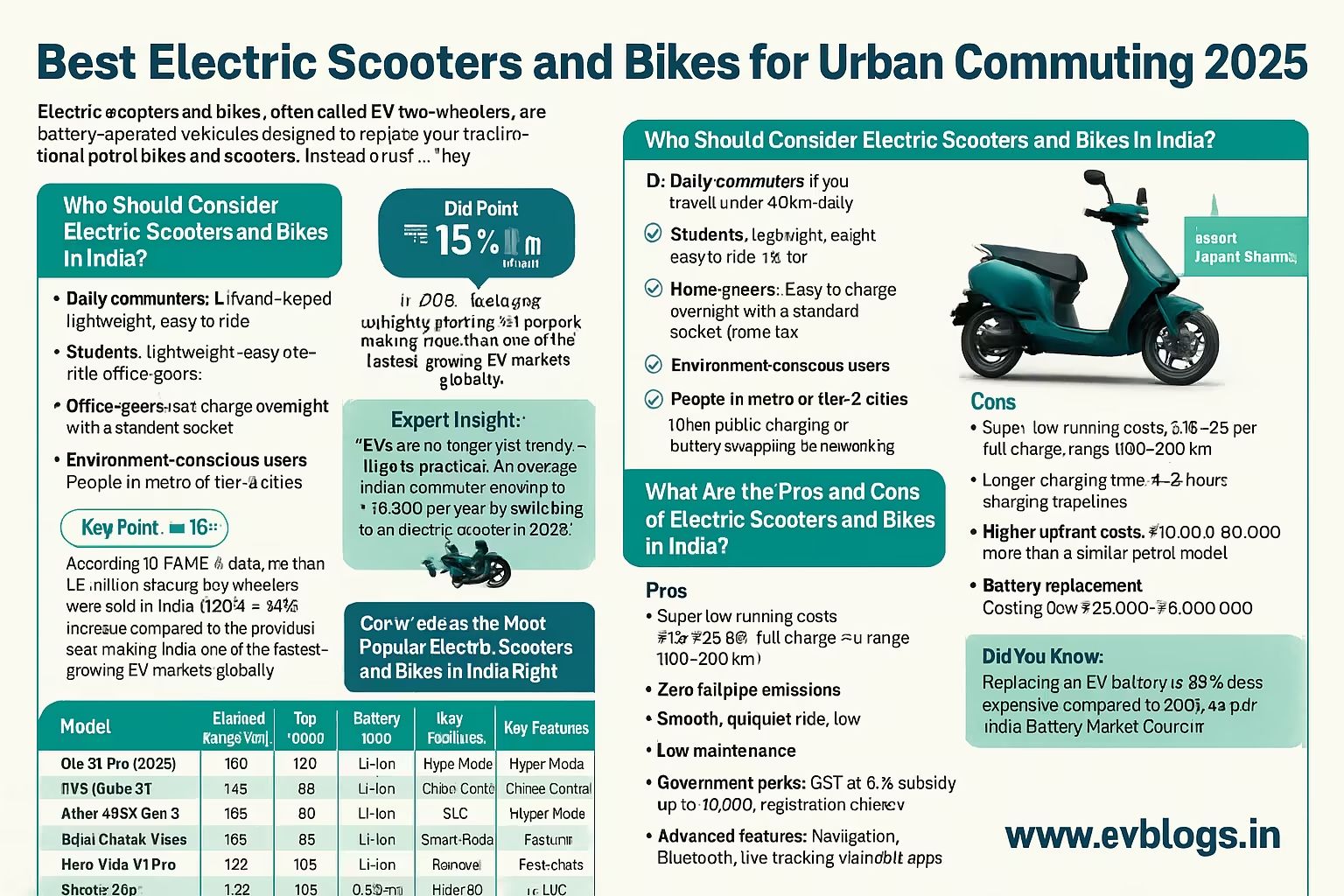
I commute on electric two-wheelers, and the question I get most often is some version of “which one should I actually buy?” The honest answer depends on whether you want a scooter or a motorcycle, how far you ride, and how much you trust the brand’s service network. So instead of giving you a brochure list, I’ve put together eight picks I’d genuinely stand behind for Indian city riding in 2026, split between scooters and bikes, with the real-world range each one delivers and the problems each one has.
One ground rule up front: the IDC range on the spec sheet is a lab number. I’ll always tell you what these actually return on the road, because that gap is usually 20 to 30%.
At a glance
| Model | Price (ex-showroom) | IDC range | Real-world | Kerb weight | Storage |
|---|---|---|---|---|---|
| TVS iQube | Rs 1.14 to 1.73 lakh | 94 to 212 km | ~100 to 120 km | 115 to 130 kg | 32 L |
| Bajaj Chetak | Rs 1.11 to 1.47 lakh | 131 to 153 km | ~100 to 120 km | ~125 kg | 35 L |
| Ather 450X | Rs 1.53 to 1.65 lakh | 126 to 161 km | 115.5 km (Eco) | 108 to 112 kg | 22 L |
| Ather Rizta | Rs 1.20 to 1.58 lakh | 123 to 160 km | 110 to 125 km | 119 to 125 kg | 34 to 56 L |
| Hero Vida VX2 | Rs 99,490 to 1.30 lakh | 92 to 142 km | ~100 km (Plus) | n/a | 33 L |
| Ultraviolette F77 Mach 2 | Rs 3.09 lakh+ | 211 km | 180 to 200 km | 197 kg | minimal |
| Revolt RV400 BRZ | Rs 1.43 lakh | 150 km | ~100 km | 108 kg | minimal |
| Oben Rorr Evo | Rs 99,999 (intro) | 180 km | ~150 km (claimed) | 140 kg | ~10 L |
Before the picks, two things worth knowing: the PM E-DRIVE subsidy gives up to Rs 5,000 off any qualifying electric two-wheeler at the dealer, applied upfront via Aadhaar authentication, but it runs only until July 31, 2026 (Autocar India ). And the market has shifted hard in 2026: TVS now leads with 42,415 units in May, Bajaj is second at 39,142, and Ola has collapsed from over 50% share to just 9% (Autocar India ).
Best electric scooters for urban commuting
TVS iQube - best overall scooter
The iQube is my default recommendation for most city riders, and the sales numbers back it up: TVS is the market leader and crossed one million cumulative electric scooter sales in 2026. The range now spans five batteries, from the Rs 1.14 lakh 2.2 kWh (94 km IDC) up to the Rs 1.73 lakh ST 5.3 kWh (212 km IDC). The mid 3.5 kWh variant returns around 100 to 105 km in real-world city riding, dropping to about 75 km if you ride hard in Power mode (GearChoice ).
What makes it a commuter’s scooter is the 32-litre boot that swallows two half-face helmets, a comfortable upright seat, and a 4.4 kW motor that’s smooth rather than aggressive. Owners rate it 4.3/5 across 3,697 ratings on 91wheels :
“The best electric scooter for everyday use. Easy to ride, easy to handle, and very comfortable for the whole family.” (Gaurav, 5/5, 91wheels, June 2026)
It isn’t flawless. Owners report the battery drains faster than claimed and the rear suspension gets harsh on longer rides (evehiclelab.com ). But for reliable, no-drama daily use, it’s the one I’d point a first-time buyer toward.
Bajaj Chetak - best for premium build
The Chetak is the one that feels most like an object you own rather than an appliance. Its full steel body and Vespa-inspired lines give it a solidity nothing else here matches. The 2026 range runs from the C3001 (131 km IDC, Rs 1.11 lakh) to the C3501 (153 km IDC, Rs 1.47 lakh), with the C35 variants returning around 100 to 120 km in real Eco-mode riding (evadda.online ).
“Single charge par 153 km tak ki range milti hai. Seating bhi kaafi comfortable hai. Paisa vasool electric scooter.” (Neelesh Pratap, 4/5, 91wheels, June 2026)
Two real limitations: the Chetak has no DC fast charging at all, by design, so you’re tied to home AC charging (ev.care ), and Bajaj’s after-sales service draws consistent complaints about delays. Buy it for the build and the brand trust, but check your local service centre first.
Ather 450X - best performance scooter
If you want a scooter that’s actually fun, the 450X is it. A 6.4 kW motor, 90 km/h top speed, and a 0 to 40 time of 3.3 seconds make it the quickest mainstream scooter here. It’s also one of the few with independently tested range: Autocar India measured 115.5 km in Eco mode and 98.2 km in Sport on the 3.7 kWh Gen 3, and noted the range readout “remained extremely accurate throughout the test” (Autocar India ). Ather Grid backs it with 5,000+ fast chargers across 395+ cities, the best charging network of any brand here.
“Best Performance for indian road. Suspension is very good. Service center available.” (Suman Santra, 5/5, 91wheels, May 2026)
The catches: the suspension is firm and gets uncomfortable over potholes, two-up seating is cramped, and the 22-litre boot is the smallest in this group (BikeDekho ). Some of the best features sit behind the paid Ather Pro Pack too. It’s a single rider’s enthusiast scooter, not a family hauler.
Ather Rizta - best family scooter
Ather clearly knows its 450X is niche, because the family-focused Rizta now makes up roughly 76% of the company’s sales (whalesbook.com ). It softens everything the 450X gets wrong: a flatter, wider seat, calmer 80 km/h tune, and up to 56 litres of storage with the optional frunk. The 3.7 kWh version returns about 110 to 125 km in the real world (ecozaar.in ), and you still get Ather Grid access.
“It has very good ride quality and gives very good range. Even 2 people can sit comfortably.” (Amit, 5/5, BikeDekho, June 2026)
It’s not perfect, with owners noting inconsistent Eco-mode behaviour and small passenger footpegs, but if you carry a pillion or a child daily, the Rizta Z 3.7 kWh is the scooter I’d buy.
Hero Vida VX2 - best value under Rs 1 lakh
The Vida VX2 is the value play, starting at Rs 99,490 ex-showroom (or Rs 59,490 on Hero’s battery-as-a-service plan). It’s also the fastest-growing brand here, up 158% year-on-year in May 2026. The removable batteries are the standout feature, letting you carry the pack indoors to charge, and fast charging does 0 to 80% in an hour. The Plus 3.4 kWh (142 km IDC) returns around 100 km in real Eco riding (carblogindia.com ).
“Perfect for daily use, best in budget segment, comfortable seat with good sitting positions, fast charging is also good.” (Krishna, 4.3/5, BikeDekho, June 2026)
Watch for the firm front suspension on broken roads and a display that washes out in direct sunlight (ackodrive.com ). For the money, though, the removable battery and fast charging make it the smartest sub-1-lakh buy.
Best electric motorcycles for urban commuting
Ultraviolette F77 Mach 2 - best premium electric bike
The F77 Mach 2 is the only EV here that’s genuinely thrilling. A 27 kW motor, 90 Nm, a 155 km/h top speed, and a 0 to 40 of 2.9 seconds put it in proper performance-bike territory. The 7.1 kWh battery claims 211 km IDC and Autocar India saw 180 to 200 km in mixed riding, dropping to about 150 km when ridden hard in Ballistic mode (Autocar India ). It’s loaded with dual-channel ABS, traction control, and 9-level regen.
At Rs 3.09 lakh and up it’s expensive, and at 197 kg it’s heavy to wrestle in tight traffic. The service network is also thin outside metros, so you need an early-adopter mindset. But for a single rider who wants a fast, well-equipped electric motorcycle, nothing else here comes close.
Revolt RV400 BRZ - best beginner electric bike
The RV400 BRZ is the affordable way into an electric motorcycle, at Rs 1.43 lakh. It’s a stripped-down version of Revolt’s RV400, dropping the Bluetooth, GPS and keyless ignition to hit the price. The 3.24 kWh battery claims 150 km but realistically gives around 100 km in Normal mode and 85 to 90 km in Sport. At 108 kg it’s light and easy for a new rider to manage.
“It provides decent pick-up for navigating traffic lights and keeping pace with urban riding conditions.” (Anonymous, ZigWheels)
Be honest with yourself about two things: there’s no fast charging on the BRZ, and at least one owner documented an 8-month wait for a battery replacement (teslaclub.in ). The review base is also tiny, just 14 reviews on ZigWheels. It’s a good starter bike if you accept those risks.
Oben Rorr Evo - best affordable electric bike (new)
The Rorr Evo launched in May 2026 at a Rs 99,999 introductory price (Rs 1.25 lakh regular) and pulled 25,000+ bookings in 15 days (EVINDIA ). On paper it’s striking: a 9 kW motor, 110 km/h top speed, 180 km IDC range, and LFP battery chemistry that avoids rare-earth magnets, all at 140 kg with 200 mm of ground clearance (Autocar India ). Oben’s own real-world claim is around 150 km.
I have to be straight with you: it’s too new to trust blind. There are zero published owner reviews on any platform as of June 2026, no independent range test, a warranty figure that conflicts between sources (3 years versus a claimed 8-year battery cover), and Oben is a small brand with limited service reach. If the introductory price and your nearest service centre both work out, it’s a compelling buy, but go in knowing you’re an early tester.
A word on the Ola S1 Pro
The Ola S1 Pro still looks great on a spec sheet, with up to 320 km IDC range and ferocious acceleration. I’m not recommending it in 2026, and I want to be clear about why. An April 2026 investigation documented safety-critical problems including a software glitch causing the scooter to reverse when accelerating, battery overheating and shutdowns, and wheel detachment during braking, alongside an estimated 80,000+ complaints a month, a CCPA investigation, and a consumer-court arrest warrant for the CEO (Free Press Journal ). Owners themselves flag the service collapse:
“The service, maintenance of the vehicle is very bad from the Ola side. There are very few Service centre and they are already full for 2-3 months.” (Rohit Jagtap, ZigWheels, February 2026)
If Ola fixes its service and the safety record stabilises, it could earn a spot back. Right now I’d send my money elsewhere.
Category winners
- Best overall scooter: TVS iQube. Reliable, practical, and backed by the market leader’s growing network.
- Best family scooter: Ather Rizta Z 3.7 kWh. Comfortable two-up, huge storage, accurate range.
- Best performance scooter: Ather 450X 3.7 kWh. Quickest and most fun, for solo riders.
- Best value scooter: Hero Vida VX2 Plus. Removable battery and fast charging under budget.
- Best premium build: Bajaj Chetak. Steel body and brand trust, if your service centre is good.
- Best overall motorcycle: Ultraviolette F77 Mach 2. Genuinely fast and well-equipped.
- Best beginner motorcycle: Revolt RV400 BRZ. Light and affordable, with caveats.
- Best new value bike: Oben Rorr Evo, if the intro price holds and you accept early-adopter risk.
How I picked these
I weighed four things that actually matter for city riding, not just spec-sheet bragging rights. Real-world range came first, using independently tested figures wherever they exist (like Autocar India’s 115.5 km Eco-mode result for the Ather 450X) rather than IDC claims. Traffic ease mattered next, which is why I kept an eye on kerb weight, since anything much over 130 kg is a chore to filter through Indian traffic. Charging convenience weighed heavily, because a brand with its own fast network (Ather) or removable batteries (Hero Vida) is genuinely easier to live with than one tied purely to home AC. And service and reliability was the tiebreaker, drawn from documented owner reports rather than brochures. Two candidates didn’t make it: the Tork Kratos R is discontinued, and the Matter Aera lacks enough verified India sales data to judge fairly.
What to check before you buy
- Plan your charging before the vehicle. If you have home parking, almost anything here works. If you don’t, lean toward Ather (its Grid network) or Hero Vida (removable batteries you can carry indoors).
- Judge range by the tested number, not the IDC figure. Aim for at least double your daily distance in real-world range.
- Match weight to your traffic. Heavier bikes like the Ultraviolette F77 (197 kg) are a handful in dense city traffic, where a sub-115 kg scooter shines.
- Visit the service centre. For newer or smaller brands (Oben, Ultraviolette, Revolt), confirm a service point is within reach before buying.
- Claim the PM E-DRIVE subsidy before July 31, 2026, and check for a state incentive on top.
My final verdict
For the largest number of city commuters, the TVS iQube is the safe, sensible buy. If you carry a pillion, get the Ather Rizta. If you ride solo and want some excitement, the Ather 450X among scooters or the Ultraviolette F77 among bikes. And if budget rules everything, the Hero Vida VX2 is the smartest sub-1-lakh scooter on sale. Whatever you choose, claim the PM E-DRIVE subsidy before July 31, 2026, and judge the brand by its nearest service centre, not its spec sheet.
FAQ
Which electric scooter is best for daily commuting in India in 2026? The TVS iQube is my overall pick for reliability, practicality, and a large dealer network. It returns about 100 to 105 km in real city riding on the 3.5 kWh battery and has a 32-litre boot that fits two half-face helmets.
What is the real-world range of these scooters versus the IDC claim? Expect roughly 20 to 30% less than the IDC figure. The Ather 450X 3.7 kWh, for example, is rated 161 km IDC but Autocar India tested 115.5 km in Eco mode. Always plan around the tested number, not the brochure.
Can I get a subsidy on an electric scooter in India in 2026? Yes. The central PM E-DRIVE scheme gives up to Rs 5,000 off any qualifying electric two-wheeler, applied as an upfront discount at the dealer through Aadhaar authentication. It runs until July 31, 2026 or until the fund is exhausted, and some states add their own incentives on top.
Which electric motorcycle is best for city commuting? The Ultraviolette F77 Mach 2 if you want performance and can afford Rs 3 lakh plus, or the Revolt RV400 BRZ at Rs 1.43 lakh for a lighter, beginner-friendly bike. The new Oben Rorr Evo is the cheapest at Rs 99,999 but has no owner track record yet.
Is the Bajaj Chetak a good buy in 2026? The build quality and brand trust are excellent, and real-world range on the C35 variants is a solid 100 to 120 km. The two drawbacks are no DC fast charging at all and an after-sales service network that draws consistent complaints, so check your local centre before buying.
Is the Ola S1 Pro still worth buying in 2026? I don’t recommend it right now. Despite strong specs, it carries documented safety-critical issues and a service network that owners describe as overwhelmed, alongside active regulatory investigations. There are more dependable options at the same price.