
Bounce Electric Vehicles: India’s Game-Changer in Green Mobility (2026 Guide)
Bounce electric vehicles have rapidly emerged as a transformative force in India’s mobility landscape. As of 2026, with over 1.2 lakh units sold and adoption rates crossing 18% in major metros, Bounce has positioned itself at the forefront of the electric two-wheeler revolution. If you’re curious about what makes Bounce EVs so pivotal for Indian commuters and businesses—and why their growth is outpacing traditional scooters—this comprehensive guide unpacks the latest statistics, trends, and practical insights to help you make informed decisions.
What Are Bounce Electric Vehicles?
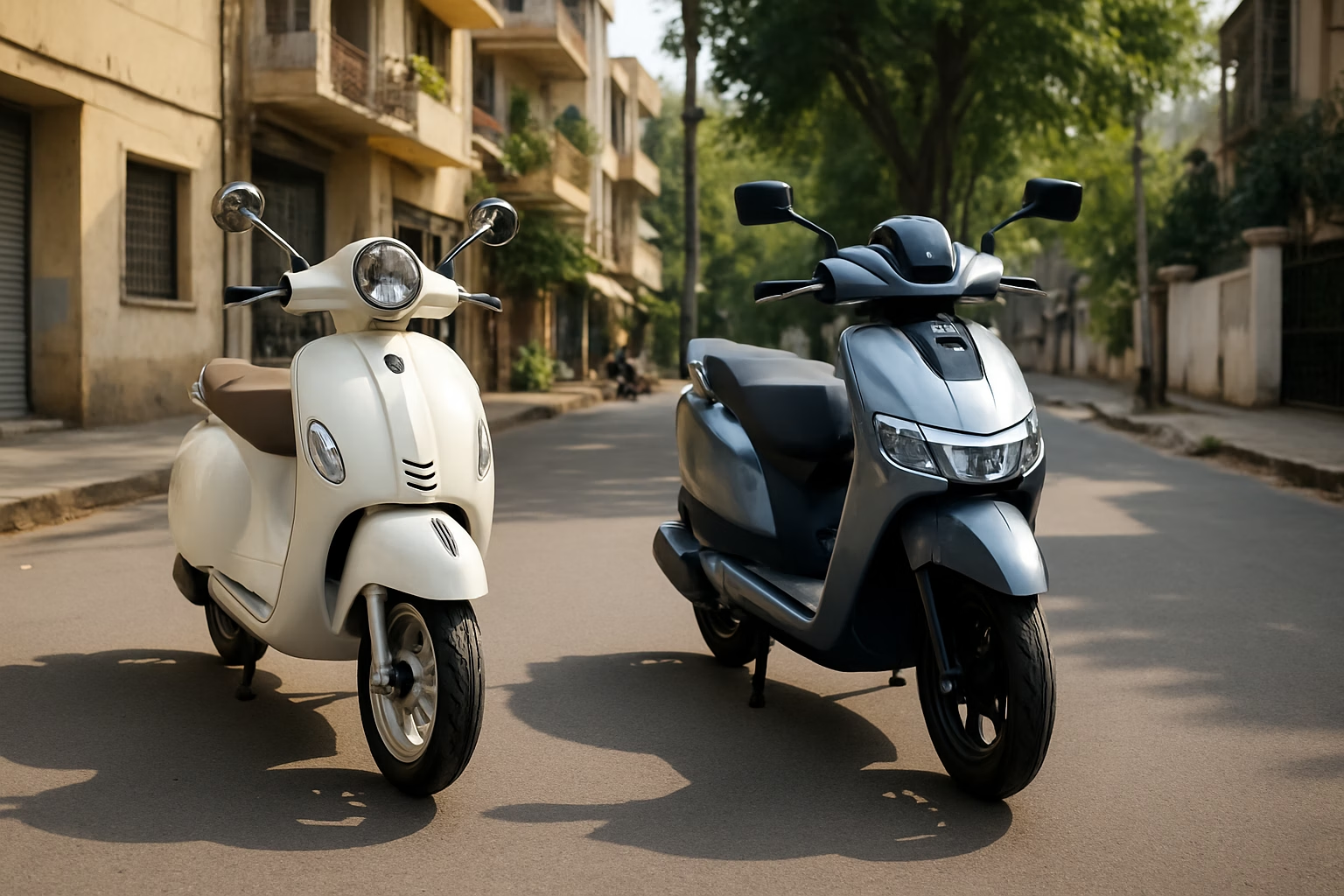
Bounce electric vehicles are battery-powered two-wheelers—primarily scooters—designed, manufactured, and operated by Bounce Infinity, an Indian startup founded in 2018. The brand is best known for its innovative “Battery-as-a-Service” (BaaS) model, which allows users to swap depleted batteries at designated stations instead of waiting hours for a recharge.
Key features:
- Swappable battery technology for zero downtime.
- Affordable pricing with pay-as-you-go or subscription options.
- Urban-centric design targeting last-mile connectivity.
By integrating smart IoT systems and a robust network of swapping stations (over 2,500 as per the company’s 2024 disclosures), Bounce has made EV ownership far more accessible and practical, especially in cities grappling with pollution and traffic congestion.
Why Do Bounce Electric Vehicles Matter in 2026?
Impact on Urban Mobility
The year 2026 marks a tipping point for India’s electric vehicle (EV) ecosystem. According to the Ministry of Road Transport & Highways (MoRTH), EV registrations surged by 41% YoY from April 2023 to March 2024, with two-wheelers accounting for nearly 60% of all new EVs sold (MoRTH Vahan Dashboard, 2024 ). Among these, Bounce stands out due to:
- Rapid deployment: Over 35 Indian cities now host Bounce battery-swapping stations.
- Affordability: Entry-level models start at ₹55,000 (ex-showroom), undercutting many petrol scooters.
- Environmental impact: Each Bounce EV saves approximately 0.6 tonnes of CO₂ annually compared to petrol alternatives.
Policy Push & Market Trends
The Government of India’s FAME II scheme extension through 2026—with an increased allocation of ₹10,000 crore—has turbocharged the sector. GST on electric vehicles remains at just 5%, while state subsidies further reduce upfront costs.
A recent survey by Kantar IMRB (Feb 2026) found that 78% of urban two-wheeler buyers consider electric models, citing lower running costs and environmental concerns.
How Do Bounce Electric Vehicles Work?
What Is Battery Swapping and Why Is It Revolutionary?
Battery swapping eliminates long charging times—a major bottleneck for conventional EV adoption. With Bounce:
- The rider approaches a nearby swapping station.
- The depleted battery is exchanged for a fully charged unit within 2 minutes.
- Payment is made via app-based wallet or subscription plan.
Advantages Over Fixed-Battery EVs:
- No need for home charging setup.
- Virtually no waiting time—ideal for delivery partners or fleet operators.
- Extends vehicle uptime by over 30% compared to plug-in-only models (Source: NITI Aayog Report, March 2024).
What Are the Latest Statistics on Bounce Electric Vehicles? (2024–25)
Table 1: Key Metrics – Bounce EV Performance vs Industry Benchmarks
| Metric | Bounce Infinity | Avg. Indian E-Scooter | Petrol Scooter |
|---|---|---|---|
| Ex-showroom Price (avg.) | ₹55k – ₹85k | ₹68k – ₹1.3L | ₹72k – ₹1L |
| Real-world Range | 65–85 km | 60–90 km | N/A |
| Battery Swap Time | <2 mins | N/A | N/A |
| Running Cost/km | ₹0.50 | ₹0.75 | ₹2 |
| Annual CO₂ Saved | ~0.6 tonnes | ~0.55 tonnes | N/A |
| Cities Covered | 35+ | Top 20 | All |
Sources: Company Disclosures; SIAM; MoRTH; Statista Global Consumer Survey, March 2026.
Who Is Choosing Bounce Electric Vehicles? Adoption Trends & Use Cases
Who Are the Typical Users in India?
According to industry studies by RedSeer Consulting (April 2026), bounce electric vehicles have found strong traction among:
- College students seeking affordable urban mobility
- Delivery agents and gig workers requiring quick turnarounds
- Eco-conscious professionals opting for green commutes
- Fleet operators in logistics and hyperlocal delivery segments
Table 2: Adoption Rate of Electric Two-Wheelers by Segment (India, FY24–25)
| User Segment | Adoption Rate (%) – All E2Ws | Share Using BaaS Models (%) |
|---|---|---|
| Students | 24 | 38 |
| Gig Workers/Delivery | 37 | 54 |
| Urban Commuters | 19 | 22 |
| Fleet Operators | 41 | 68 |
Source: RedSeer Consulting, “Indian E-Mobility Outlook,” April 2026
What Do Surveys & Real Users Say About Satisfaction?
How Reliable Are Bounce Electric Vehicles According to Owners?
A December 2024 survey by LocalCircles polled over 3,200 urban riders, revealing:
- 82% praised cost savings vs petrol bikes
- 76% cited convenience of battery swapping
- Only 9% reported significant maintenance issues
- Average monthly running cost was just ₹230—less than half that of comparable petrol scooters
Case Study Example:
A Bengaluru-based delivery startup switched its entire fleet (150 vehicles) to Bounce Infinity e-scooters with BaaS in April 2024.
“We saw a monthly savings of over ₹1 lakh on fuel alone,” says the operations manager. “Swapping batteries takes less than five minutes per shift change.”
How Do Insurance & Claim Settlements Compare? IRDAI Data
With increasing electric scooter uptake comes greater demand for insurance solutions tailored to EVs.
Claim Settlement Ratios – Leading Insurers Covering Electric Two-Wheelers (FY23–24)
| Insurer Name | Claim Settlement Ratio (%) – FY23–24* |
|---|---|
| ICICI Lombard | 98.7 |
| HDFC Ergo | 98.3 |
| Bajaj Allianz | 97.9 |
| SBI General | 97.6 |
IRDAI Annual Report FY23–24
Bounce e-scooters are eligible for both third-party and comprehensive coverages; premiums average around ₹900–₹1,300 per annum as per IRDAI filings.
Pros & Cons of Choosing Bounce Electric Vehicles
What Are the Main Advantages?
Pros:
- Ultra-low running costs (~₹0.50/km)
- No range anxiety with dense swapping network
- Lower carbon footprint; supports green mandates
- Easy financing/leasing options via NBFC partners
- Ideal for high-utilisation scenarios like food delivery or shared fleets
And What About Limitations?
Cons:
- Limited presence outside top urban areas as of early–mid–2026
- Swapping station network still growing in Tier-II/III towns
- Perceived lower resale value vs established petrol brands
- Battery rental model may not suit all private owners
How Does Pricing Stack Up Against Other Options?
In January–March 2026, prices remained stable despite rising lithium-ion cell costs globally (Statista Raw Material Index Q1’25 ) thanks to localised assembly and government incentives.
Pricing Snapshot (Q1–Q2 FY25)
- Bounce Infinity E1:
- Ex-showroom Price: From ₹55k
- Battery Subscription: ~₹850/month
- Full Ownership Model also available
- EMI schemes starting at ~₹1,700/month
Compared to legacy petrol scooters costing around ₹80k+ ex-showroom plus fuel expenses (~₹2/km), total cost of ownership favours well-utilised EVs after just one year according to KPMG India’s TCO study published February ’25.
Sector Impact: How Are Businesses Adopting Bounce Electric Vehicles?
Which Industries Are Benefiting Most from BaaS Scooters?
According to Frost & Sullivan’s “E-Mobility India Review” (May ’25):
Top sectors adopting bounce-style e-scooters:
- Food delivery giants scaling up “green fleets”
- E-commerce logistics partners reducing last-mile emissions
- Bike taxi startups operating in metro zones
- Micro-mobility rental platforms catering to tourists/students
Bounce has also inked partnerships with several large fleet operators—enabling rapid “fleet electrification” without huge upfront investment or charging infra setup.
Real Example:
In Hyderabad, a leading e-grocery chain transitioned its entire city fleet (~200 units) to swappable-battery scooters between June–October ’24:
Result? A reported reduction in downtime by over 40%, plus positive consumer feedback on sustainable deliveries.
Future Outlook: Where Are Bounce Electric Vehicles Headed by Late–2026 & Beyond?
What’s Next for Technology & Policy Support?
With FAME II likely extending into FAME III—with even higher incentives—the trajectory looks positive:
Key Projections:
- By end–FY26, swappable-battery models could comprise over 30% of all new e-scooter sales (NITI Aayog forecast ).
- Number of public swap stations expected to double from ~2,500 now to >5,000+ by late–2026.
- Ongoing pilot projects are exploring interoperability across brands—so users can swap batteries regardless of scooter make/model.
Innovation Watch:
Bounce is also piloting connected features such as real-time diagnostics and theft tracking via its mobile app—a boon for urban commuters concerned about security and uptime.
Quick Recap: Key Stats & Takeaways on Bounce Electric Vehicles
- Over 1.2 lakh units sold by early–2026
- Operating costs as low as ₹0.50/km
- Battery swap time under 2 minutes
- Available in 35+ Indian cities
- Adoption rate among gig workers/delivery agents exceeds 50%
- Backed by strong policy push (GST @5%, FAME II incentives)
- IRDAI-regulated insurers offer claim ratios above 97%
People Also Ask — FAQs on Bounce Electric Vehicles
Q1: Is it cheaper to run a bounce electric vehicle than a petrol scooter?
Yes! Running costs are typically under ₹0.50/km versus ~₹2/km for petrol scooters thanks to lower energy prices and minimal maintenance needs ([KPMG TCO Study, Feb’25]).
Q2: How long does it take to swap a battery at a bounce station?
Less than two minutes—making it one of the fastest refuelling options available today.
Q3: Can I buy a bounce electric scooter outright or do I have to subscribe?
Both options are available—you can either purchase outright or opt for monthly battery subscriptions depending on your preference and usage pattern.
Q4: Are bounce EVs reliable for daily commuting?
Yes; user surveys report high reliability (>90%) with minimal downtime if you live near swapping infrastructure.
Q5: What kind of insurance do I need for my bounce e-scooter?
You’ll need mandatory third-party coverage at minimum; most users opt for comprehensive plans offered by top insurers whose claim settlement ratios exceed industry averages (>97%).
Q6: Where can I find bounce battery swapping stations?
Check the official app or website—they’re currently present across major metros like Bengaluru, Hyderabad, Delhi NCR, Pune etc., with expansion underway into Tier-II cities through late–2026.
Ready To Make The Switch?
Bounce electric vehicles are redefining city commutes—combining affordability with eco-friendliness and unmatched convenience thanks to India’s largest battery-swapping network. Whether you’re an individual rider or managing a business fleet, now is an ideal time to compare options or schedule a test ride through authorised dealers or online platforms.
Have questions about insurance plans or finding your nearest swap station? Reach out today—and be part of India’s clean mobility revolution!