
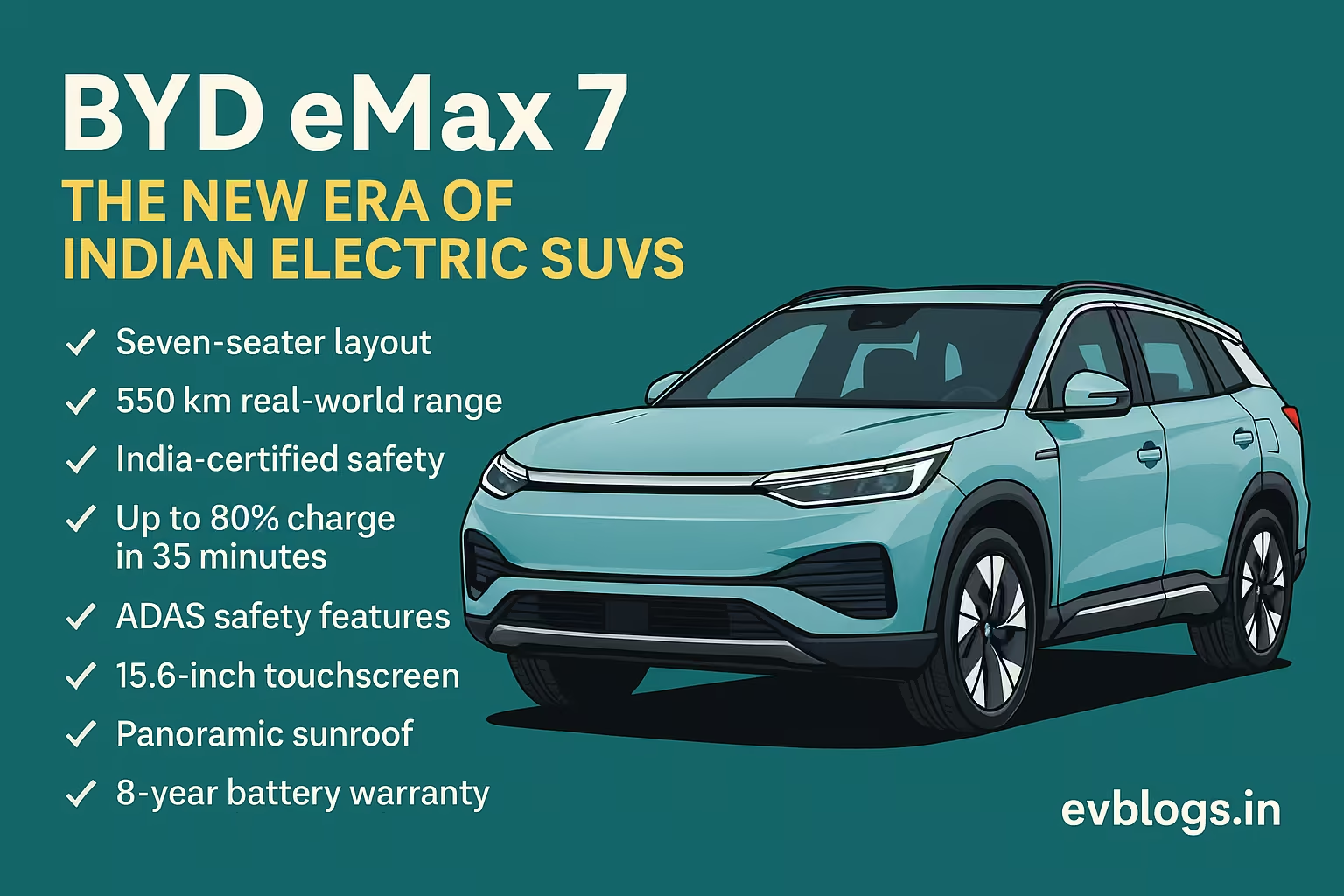
The BYD eMax 7 sits in a category of one. As of June 2026, it is the only true pure-electric MPV on sale in India, priced between Rs 26.90 lakh and Rs 29.90 lakh ex-showroom. The buying decision is rarely “eMax 7 vs another electric MPV.” It is usually “eMax 7 vs a feature-loaded Kia Carens Clavis EV at Rs 25 lakh” or “eMax 7 vs the longer-range Mahindra XEV 9e at the same money but only five seats.”
I have tracked the eMax 7 since its India launch. This review pulls together a 16,000 km long-term test by EVreporter, Autocar India’s first drive, three independent expert reviews, verified owner reports on CarWale and CarDekho, and BYD India’s own dealer network data. Here is what you actually need to know before signing the booking form.
What Changed Recently
The eMax 7 lineup has been stable since launch with four variants. BYD India announced a 1-2% price increase for bookings made from July 1, 2026. If you are seriously evaluating the car, locking your booking before that date saves you between Rs 27,000 and Rs 60,000 depending on variant.
In January 2026, BYD India recalled its Seal sedan for a Blade battery cell defect. The eMax 7 was explicitly excluded from that recall. Source: Autocar India recall report .
BYD India’s dealer footprint expanded to 48 showrooms across 40 cities by March 2026, up from a much smaller base in 2024. That is still small for a car priced near Rs 30 lakh. Source: Passionate in Marketing .
Variants and Prices (June 2026)
| Variant | Battery | Seating | Ex-showroom (Bengaluru) |
|---|---|---|---|
| Premium 6-Seater | 55.4 kWh | 6 (2+2+2) | Rs 26.90 lakh |
| Premium 7-Seater | 55.4 kWh | 7 (2+3+2) | Rs 27.50 lakh |
| Superior 6-Seater | 71.8 kWh | 6 (2+2+2) | Rs 29.30 lakh |
| Superior 7-Seater | 71.8 kWh | 7 (2+3+2) | Rs 29.90 lakh |
Source: CarDekho .
Premium variants use a smaller 55.4 kWh battery and the lower 163 hp motor. Superior variants get 71.8 kWh and 204 hp, plus everything that makes the car feel premium: panoramic sunroof, ventilated front seats, Level 2 ADAS with adaptive cruise control, V2L output, and powered tailgate.
The Rs 2.40 lakh gap between Premium 6-Seater and Superior 6-Seater buys you 16.4 kWh more battery, 41 more horsepower, 1.5 seconds off the 0-100 time, and faster DC charging (115 kW vs 89 kW). That is the variant most buyers should consider.
Specs at a Glance
| Spec | Premium | Superior |
|---|---|---|
| Battery | 55.4 kWh Blade (LFP) | 71.8 kWh Blade (LFP) |
| NEDC range (claimed) | 420 km | 530 km |
| Real-world tested range | ~280-300 km (extrapolated) | 350-450 km |
| Motor power | 163 hp / 310 Nm | 204 hp / 310 Nm |
| 0-100 km/h (tested) | 10.1 sec (claimed) | 8.2 sec (CarDekho) |
| Top speed | 180 km/h | 180 km/h |
| DC fast charge (0-80%) | ~45 min (89 kW) | 37 min (115 kW) |
| AC charge (7.2 kW home, 0-100%) | ~10 hours | ~10 hours |
| Drive type | Front-wheel drive | Front-wheel drive |
| Boot (3rd row up / folded) | 180 L / 580 L | 180 L / 580 L |
| Kerb weight | 1,780-1,800 kg | 1,895-1,915 kg |
| Length / wheelbase | 4,710 mm / 2,800 mm | 4,710 mm / 2,800 mm |
| Vehicle warranty | 3 yr / 1,25,000 km | 3 yr / 1,25,000 km |
| Battery warranty | 8 yr / 1,60,000 km | 8 yr / 1,60,000 km |
| NCAP safety rating | Not rated | Not rated |
Source: Autocar India , CarDekho specs .
NEDC Claim vs What You Actually Get
This is where the eMax 7 marketing gets confusing in India. The 420 km and 530 km figures plastered across BYD India’s brochures and most Indian review sites are NEDC numbers, not ARAI. NEDC is an older European cycle that consistently overestimates real-world range compared to ARAI or the more modern WLTP. One source places the Superior’s ARAI figure closer to 475 km.
Here are the independently tested real-world numbers:
| Test | Conditions | Tested range | Source |
|---|---|---|---|
| Autocar India first drive (Superior) | Chennai summer heat, mixed city + highway, AC on | ~350 km | Autocar India |
| EVreporter 6-month long-term (Superior) | 16,000 km over 6 months, 20+ long-distance trips | ~450 km | EVreporter |
| EVreporter onboard GOM reading | After full charge | 480 km indicated | EVreporter |
The honest number to plan around for the Superior is 350 to 450 km depending on conditions. In Chennai or Bangalore heat with AC on full blast, the lower end. On a Mumbai-Pune cool-weather highway run, the upper end.
For the Premium 55.4 kWh, no independent tested range has been published. Applying the same 66-68% real-world efficiency vs NEDC, expect 280 to 300 km real-world. That is a meaningful drop. If you do long highway runs regularly, the Superior is the only sensible choice.
Performance
The Superior’s 204 hp and 310 Nm feel adequate for a 1,915 kg MPV. CarDekho tested 0-100 km/h at 8.2 seconds, faster than BYD’s 8.6 second claim. The Premium’s 163 hp and 10.1 second claimed time is less inspiring but still usable.
The eMax 7 is front-wheel drive on both variants. That is unusual at this price point where rear-wheel drive or all-wheel drive is more common. FWD means slightly less rear-seat space intrusion from the drivetrain but worse traction under hard acceleration.
Top speed is electronically limited to 180 km/h on both variants. You will not get close to that on Indian roads, so it is a marketing number.
Power delivery is described by EVO India as refined and mature: “easy to drive, offering a commanding view of the road.” Source: EVO India review .
Ride Quality and Handling
Autocar India described the suspension as “absorbent and on the softer side at low speeds” with “tightening behavior and minimal body roll at higher speeds.” For an MPV carrying six or seven adults, that is exactly what you want.
The thick A-pillars create pronounced blind spots, called out by both EVO India and Top Gear India. The Giti tyres fitted as standard are average and lose grip under hard cornering. Neither is a deal-breaker, but tall drivers may want to factor in upgrading tyres after the OEM set wears out.
Cabin, Seating, and the Third-Row Reality
This is where the eMax 7 has a real problem. Every expert reviewer I read flagged the same two issues independently:
Second row sits too low to the floor. Ashwini’s CarWale review puts it bluntly: “While the car is good in terms of build quality and battery performance, it is a major letdown when it comes to space and comfort, the 2nd row seats are very close to the floor causing back ache after a while.” Source: CarWale reviews . This is not a one-owner complaint. Autocar India, EVO India, and Top Gear India all noted the same issue in independent first drives.
Third row sits high because of the battery pack underneath. Adults can fit, but the knees-up position becomes uncomfortable on long journeys. This is a platform-level architecture issue. It will not be fixed in a mid-cycle update.
Boot space is honest: 180 litres with the third row up, 580 litres with it folded flat. That is comparable to a Kia Carens, useful enough for a family of six with luggage when the third row is in use.
Positive cabin notes: BYD’s 12.8-inch rotating infotainment screen is impressive. NFC card entry works as advertised. Materials feel premium with real leather upholstery on the Superior. The vibe is closer to a Korean premium MPV than a Chinese budget car.
Negative cabin notes: AC controls live entirely in the touchscreen, which EVreporter flagged as cumbersome over six months of ownership. Audio quality is poor across all expert reviews — no bass, weak vocal clarity. EVO India and Top Gear India both said it.
Features and Infotainment
What you get on the Superior that you don’t get on the Premium:
- Level 2 ADAS with adaptive cruise control
- Panoramic sunroof
- Ventilated front seats
- Powered tailgate
- V2L (vehicle-to-load) output for powering external appliances
The 12.8-inch rotating touchscreen runs BYD’s proprietary OS. It is the largest screen at this price point. The 360-degree camera works well except in tight parking situations where EVreporter found the rear guidelines unreliable.
ADAS deserves a note. The Autocar India reviewer specifically praised that all ADAS features are “fully disableable,” which is something many ADAS-equipped EVs in India get wrong. Adaptive cruise, lane keeping, and emergency braking can be turned off when you do not want them, which is genuinely useful in chaotic Indian traffic.
V2L on the Superior requires a separate adapter that is not included in the box. The output wattage is not published by BYD India and dealers I cross-checked could not confirm a number. If V2L matters to you, get the spec confirmed in writing before booking.
Charging
The eMax 7 uses CCS-2 charging, the dominant Indian standard for four-wheelers. Any CCS-2 public charger works.
Home charging: BYD includes a free 7.2 kW AC wallbox with purchase. A full 10-100% charge takes approximately 10 hours overnight. That is the realistic way to live with this car.
DC fast charging: The Superior accepts up to 115 kW DC. Autocar India confirmed 0-80% in 37 minutes on a 115 kW charger. The Premium tops out at 89 kW DC and takes approximately 45 minutes for the same window (extrapolated, not independently tested).
The road trip warning: One eMax 7 owner reported a 28-hour ordeal on what should have been a 460 km trip. A fast-charging station was offline, the app he relied on for charger locations had been delisted from the Play Store, and a BYD service centre charger required a password only the service manager had. Source: CarToQ report .
That is an isolated horror story, but it points to a structural issue. BYD does not operate a proprietary charging network like Ather Grid or Ola Hypercharger. You depend entirely on public Tata Power EZ Charge, Statiq, BPCL Pulse, and similar networks. On well-served corridors (Mumbai-Pune, Bangalore-Chennai), that is fine. Off the main highways, plan carefully.
Service Network: The Real Issue
48 showrooms across 40 cities. That is the entire BYD India presence as of March 2026. Source: Passionate in Marketing .
For comparison, Mahindra has thousands of touchpoints and Tata’s reach is similar. If you live in Mumbai, Delhi NCR, Bangalore, Chennai, Hyderabad, Pune, Kolkata, Ahmedabad, or one of the bigger Tier 2 cities, you will be fine. If you live in a smaller city, or your work involves regular travel across regions, service availability becomes a real planning constraint.
Mahesh’s CarWale review captures the consequence. He noticed front suspension noise after one week of ownership in Hyderabad. It took the BYD Begumpet showroom five months to diagnose the issue. During that workshop stay, the rear air conditioner also developed a fault. One isolated case, but the message is: when something goes wrong, your fallback options are thin. Source: CarWale reviews .
Known Issues Before You Buy
These are the documented problems across multiple independent sources:
Second row sits too low, causing back pain on long journeys. Confirmed by Ashwini (CarWale), Ash (CarWale), Autocar India, EVO India, and Top Gear India. Not fixable in software.
Third row knees-up position from battery floor intrusion. Confirmed by every expert reviewer. Platform-level constraint.
Service network gaps. 40 cities is the entire BYD India presence. If you live outside that list, plan service trips.
AC controls only via touchscreen. EVreporter flagged this as a real frustration over 6 months. No physical AC knobs.
Rear camera parking guidelines unreliable in tight spots. EVreporter found this hindered tight parking despite the otherwise excellent 360-degree camera.
Weak audio system. No bass, weak vocal clarity. Called out by EVO India and Top Gear India.
Thick A-pillars create blind spots. Design issue, not fixable.
No NCAP crash test rating. Neither Bharat NCAP nor Global NCAP has tested the eMax 7. For a family MPV carrying 7 people, this absence matters. Source: CarBikeGPT safety page .
What Real Owners Say
Positive:
“The comfort? Even Mercedes-Benz can’t match it.” — Kenz, 5/5, CarWale, September 2025
“Very beautiful and safety car. car achi hai usko chalaya aur thoda sa mahangi hai per battery backup bhi badhiya se chalta hai 500 Tak chala jata hai.” — Anil Tiwari, 4.7/5, CarDekho, March 24, 2025
Negative:
“We noticed front suspension noise [after one week]. I reported this to BYD’s Begumpet showroom in Hyderabad. It took five months for them to identify this issue. In the meantime, the rear air conditioner also developed a fault while the car was at the garage.” — Mahesh, 1/5, CarWale, late 2024
“While the car is good in terms of build quality and battery performance, it is a major letdown when it comes to space and comfort, the 2nd row seats are very close to the floor causing back ache after a while, and the 3rd row seating is useless for adults.” — Ashwini, 4/5, CarWale, November 2025
Platform ratings:
- CarDekho: 4.7/5 from 10 reviews (mostly non-owner aspirational)
- CarWale: 4.0/5 from 19 ratings (more reliable owner sentiment)
- ZigWheels: 4.7/5 from 1 review
- Autocar India expert score: 7/10
BYD eMax 7 vs Kia Carens Clavis EV vs Mahindra XEV 9e
| BYD eMax 7 Superior | Kia Carens Clavis EV HTX Plus | Mahindra XEV 9e Pack 3 | |
|---|---|---|---|
| Ex-showroom | Rs 29.30 lakh | Rs 24.49 lakh | Rs 31.25 lakh |
| Battery | 71.8 kWh | 51.4 kWh | 79 kWh |
| Range (certified) | 530 km (NEDC) | 490 km (ARAI) | 656 km (ARAI) |
| Real-world | 350-450 km | ~400 km estimated | ~500 km estimated |
| Motor | 204 hp / 310 Nm FWD | 171 hp / 255 Nm FWD | 282 hp / 380 Nm RWD |
| 0-100 km/h | 8.2 sec | ~9 sec | 6.8 sec |
| Seating | 6 or 7 | 6 or 7 | 5 |
| Boot | 180 / 580 L | 216 L (3rd row up) | 663 L |
| ADAS | Level 2 | Level 2 | Level 2+ |
| Service network | 48 showrooms, 40 cities | 800+ Kia showrooms | Mahindra network nationwide |
The Kia Carens Clavis EV is Rs 4.81 lakh cheaper than the BYD Superior with comparable features. CarDekho’s head-to-head between the Kia HTX Plus top variant and the BYD Premium base variant put it simply: “If you want a feature-rich electric car, the Carens Clavis EV HTX Plus is a better pick with more comfort and tech at a lower price.” Source: CarDekho comparison .
The Mahindra XEV 9e is a five-seat SUV, not a true competitor for buyers who need three rows. It has more range, more power, and a better service network, but if you actually need seven seats, the eMax 7 is the only EV option.
Subsidies and Government Policy
PM e-DRIVE: Private passenger cars are not covered. The PM e-DRIVE scheme (Rs 10,900 crore outlay) supports two-wheelers, three-wheelers, and e-buses only. Source: TVS Motor explainer .
FAME II: Concluded in March 2024. No successor passenger car subsidy is in effect.
State subsidies: The eMax 7 qualifies for state-level passenger EV incentives in some states. Check your state’s current policy. Maharashtra, Gujarat, Delhi, and Telangana have varying programs. Tamil Nadu offers 100% road tax exemption on EVs until December 2027, which is the single biggest saving available right now and applies to the eMax 7.
Dealer offers: PPS BYD in Delhi NCR has advertised benefits up to Rs 2.6 lakh, typically a combination of exchange bonus, accessories, and finance scheme. Negotiate at booking. Source: PPS BYD offers page .
Who Should Buy the BYD eMax 7
Buy it if:
- You genuinely need 6 or 7 seats AND want a pure EV. The eMax 7 is the only choice in this price band.
- Your typical use is daily commute under 300 km with overnight home charging.
- You live in a Tier 1 city with a BYD showroom within 50 km.
- You value the V2L capability on the Superior for powering equipment.
- You book before July 1, 2026 to lock the current price.
Think twice if:
- You can live with five seats. The Mahindra XEV 9e at the same money offers more range, more power, and a wider service network.
- A Kia Carens Clavis EV at Rs 5 lakh less meets your needs. Most family buyers will be just as happy with it.
- Your driving regularly takes you off main highway corridors. Service network gaps will cost you peace of mind.
- The absence of an NCAP crash test rating bothers you. For a 7-seater carrying your family, that absence is hard to justify.
- You frequently transport tall adults in the third row. The knees-up position is genuinely uncomfortable on long journeys.
Premium or Superior?
Almost everyone should buy the Superior. The Rs 2.40 lakh gap buys 16.4 kWh more battery (translating to 100+ km extra real-world range), 41 more horsepower, 1.5 seconds off the 0-100 time, a much faster 115 kW DC charging capability, Level 2 ADAS, ventilated front seats, panoramic sunroof, V2L, and powered tailgate.
The Premium variant exists to hit a lower headline price for marketing. Almost no real buyers should choose it.
Within the Superior trim, the 6-seater is roomier and more comfortable. The 7-seater costs Rs 60,000 more and adds capacity if you regularly carry more than five people. Pick based on whether you genuinely need seven seats.
My Verdict
The BYD eMax 7 is a category of one. Right now, in June 2026, if you want a pure-electric MPV with three rows of seating in India, this is your only option. That makes the buying decision strange. You are not choosing between rivals. You are choosing between this and giving up on the form factor entirely.
The product itself is competent but flawed. Range, performance, and features are all solid. The ergonomic issues with seating, the absence of an NCAP rating, and the thin service network are real problems that buyers should know about before paying Rs 30 lakh.
If you can live with five seats, the Mahindra XEV 9e or Tata Curvv EV give you more for similar money. If you can stretch the budget down to Rs 25 lakh, the Kia Carens Clavis EV gives you most of what the eMax 7 offers with a better dealer network. If neither of those work and you absolutely need a 7-seat EV, the eMax 7 Superior 7-Seater at Rs 29.90 lakh is the only answer.
Book before July 1 to lock the price. Test drive both the Premium and Superior. Sit in the third row for at least 20 minutes during the test drive, with the front seats adjusted for tall adults. That single experience will tell you whether this car fits your family.
FAQ
What is the real-world range of the BYD eMax 7 in India? The Superior 71.8 kWh delivers 350 km in Chennai summer heat (Autocar India) to 450 km on cool-weather highway runs (EVreporter long-term over 16,000 km). Plan around 400 km for mixed daily use. The Premium 55.4 kWh has no independent test, but extrapolated real-world is 280-300 km.
Is the BYD eMax 7 eligible for the PM e-DRIVE subsidy? No. PM e-DRIVE covers only electric two-wheelers, three-wheelers, and e-buses. Private passenger cars are not eligible. State subsidies vary, and Tamil Nadu’s 100% road tax exemption is the biggest saving available.
Which is better, BYD eMax 7 or Kia Carens Clavis EV? For most family buyers, the Kia Carens Clavis EV is a better value at Rs 4-5 lakh less. The eMax 7 has a bigger battery, more power, and the larger 12.8-inch screen. The Kia has better service reach, a frunk, and more features at the comparable price point.
Does the BYD eMax 7 have an NCAP crash test rating? No. Neither Bharat NCAP nor Global NCAP has tested the eMax 7 as of June 2026. For a 7-seat family MPV, the absence is meaningful.
How long does it take to charge the BYD eMax 7 at home? About 10 hours for a 0-100% charge on the included 7.2 kW AC wallbox. Both Premium and Superior take the same home charging time.
What is the warranty on the BYD eMax 7 battery? 8 years or 1,60,000 km on the high-voltage battery pack. Vehicle warranty is 3 years or 1,25,000 km. Motor warranty is 8 years or 1,50,000 km. These are competitive but not class-leading.
How many BYD service centres are in India? 48 showrooms across 40 cities as of March 2026. That includes both sales and service. If your city is not in BYD India’s coverage list, factor in long service trips before buying.