
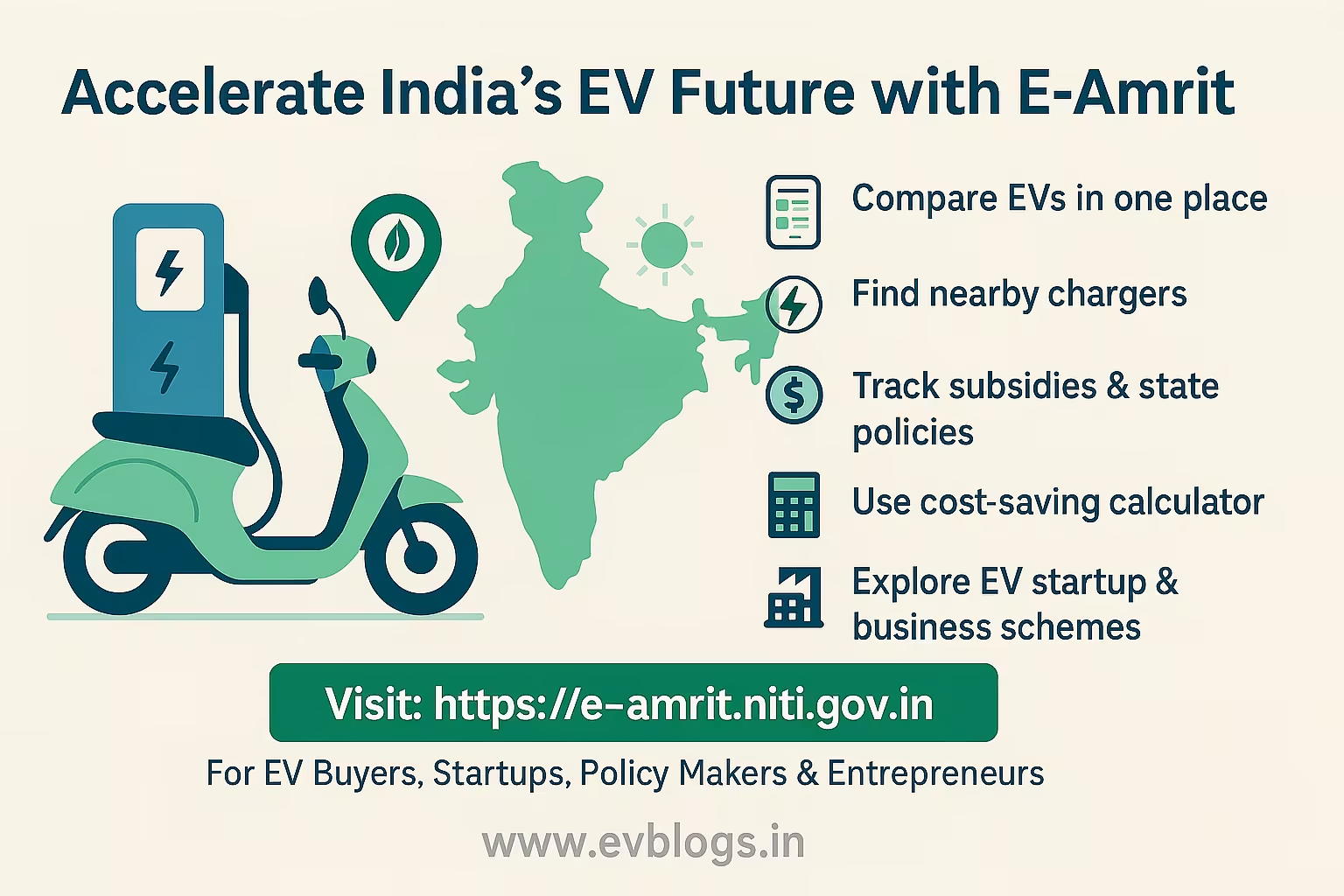
I’m going to give you a straight answer about E-Amrit before you spend an hour browsing it. The portal exists. The government built it with the UK’s help in 2021. It has a useful set of cost calculators, an FAQ section, and policy aggregator pages. But most of its data is from 2021. The charger locator shows 934 stations against India’s actual 12,000+. The policy page still highlights FAME II, which ended in March 2024. The mobile app sits at 2.4 stars on Google Play.
For an actual EV buyer in 2026, E-Amrit is a starting point, not a destination. This guide explains exactly what the portal does, where it’s outdated, and which government and commercial sources you should pair with it.
What E-Amrit Actually Is
E-Amrit stands for Accelerated e-Mobility Revolution for India’s Transportation. It’s hosted at e-amrit.niti.gov.in and run by NITI Aayog, the Government of India’s top policy think tank.
Key verified facts:
| Detail | Value |
|---|---|
| Launch date | November 10, 2021 |
| Launch venue | COP26 Summit, Glasgow |
| Primary host | NITI Aayog |
| Collaboration partner | UK Government (under the UK-India Joint Roadmap 2030) |
| Technical developers | TERI and CENEX UK |
| Additional support | PricewaterhouseCoopers India |
| Contact email | mobility-niti[at]nic[dot]in |
| Mobile app | Yes, developer: National Informatics Centre |
| App rating | 2.4/5 from 25 reviews on Google Play |
Source: NITI Aayog E-Amrit page , E-Amrit About the Portal .
One quick correction. You may have seen articles claiming E-Amrit was built in collaboration with the International Transport Forum. That’s wrong. The collaboration is with the UK Government, with TERI and CENEX UK as the actual technical developers. If you’re citing the portal in research or reports, get the partner right.
The Six Sections of E-Amrit
The portal is organised into six main sections. Here’s what each does and how much of it is genuinely useful in 2026.
Section 1: Going Electric
Aimed at first-time EV buyers. Covers benefits of going electric, types of EVs (BEV, PHEV, HEV), financing options, insurance considerations, and government incentives. The content is accurate at a foundational level but doesn’t address current-cycle questions like which states still offer purchase subsidies as of 2026 or whether PM e-DRIVE applies to passenger cars.
Useful for: Absolute beginners trying to understand the EV category for the first time. Limited for: Buyers who’ve already researched basics and want current pricing or subsidy information.
Section 2: E-Mobility Businesses
A directory of EV manufacturers, charging infrastructure providers, service businesses, and investment opportunities. The directory was current at launch in 2021 and has aged. New entrants like Hero Vida, Vinfast India, and the post-2022 wave of charging operators (Statiq, Bolt Earth, ChargeZone) are missing or under-represented.
Useful for: A historical snapshot of the Indian EV business ecosystem. Limited for: Anyone looking for current vendor or partnership information.
Section 3: Tools (the genuinely useful part)
This is the strongest section of E-Amrit. Five calculators:
- Vehicle selector — helps match buyers to suitable EV models
- Home charging cost calculator — estimates monthly electricity cost based on usage
- Public charging cost calculator — applies to commercial charging tariffs
- Journey cost calculator — compares EV vs petrol/diesel running cost
- Emissions calculator — quantifies CO2 saved by switching to EV
The journey cost calculator is the most practical for someone weighing the petrol-to-EV switch. Source: E-Amrit homepage .
Useful for: Buyers doing the financial maths on EV vs petrol ownership. Limited by: Default electricity rates may not match your actual tariff. Cross-check with your local DISCOM tariff before relying on the output.
Section 4: Charging Station Locator (the problem area)
This is where E-Amrit’s age becomes a hard problem. The locator page at e-amrit.niti.gov.in/charging-map asks for a pincode and a radius (2 km, 5 km, or 10 km), then displays charging stations in three categories: “Out of Service,” “Available to Use,” “No Issues Reported.”
The portal’s own FAQ states there are 934 active public charging stations listed. That figure is from 2021.
Independently verified current figures:
| Source | Public charging stations | Date |
|---|---|---|
| E-Amrit portal | 934 | 2021 (stated) |
| GreenTax.in | 12,000+ | April 2026 |
| Anariev industry analysis | 29,000+ | May 2025 |
In other words, E-Amrit’s charger locator shows you roughly 3% of the actual public charging infrastructure in India. If you rely on the portal alone to plan an inter-city EV trip, you will miss most of the chargers actually available on your route.
What to use instead: Commercial apps like Tata Power EZ Charge, Statiq, Bolt Earth, Plugshare India, and the network apps from BPCL Pulse and HPCL Eway. These maintain live, current charger status.
Section 5: Resources
Hosts national and state EV policies, electricity cost data tables, standards documents, and reports including GIZ/IITB grid integration studies. The reports section is genuinely useful for researchers and policy professionals. For consumers, most of this is too technical.
Section 6: FAQs
Six categories of FAQs: portal-specific (4 questions), Electric Vehicles (7), EV Charging (6), Business (4), Savings and Incentives (2), Safety (11). Some content is useful as a primer. Some is outdated.
Sample data points from the FAQ as it currently reads:
- 2-wheeler average range: “around 84 km per charge”
- Cars average range: “between 150-200 km per charge”
- EV manufacturers in India: 380 (figure as of July 31, 2021)
- EV startups in India: 399 (figure as of July 31, 2021)
- Public charging stations: 934
Source: E-Amrit FAQ page .
Indian EV ownership in 2026 looks very different. The TVS iQube ST 5.3 kWh delivers 212 km IDC. The Mahindra XEV 9e Pack 3 delivers 656 km ARAI. The 2-wheeler “84 km” and car “150-200 km” averages are not what current buyers experience.
The Outdated Homepage Stats
The E-Amrit homepage shows what look like live counters at the top of the page. Here’s what they show and how they compare to actual current figures.
| Stat shown on portal | Value | Actual current figure (2026) |
|---|---|---|
| Registered electric vehicles | 7,59,182 | India sold 27,03,780 EVs in just Jun 2025-May 2026 alone (EVReporter ) |
| EV manufacturers | 380 | Active EV manufacturer count has grown; precise current figure not centrally published |
| Charging stations | 1,800+ | 12,000+ to 29,000+ depending on source |
| States with EV policies | 25+ | All 28 states + 8 Union Territories now have EV policies (EVTech News ) |
For context, India’s full-year FY2026 EV sales hit 24.5 lakh units with 25% YoY growth per Autocar Professional . The single month of May 2026 alone saw 2,71,019 EV registrations.
The numbers on E-Amrit are not just slightly stale. They’re off by orders of magnitude.
The Policy Page Problem
The national policy aggregator at e-amrit.niti.gov.in/national-level-policy still lists FAME II as a current incentive. FAME II ended on March 31, 2024.
| Policy on portal | E-Amrit status | Actual status |
|---|---|---|
| FAME II | Listed as current with full subsidy details | Concluded March 31, 2024 |
| Phased Manufacturing Programme | Listed as current | Active but dates need verification |
| National Mission on Transformative Mobility | Listed | Active |
What’s missing entirely from the portal’s national policy page: PM e-DRIVE. This is the current Rs 10,900 crore flagship scheme that replaced FAME II. It launched on October 1, 2024 and was extended to March 31, 2028 in August 2025 . Any buyer trying to use E-Amrit to research current subsidies will get the wrong answer.
The PM e-DRIVE scheme covers:
- Electric two-wheelers and three-wheelers (subsidy ended March 31, 2026 for 2W, extended to 2028 for 3W)
- Electric buses
- Electric trucks (up to Rs 9.6 lakh per N2/N3 vehicle)
- Charging infrastructure (Rs 2,000 crore allocated)
- E-ambulances (Rs 500 crore)
Source: Angel One PM e-DRIVE explainer .
The right portal to research current subsidies is the official PM e-DRIVE portal at pmedrive.heavyindustries.gov.in , not E-Amrit.
E-Amrit vs PM e-DRIVE Portal — Use the Right Tool
A lot of buyers conflate these two portals. They’re different things.
| Aspect | E-Amrit | PM e-DRIVE Portal |
|---|---|---|
| Purpose | Information and awareness | Subsidy claim and disbursement |
| Operated by | NITI Aayog | Ministry of Heavy Industries |
| For buyers | Understanding EVs, cost calculators, policy info | Verifying eligibility and getting Aadhaar-based e-Voucher |
| Transactional | No | Yes |
| Subsidies displayed | Shows FAME II rates (outdated) | Shows current PM e-DRIVE rates |
| Last meaningful update | Circa 2021-2022 | Active, last update March 27, 2026 |
Source: The Current India PM e-DRIVE guide .
When to use each:
- E-Amrit: Browse the journey cost calculator. Read the basic EV explainer pages if you’re new to the category.
- PM e-DRIVE portal: Check whether your specific vehicle qualifies for subsidy, see the current rate per kWh, and trigger the e-voucher at the dealership.
- Commercial portals (CarDekho, BikeWale, 91Wheels): Get current ex-showroom prices, variant comparisons, and owner reviews.
- EVBlogs.in state subsidy pages: Get state-specific subsidy and road-tax exemption details. State EV policies in 2026 vary widely. Tamil Nadu offers 100% road tax exemption until December 2027. Karnataka removed its exemption in April 2026. Maharashtra and Delhi run separate two-wheeler and four-wheeler schemes.
What NITI Aayog Has Done on EVs Since the Portal Launched
NITI Aayog hasn’t stopped working on EV policy since E-Amrit launched. The work just hasn’t flowed back into the portal.
PM e-DRIVE shaping (2024-2026): NITI Aayog provides policy input but the scheme is operated by the Ministry of Heavy Industries. Total outlay Rs 10,900 crore. Extended to March 31, 2028 in August 2025.
Battery Swapping Policy (2022 draft, expired 2025): NITI Aayog released a draft Battery Swapping Policy in April 2022. The policy expired in March 2025 and the Centre is planning fresh consultations for interoperable standards . Private swap networks crossed 4,000 stations nationally by mid-2025 across Delhi-NCR, Bengaluru, Hyderabad, Chennai, and Mumbai.
The $200 Billion EV Report (August 2025): NITI Aayog released a flagship report titled “Unlocking a $200 Billion Opportunity: Electric Vehicles in India” in August 2025. Released by Rajiv Gauba (NITI Aayog Member) alongside Kamran Rizvi (Secretary, Ministry of Heavy Industries).
Key findings from the report:
- India’s EV sales grew from 50,000 in 2016 to 2.08 million in 2024 — a 41-fold increase
- Current penetration: 7.6% of new vehicle sales against the 30% by 2030 target
- EVs cost 2-3x more than ICE vehicles
- Public charging costs roughly 4x home charging
- Key recommendation: shift from incentives to mandates, including ZEV production requirements and phased ICE disincentives
- Focus areas: e-buses, urban freight, e-paratransit
The recommendation to move from incentives to mandates is significant. It signals that the era of direct purchase subsidies is winding down, and future EV adoption will be driven by manufacturing mandates and ICE disincentives rather than buyer subsidies.
Full report PDF: niti.gov.in EV report PDF . Source: DD News August 4, 2025 , Clean Mobility Shift analysis .
A quote from the launch event from Rajiv Gauba: “India stands at the cusp of a transformative shift in clean mobility.”
None of this NITI Aayog work has been integrated into the E-Amrit portal. The portal sits where it was in 2021 while NITI Aayog’s actual EV policy work has continued elsewhere.
The Mobile App
E-Amrit has a mobile app on Google Play, developer National Informatics Centre. Source: Google Play listing .
The app rating tells you everything: 2.4/5 from 25 reviews. Twenty-five reviews after nearly five years live. For comparison, the TVS Connect app has over 1,10,000 reviews (rated 2.7/5). The Ola Move app has hundreds of thousands of reviews.
The low review count suggests the app has near-zero actual user adoption. The 2.4 rating from those few who did use it suggests the app has the same data freshness problem as the web portal.
When You Should Actually Use E-Amrit
After all the criticism, here’s what E-Amrit is still genuinely good for:
Use E-Amrit if you:
- Are completely new to EVs and want a government-validated primer
- Want to use the journey cost calculator to do a quick petrol vs EV running cost comparison
- Are a student, researcher, or policy professional looking for the official information about FAME II framework, EV taxonomy, or government EV reports
Don’t use E-Amrit if you:
- Need current subsidy information (use PM e-DRIVE portal)
- Need a working public charger locator (use Tata Power EZ Charge, Statiq, or Plugshare India)
- Want to compare current vehicle specs (use CarDekho, BikeWale, 91Wheels)
- Want state-specific incentive details for 2026 (use EVBlogs.in state subsidy pages or your state’s transport department portal)
My Verdict on E-Amrit in 2026
E-Amrit was a good idea executed at the right time. The COP26 launch positioned India as a serious EV adopter on the global stage in 2021. The portal had real ambition to be a one-stop public resource.
What it became is a snapshot of where India was at the end of 2021. The charger count is off by 13,000. The policy page misses the country’s flagship current scheme. The homepage stats reflect a sub-million EV market when current monthly volume is over 2.7 lakh.
That’s not necessarily NITI Aayog’s failure. Government portals notoriously struggle with maintenance budgets. But for the EV buyer reading this in 2026, the practical takeaway is simple. Use the calculators. Read the FAQ for a primer. Then move to current sources for any decision that actually involves money.
NITI Aayog’s real EV work, including PM e-DRIVE policy shaping, the Battery Swapping framework, and the August 2025 $200 Billion report, is happening. It’s just not happening on this portal.
FAQ
What is the E-Amrit portal by NITI Aayog? E-Amrit (Accelerated e-Mobility Revolution for India’s Transportation) is an information portal at e-amrit.niti.gov.in launched by NITI Aayog at COP26 Glasgow in November 2021, in collaboration with the UK Government. It provides EV awareness content, cost calculators, an FAQ section, and policy reference material.
Is E-Amrit the same as the PM e-DRIVE portal? No. E-Amrit is an information portal run by NITI Aayog. The PM e-DRIVE portal at pmedrive.heavyindustries.gov.in is operated by the Ministry of Heavy Industries and handles actual subsidy disbursement through Aadhaar-based e-vouchers.
How accurate is E-Amrit’s charging station locator? Not accurate. The portal lists 934 active charging stations, while India’s actual public charging infrastructure stands at 12,000+ as of April 2026 (GreenTax) to 29,000+ as of May 2025 (Anariev industry analysis). Use commercial charging apps like Tata Power EZ Charge or Plugshare India for current data.
Can I claim my EV subsidy through E-Amrit? No. E-Amrit does not handle subsidy disbursement. Use the PM e-DRIVE portal for vehicle eligibility verification and the Aadhaar-based e-voucher system. The actual subsidy is applied at the dealership at the time of purchase.
Why is E-Amrit’s data outdated? The portal hasn’t received meaningful content updates since 2021-2022, based on the homepage stats, charger counts, and the absence of PM e-DRIVE from the national policy page. NITI Aayog continues to publish EV policy work, but the portal itself has not been refreshed.
Is the E-Amrit mobile app worth downloading? The app rates 2.4/5 from 25 reviews on Google Play. The low review count after nearly five years live suggests minimal user adoption. The data is the same as the web portal, so unless you specifically need offline reference, the website provides a similar experience.
What did NITI Aayog publish about EVs in 2025? NITI Aayog released the report “Unlocking a $200 Billion Opportunity: Electric Vehicles in India” in August 2025. Key findings: India’s EV sales grew 41-fold from 50,000 in 2016 to 2.08 million in 2024. Current penetration is 7.6% against a 30% by 2030 target. The report recommends shifting from incentives to mandates, including ZEV production requirements and phased ICE disincentives.