
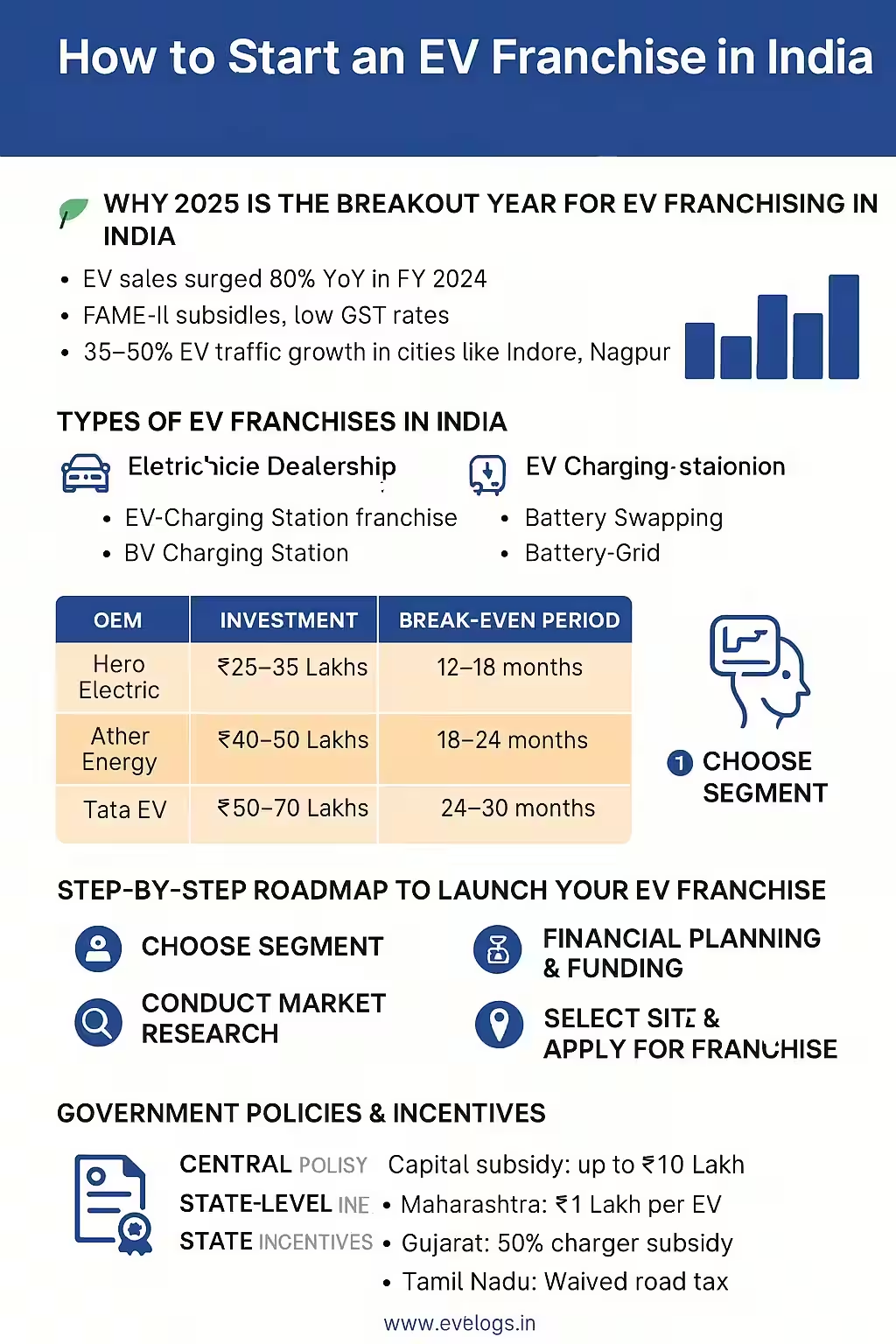
India’s EV market has crossed a real inflection point. FY2026 saw 24.5 lakh EV registrations, up 25% year-on-year. EV penetration hit 8.27% of new vehicle sales. The government is pushing PM e-DRIVE with Rs 10,900 crore in scheme funding. State policies in Maharashtra, Tamil Nadu, Karnataka, and Delhi offer real incentives.
But “EV business” isn’t one thing. A dealership franchise, a charging station network, a battery swapping partnership, an EV-specific service centre, and a battery recycling facility are completely different businesses with different investment requirements, regulatory burdens, and revenue models.
This guide breaks down what’s actually involved in each of the seven main EV business models available to Indian entrepreneurs in 2026. Numbers are verified from official brand franchise pages, government scheme documents, and reported deal data.
Why Now (And the Hard Numbers)
Market size: India sold 24.5 lakh EVs in FY2026 with 25% YoY growth across all segments. EV penetration hit 8.27% of new vehicle sales. Source: Autocar Pro FY2026 EV sales .
Charging gap: India has 27,737 public charging stations against a 2030 need of 1.32 million. The charger-to-EV ratio is 1:235 vs the global 1:6 to 1:20 benchmark. Source: Business Standard charging gap analysis .
That gap is the core business opportunity. Every EV sold needs charging access. The country is wildly under-provisioned. The brands and government are deploying capital — Rs 2,000 crore allocated under PM e-DRIVE specifically for charging infrastructure.
Business Model 1: EV Dealership / Franchise
A dealership is the most familiar EV business model — you become an authorized seller and service centre for a specific brand. Investment ranges widely based on brand tier.
Verified Investment Requirements (June 2026)
| Brand | Investment range | Vehicle type | Tier | Source |
|---|---|---|---|---|
| Tata Motors (EV-specific Support Centre) | Rs 1.5 to 3 crore | 4-wheeler EVs | Premium | Franchise India Tata |
| Ather Energy | Rs 50 lakh to 1 crore | 2-wheeler EV | Mid | FranchiseBazar Ather 2026 |
| Bajaj Chetak | Rs 40 lakh to 1.4 crore | 2-wheeler EV | Mid | Multiple franchise broker sources |
| TVS Motor (EV) | Rs 1 crore to 5 crore | 2-wheeler + 3-wheeler EV | Mid-Premium | TVS dealer brochures |
| BYD India | Rs 4 to 7 crore | 4-wheeler EV | Premium | Dealer onboarding documents |
| Hyundai (EV models) | Rs 5 to 8 crore | 4-wheeler EV | Premium | Dealer franchise data |
| Hero Vida | Rs 1 to 1.5 crore | 2-wheeler EV | Mid | Hero MotoCorp dealer kits |
| Ola Electric | NOT franchising | — | — | Ola dealership page |
Critical Warnings
Ola Electric is not franchising. The official Ola dealership page explicitly states there are no authorized franchise opportunities. Multiple fraud cases involve people paying Rs 30-50 lakh to fake “Ola franchise” agents. Source: Ola Electric Dealership Confirmation .
Mahindra EV-specific dealer fees: Mahindra operates a multi-format dealer model but has not published a transparent EV-specific franchise fee structure. Speak directly to your Mahindra regional office. [UNVERIFIED] published numbers in this space.
Kia and MG EV franchise costs: Not publicly disclosed in transparent form. Most EV brands use existing ICE dealer networks rather than separate EV franchises.
What the Investment Actually Buys
A typical Rs 2 crore EV dealership franchise covers:
- Showroom buildout (Rs 50-80 lakh)
- Service centre with EV-specific equipment (Rs 40-60 lakh)
- Initial inventory deposit (varies, often refundable)
- Brand franchise fee (Rs 20-50 lakh, often non-refundable)
- Working capital for 6-12 months (Rs 30-50 lakh)
- Staff training and brand-mandated systems
Revenue and ROI
- Margins: 3-7% on vehicle sales (lower than ICE because brand margins are tight)
- Service revenue: 60-65% of total dealer profitability
- ROI timeline: 3-5 years for mid-tier brands; 5-7 years for premium
The honest reality: Dealer margins on EVs are squeezed. Most successful EV dealerships profit from service and accessories rather than vehicle sales themselves.
Business Model 2: EV Charging Station
The most genuine growth opportunity in EV business right now. India needs to scale from 27,737 stations today to over 1 million by 2030 — a 35x expansion.
Independent Setup (Single Site)
Investment range: Rs 1.5 lakh to Rs 25 lakh+ per site depending on charger type:
- AC slow charger (3.3 kW): Rs 1.5-3 lakh per unit
- AC fast charger (7.4 kW): Rs 4-7 lakh per unit
- DC fast charger (30-60 kW): Rs 12-18 lakh per unit
- DC ultra-fast (100-180 kW): Rs 25-40 lakh per unit (often franchise-only)
Plus site setup costs (electricity meter, transformer upgrade, civil work, signage): Rs 3-8 lakh.
Franchise Options (Verified)
Tata Power EZ Charge — India’s largest charging network with 29,277+ public stations. Franchise opportunities exist for site partners providing land. Tata Power installs and operates; partner provides location and shares revenue. Source: Tata Power EZ Charge Franchise .
Statiq — Rs 30 lakh to Rs 3 crore investment depending on location and charger count. Statiq claims 14% to 98% ROI based on traffic patterns. Source: Statiq Franchise .
ChargeZone — Rs 20 lakh to Rs 10 crore investment for franchise super-charging stations. Targeting 1,000 highway franchise stations by FY2027. SBI offers backing loans at 6.7% interest. Source: ChargeZone Franchise , Autocar Pro ChargeZone expansion .
Revenue Model
- Gross margin per kWh: Rs 6-12 depending on tariff structure and location
- Monthly earnings at average urban site: Rs 40,000-70,000
- Highway and metro stations significantly higher
- GST: 18% applies to EV charging services. Source: ITR n GST EV charging
Practical reality: A single charging station at a low-traffic site (under 10 sessions per day) struggles to pay back invested capital. Site selection is the most important variable.
Regulatory Requirements
- CEA (Central Electricity Authority) compliance for charger hardware. Source: CEA EV Charging Standards .
- Local DISCOM coordination for high-amperage connections
- GST registration
- Fire NOC for charging sites
- AIS-138 standards adherence
- CPO (Charge Point Operator) licensing where required
- Source: Bolt.Earth compliance guide
Business Model 3: Battery Swapping Station
The least capital-intensive EV business model for entrepreneurs. The franchise companies own and supply the batteries; you provide the swap location.
Verified Franchise Options
Battery Smart — India’s largest battery swapping network. Rs 8 lakh franchise fee only. All capex (batteries, swap hardware) by company. Partners earn Rs 50,000-80,000/month at average sites. 87% partner retention rate. Battery Smart had 1,600+ stations as of 2025 across 50+ cities.
Source: Inc42 Battery Smart playbook , The Better India Battery Smart story .
Indofast Energy (SUN Mobility + IndianOil JV) — Rs 10-40 lakh investment for franchise stations. Projected 1.7x to 2.7x returns. Targeting nationwide expansion through IndianOil’s fuel station network. Source: EVReporter Indofast Energy .
Revenue Model
- Per-swap fee (typically Rs 30-60 per swap)
- Monthly earnings: Rs 50,000-80,000 at average urban sites
- High traffic locations significantly higher
- Battery Smart franchise typically retains 60-70% of per-swap fee
Best for
Entrepreneurs wanting EV exposure with low upfront capital and minimal technical complexity. Battery Smart’s Rs 8 lakh model is the most accessible EV business in India today.
Business Model 4: EV Service Centre
Independent EV service centres are an emerging segment. Brand-authorized service requires dealership status. Independent service shops serve out-of-warranty vehicles and fleet operations.
Investment
- Workshop setup: Rs 8-15 lakh
- EV-specific diagnostic equipment: Rs 4-8 lakh
- Initial parts inventory: Rs 3-6 lakh
- Total typical entry: Rs 15-30 lakh
Certification Requirements
- ASDC (Automotive Skills Development Council) certification under NSDC/Skill India
- AIS-156 compliance training for battery handling
- Training providers: DIYguru, VisionAstraa
Revenue Model
- Service margins: 25-40% on labour
- Parts: 15-25% on consumables
- Monthly revenue at established centre: Rs 2-5 lakh per technician
The challenge: Manufacturers typically don’t supply original parts to independent shops. Most EV-specific repairs route through brand dealer networks. The independent service centre model works mainly for general maintenance, battery diagnostics, accessory installation, and out-of-warranty repairs.
Business Model 5: Battery Recycling
The newest and highest-margin EV business. India’s first significant battery wave is reaching end-of-life in 2027-2030, creating recycling demand.
Investment and Returns
- Total setup investment: Rs 3-4 crore
- Gross margins: 35-50% (vs 5-15% for most automotive businesses)
- ROI timeline: 3-4 years
- Government incentive scheme: Rs 1,500 crore
Source: Green Permits Lithium Battery Recycling India , India-EU Battery Recycling Initiative .
Regulatory Requirements
- CPCB (Central Pollution Control Board) EPR registration mandatory
- Hazardous waste handling licenses
- Site planning and emissions clearance
- Battery procurement contracts with manufacturers
Best for
Existing chemical, metallurgy, or recycling businesses adding EV battery recycling. Not for first-time entrepreneurs.
Business Model 6: Vehicle Scrapping (RVSF)
Registered Vehicle Scrapping Facility licenses cover EVs alongside ICE vehicles.
- Investment: Rs 10 lakh bank guarantee minimum, total setup Rs 50 lakh-2 crore
- Single-window state government registration
- 60-day deemed approval if no objection raised
- Source: Whizseed RVSF License Guide
Revenue from scrap metal, battery recovery, parts resale.
Business Model 7: EV Driver Training School
Smaller-scale opportunity for entrepreneurs in metro areas with growing EV adoption.
- Investment: Rs 5-15 lakh
- EV fleet (3-5 vehicles): Rs 30-50 lakh (often lease/financed)
- Required: RTO-approved training school license, ASDC instructor certification
Revenue: Course fees Rs 8,000-15,000 per student.
Government Schemes That Actually Apply
PM e-DRIVE (Active Through March 2028)
- Total outlay: Rs 10,900 crore
- Charging infrastructure allocation: Rs 2,000 crore
- Operator note: Private charging operators cannot claim PM e-DRIVE subsidy directly. The Rs 2,000 crore is disbursed via designated implementing agencies and state nodal agencies.
- Two-wheeler subsidies ended: July 31, 2026
- Three-wheeler subsidies continue: Until March 31, 2028
Source: PIB PM e-DRIVE charging infrastructure .
SBI EV Mitra Loan
- Interest rate: 6.7%
- Maximum loan: Rs 10 crore
- Tenor: Up to 7 years
- For: EV dealerships, charging stations, fleet operations
- Source: SBI EV Mitra
SIDBI EV4ECO
- Interest rate: 7-8%
- For: EV ecosystem businesses including charging, swapping, recycling
- MSME-focused
Other Schemes Worth Knowing
- MUDRA loans for sub-Rs 10 lakh investments
- CGTMSE for unsecured collateral-free loans
- State EV mission-specific subsidies in Tamil Nadu, Karnataka, Maharashtra, Delhi
State Government Incentives for EV Businesses
Maharashtra: Capital subsidy up to 25% for EV charging stations, max Rs 10 lakh per site. EV manufacturing units get land subsidy and SGST refund for 7 years.
Tamil Nadu: 100% road tax exemption on EVs until December 31, 2027. SGST refund for new EV manufacturing units. Capital subsidy for charging infrastructure.
Karnataka: State EV policy provides infrastructure status to charging stations. 25% capital subsidy on first 100 stations per operator.
Delhi: No road tax on EVs up to Rs 30 lakh. Direct subsidy on first 30,000 vehicles per category. EV charging station subsidy up to Rs 6,000 per slow charger.
Reference: BankBazaar state EV incentives 2026 , The Current India EV subsidy schemes .
State subsidies change frequently. Verify current rates with your state’s transport department before investing.
Which Business Should You Start?
Under Rs 10 lakh capital available: Battery Smart franchise (Rs 8 lakh) — only EV business at this entry point with proven franchise model.
Rs 10-30 lakh: Statiq or Bolt Earth charging station franchise for 1-2 DC fast charger sites. Or independent service centre setup.
Rs 30 lakh-1 crore: Ather, Bajaj Chetak, or Hero Vida 2-wheeler EV dealership. Or 5-10 site charging station franchise expansion.
Rs 1-3 crore: TVS Motor EV franchise, ChargeZone supercharging franchise, or battery recycling facility.
Rs 3-8 crore: Tata Motors EV Support Centre, BYD or Hyundai 4-wheeler dealership.
Above Rs 8 crore: Premium brand dealership (Hyundai, Mercedes EQ), multi-site charging network, or integrated EV ecosystem play.
Verifying Before Investing — Practical Checklist
Verify brand authorization in writing. Ola Electric does not franchise. Multiple brands have fake “franchise agent” frauds. Always communicate directly with brand HQ contacts.
Visit existing franchise sites in your region. Talk to current franchisees about real revenue and operational challenges.
Get RTO and local DISCOM commitments in writing before signing any charging station franchise.
Confirm state subsidy eligibility at the time of decision. State policies change monthly.
Check loan terms. SBI EV Mitra at 6.7% is the cheapest formal EV business loan available. NBFC loans charge 11-14%.
Budget for 9-12 months of working capital. Most EV dealerships and charging stations take 6-9 months to reach break-even traffic.
Understand parts and inventory supply. EV brands often have 30-60 day stock cycles. Initial parts and vehicle inventory tie up significant working capital.
My Verdict
The EV business opportunity in India is genuine but very different across segments. The charging station story is the biggest scale opportunity — the gap from 27,737 to 1.32 million stations is real. Battery swapping (especially Battery Smart’s Rs 8 lakh model) is the most capital-efficient way for first-time entrepreneurs to participate. Dealership franchises are the highest revenue but the highest capital risk.
The brands that are not franchising (Ola Electric specifically) are the biggest source of fraud. Verify everything directly with HQ-listed contacts before signing any agreement.
State incentives change monthly. The Tamil Nadu road tax exemption alone justifies starting an EV business in Chennai vs Bangalore for the next 18 months. Watch state-level announcements as carefully as central PM e-DRIVE updates.
If you want my honest first recommendation: a Battery Smart franchise at Rs 8 lakh is the lowest-risk way to test the EV business model with skin in the game. If it works for you over 12-18 months, scale up to a charging station franchise or a dealership.
FAQ
What is the cheapest way to start an EV business in India? Battery Smart franchise at Rs 8 lakh franchise fee with all capex covered by the company. Partners earn Rs 50,000-80,000 per month at average sites with 87% partner retention.
How much does an EV dealership franchise cost in India? Investment ranges from Rs 40 lakh (Bajaj Chetak 2-wheeler) to Rs 8 crore (Hyundai 4-wheeler premium). Tata EV-specific Support Centre costs Rs 1.5-3 crore. Ather Energy 2-wheeler dealership costs Rs 50 lakh to 1 crore.
Is Ola Electric franchising in India? No. Ola Electric’s official dealership page explicitly states the company does not offer franchise opportunities. Multiple fraud cases involve fake “Ola franchise” agents collecting Rs 30-50 lakh from prospective buyers. Verify any opportunity directly with Ola HQ.
What is the revenue from an EV charging station in India? Gross margin per kWh is Rs 6-12 depending on tariff and location. Monthly earnings at average urban sites: Rs 40,000-70,000. Highway and metro stations earn significantly more. Site selection is the critical variable.
Does PM e-DRIVE subsidise private charging stations? Indirectly. The Rs 2,000 crore charging infrastructure allocation under PM e-DRIVE is disbursed via designated implementing agencies and state nodal agencies, not directly to private charging operators. Private operators benefit from infrastructure subsidies through state EV policies and SBI EV Mitra loans at 6.7%.
What is the SBI EV Mitra loan? A dedicated EV ecosystem loan from State Bank of India at 6.7% interest, up to Rs 10 crore loan amount, tenor up to 7 years. Covers EV dealerships, charging stations, swapping infrastructure, and fleet operations.
Which Indian state has the best EV business incentives? Tamil Nadu (100% road tax exemption until December 2027), Maharashtra (25% capital subsidy on charging stations), and Delhi (no road tax on EVs up to Rs 30 lakh) currently offer the strongest combinations. Karnataka removed its road tax exemption in April 2026.