
Hedhvick Hirav
Hedhvick Hirav is a dedicated EV researcher and editor with over 4 years of experience in India’s growing electric vehicle ecosystem. Their contributions have been recognized in leading sustainability publications and automotive journals.
Summarize & analyze this article with
Choose an AI assistant and open this article directly:
Tip: if the AI doesn’t fetch the page automatically, paste the article URL manually.
Kerala State Electricity Board Seeks EoI to Set Up Public EV Charging Stations Under PM E-DRIVE Scheme
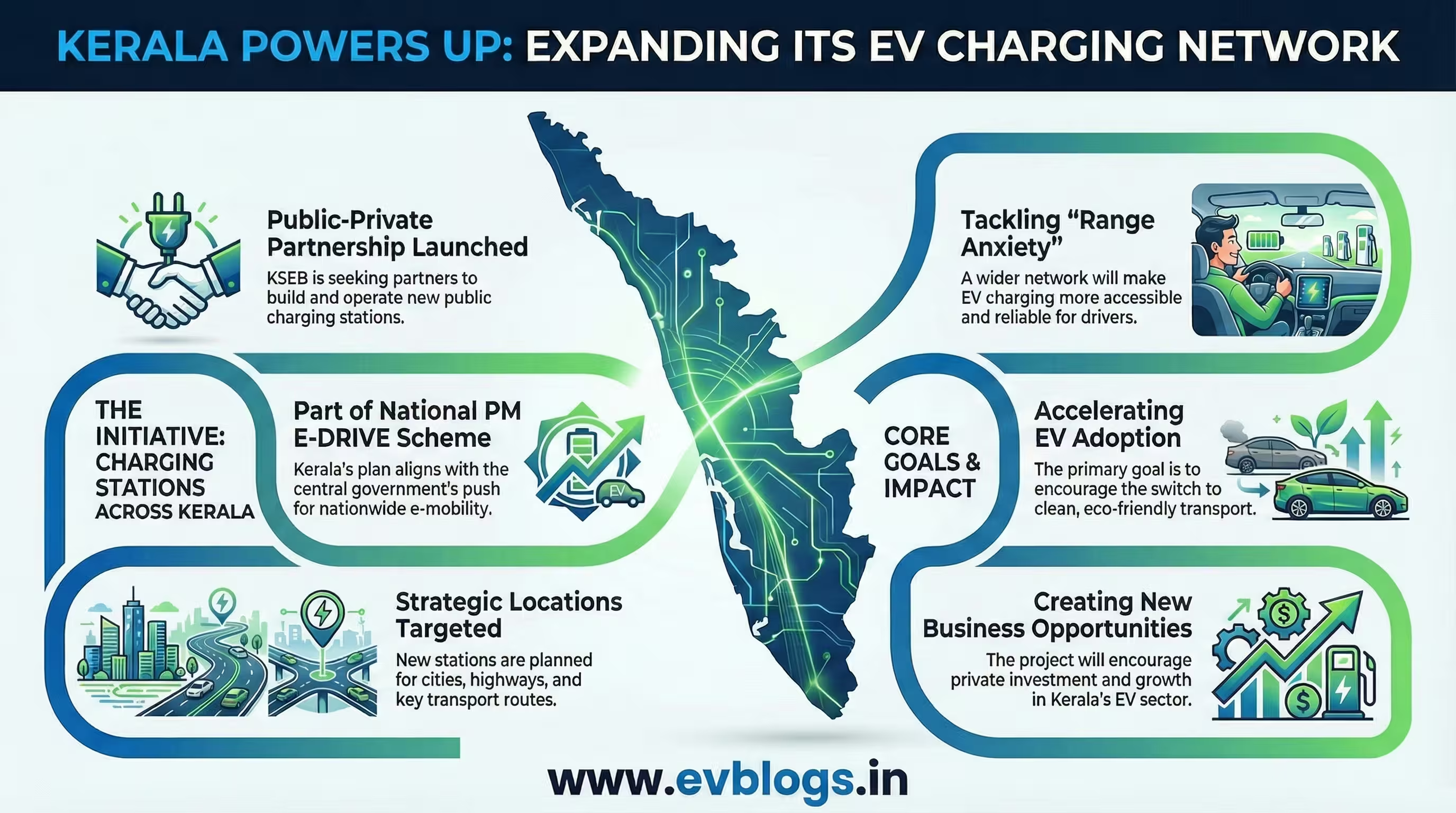
In a significant move to accelerate India’s electric mobility revolution, the Kerala State Electricity Board (KSEB) has issued an Expression of Interest (EoI) inviting partners to set up public EV charging stations across the state under the PM E-DRIVE scheme. This initiative, rolled out in early 2024, aims to bridge critical infrastructure gaps for electric vehicles and aligns with India’s ambitious target of 30% EV penetration by 2030. Backed by robust government support and rising consumer demand, this effort marks a pivotal step towards sustainable transportation in Kerala.
Understanding the PM E-DRIVE Scheme
What is the PM E-DRIVE scheme and its objectives?
The PM E-DRIVE (Electric Vehicle Development and Rapid Infrastructure for Vehicles & Environment) scheme, launched by the Government of India in late 2023, is a flagship programme aimed at catalysing nationwide EV adoption. Its key goals include:
- Establishing 10,000+ public charging stations by 2025
- Providing incentives for both infrastructure providers and end-users
- Integrating renewable energy sources into the charging grid
- Ensuring interoperability standards for chargers
According to the Ministry of Power’s 2024 report, only about 4,800 public charging stations were operational across India as of March 2024. The government aims to more than double this figure within a year through schemes like PM E-DRIVE.
Why is Kerala focusing on public EV charging stations now?
Kerala has witnessed a rapid surge in electric vehicle registrations, with over 63,000 EVs registered as of May 2024 (Transport Department, Govt. of Kerala). Despite this growth, there are less than 350 public charging points statewide — far below the estimated requirement of one charging station every 3 sq km in urban clusters.
By seeking Expressions of Interest under the PM E-DRIVE scheme, KSEB intends to:
- Attract private investment and expertise
- Expand reliable charging access beyond major cities
- Support commercial fleets and daily commuters alike
The Current State of EV Infrastructure in Kerala
How many public EV chargers does Kerala currently have?
As per data from Statista and NITI Aayog (May 2024):
| Parameter | Value |
|---|---|
| Total Registered EVs (all types) | 63,000+ |
| Existing Public Charging Stations | ~340 |
| Public Chargers Needed by 2025 | >1,200 |
| Average Distance Between Chargers | ~18 km |
Kerala lags behind states like Maharashtra and Karnataka, which have over 750 and 600 public chargers respectively.
What are the main challenges faced?
Key pain points identified in the “Kerala e-Mobility Survey 2024” include:
- Limited charger availability outside Tier-I cities
- Long wait times during peak hours
- Lack of fast-charging options on highways
- Uncertainty around pricing models
- Need for improved app-based location/discovery tools
KSEB’s Expression of Interest: Key Details
What is KSEB’s EoI seeking from partners?
KSEB’s Expression of Interest (EoI), released in June 2024, outlines opportunities for private players, startups, fleet operators, and technology providers to participate in setting up and operating public charging stations. The EoI specifies:
- Target Locations: Urban centres, national/state highways, residential clusters, transport hubs.
- Charging Types: AC slow chargers (Type2), DC fast chargers (CCS2), battery swapping units.
- Minimum Technical Standards: Adherence to Bharat/DC001/AC001 protocols; OCPP compliance; real-time monitoring.
- Business Models: Revenue sharing or fixed-fee arrangements with land/utility support from KSEB.
- Renewable Energy Integration: Preference for solar-hybrid solutions.
How will selection work?
Interested parties must submit detailed project proposals including:
- Experience & credentials
- Planned locations & capacity
- Technology stack & payment integration
- Timelines for rollout
A technical committee will evaluate submissions based on feasibility, scalability, investment commitment, and alignment with state policy goals.
Data Table: Projected Charging Station Growth in Kerala (2024–2027)
| Year | Existing Public Chargers | New Chargers Planned* | Total Projected Chargers |
|---|---|---|---|
| 2024 | 340 | +400 | 740 |
| 2025 | 740 | +600 | 1,340 |
| 2026 | 1,340 | +700 | 2,040 |
| 2027 | 2,040 | +800 | 2,840 |
*Planned figures based on government targets under PM E-DRIVE scheme
Market Trends: EV Adoption & Charging Demand in Kerala
How fast is Kerala’s EV market growing?
According to the “EV Market Outlook India – Q2 FY25” by CRISIL Research:
- Kerala’s annual EV registration growth rate stands at 34% CAGR (FY21–FY24)
- Two-wheelers account for nearly 72% of new EV sales; e-autos make up another significant segment
- By end-FY25, projected cumulative EV sales could surpass 95,000 units
This rapid adoption is driving commensurate demand for reliable charging infrastructure.
Table: Segment-Wise Adoption Trends in Kerala (as of May 2024)
| Vehicle Type | Share (%) | Key Insights |
|---|---|---|
| Two-wheelers | 72 | Driven by delivery apps & affordable e-scooters |
| Three-wheelers | 15 | Fast replacement of diesel autos |
| Cars/LCVs | 10 | Taxi fleets adopting aggressively |
| Buses | 3 | KSRTC pilot projects underway |
What do consumer surveys reveal about charger usage?
A CII-KPMG survey (“EV User Experience Index – South India”, Feb 2024):
- 81% cited “lack of convenient public chargers” as top concern
- Over half preferred fast-charging points at malls or near office parks
- Price sensitivity remains high; users favour dynamic pricing linked to grid demand
National Context: Where Does Kerala Stand Among Indian States?
How does Kerala compare with other leading states in terms of public charging infrastructure?
Table: Top Indian States by Public Charging Station Density (May 2024)
| State | Registered EVs (‘000s) | Public Chargers | Ratio (EVs/Charger) |
|---|---|---|---|
| Maharashtra | 145 | ~760 | ~191 |
| Karnataka | 120 | ~620 | ~194 |
| Delhi NCR | 90 | ~500 | ~180 |
| Tamil Nadu | 80 | ~410 | ~195 |
| Kerala | 63 | ~340 | ~185 |
(Data: Vahan Portal/MoRTH/NITI Aayog)
While Kerala ranks mid-tier in absolute numbers due to its population size and geography, its ratio of EVs per charger suggests relatively better coverage — but only within core urban areas.
Financial Incentives & Business Models Under PM E-DRIVE Scheme
What incentives are available for partners setting up charging stations?
The PM E-DRIVE scheme offers multi-layered incentives:
- Capital Subsidy: Up to ₹10 lakh per DC fast charger; ₹2 lakh per AC slow charger*
- GST Rebates: Reduced GST on chargers/components from April 2024 onwards
- Land Support: Preferential leasing/rental rates through KSEB/Govt properties
- Tariff Concessions: Special electricity tariffs (~₹6/unit vs regular ₹8–10/unit)
- Revenue Sharing Models: Flexible terms based on footfall/location category
*Source: Ministry of Heavy Industries Notification No. MHI/EV/04/24 dated February 2024
What business models are proving effective nationally?
Case studies from other states suggest three dominant models:
A) Utility-Led Model
Utility companies set up and operate chargers directly — ensures speed but limited innovation.
B) PPP Model
Public-private partnerships with revenue sharing — maximises investments and service innovation.
C) Franchise/Aggregator Model
Aggregators enable entrepreneurs/operators to run branded chargers — scales rapidly where real estate is available.
Kerala’s EoI encourages hybrid PPP/franchise approaches for wider reach.
Technology Standards & User Experience Expectations
What technical standards must be followed for new chargers?
The PM E-DRIVE guidelines mandate adherence to national standards such as:
- Bharat AC001/DC001 protocols
- CCS2/CHAdeMO compatibility for four-wheelers
- OCPP v1.6 or above for backend management
- Real-time integration with state/national e-mobility platforms
All new installations must also support digital payments via UPI/RuPay/NFC wallets.
How will users benefit from improved infrastructure?
According to industry studies (“India Electric Mobility Barometer”, June 2024):
Users can expect:
- Reduced range anxiety due to denser charger networks
- Faster turnaround times at DC fast-charging points
- Transparent pricing through mobile apps
- Higher uptime (>96%) due to remote diagnostics
These improvements are crucial as survey data shows that nearly two-thirds of potential buyers cite “charging convenience” as their top decision factor.
Impact Assessment: Socio-Economic & Environmental Benefits
What are the key benefits expected from expanding public charging infrastructure in Kerala?
Economic Impact:
- Projected creation of over 7,500 direct jobs statewide by end-FY26 (CII estimates)
- Increased local manufacturing opportunities for charger OEMs/cabling firms
Environmental Gains:
- Each additional charger deployed can cut CO₂ emissions by approx. 12 tonnes/year via ICE vehicle displacement*
- Boosts renewable energy consumption if integrated with solar/wind microgrids
*Source: Energy Policy Journal Vol.68/May’24
Urban Mobility Gains:
- Sharper reduction in traffic-related air pollution hotspots
- Encourages modal shift towards shared mobility/e-fleets
Risks & Challenges Ahead
What hurdles could slow down progress despite strong policy support?
Major risks flagged by industry stakeholders include:
- Slow project clearances at local body level
- Land acquisition delays near busy corridors
- Grid capacity constraints or transformer upgrades required
- Uncertain return on investment if user adoption lags projections
- Potential vandalism/theft at unmanned sites
Policy focus on streamlined approvals and robust O&M contracts will be key mitigants.
Future Outlook: What Lies Ahead For Electric Mobility In Kerala?
Can Kerala meet its ambitious targets for public EV charging stations by FY27?
Given current trends — rising vehicle adoption (+34% CAGR), robust policy push via schemes like PM E-DRIVE and enthusiastic investor response — most analysts see targets as achievable but challenging.
Key success factors include:
- Effective PPP collaboration under KSEB stewardship
- Accelerated rollout along highways/tourist belts
- Continuous user education about charge point locations/apps
A successful outcome could position Kerala as a model state in sustainable mobility infrastructure by mid-decade.
Quick Recap: Key Stats & Takeaways
- KSEB has invited partners via an EoI to set up public EV charging stations under India’s flagship PM E-DRIVE scheme.
- Over 63,000 electric vehicles registered statewide; only ~340 public chargers exist as of May ’24.
- PM E-DRIVE targets over 1,200+ new chargers across urban/rural corridors by end-FY25.
- Business models include PPP/franchise with attractive capital subsidy (₹10 lakh/DC charger).
- User surveys show >80% cite lack of easy access as main hurdle; new infra aims for <5 km average spacing.
- Economic benefits include thousands of jobs; environmental gains are substantial via CO₂ cuts.
People Also Ask
Q1: How can private companies participate in KSEB’s public charging station initiative?
A: Interested entities must respond to KSEB’s Expression of Interest with detailed proposals covering experience, technology plans, target locations and financial commitments before the stipulated deadline.
Q2: What incentives does the PM E-DRIVE scheme offer?
A: The scheme provides capital subsidies up to ₹10 lakh per fast charger plus GST rebates and discounted power tariffs specifically for qualified operators.
Q3: Is there enough demand for more charging stations across Kerala?
A: Yes; with over sixty thousand registered EVs but less than four hundred public chargers statewide (as per May ’24 data), demand far outstrips supply especially outside major cities.
Q4: Are rural areas included under this expansion drive?
A: Absolutely; KSEB’s plan prioritises both urban clusters and key rural/tourist routes ensuring comprehensive geographic coverage under PM E‑DRIVE mandates.
Q5: Will these new stations support all vehicle types?
A: Yes; upcoming sites will feature AC slow chargers for two-/three-wheelers as well as DC fast chargers compatible with cars/buses plus select battery swapping points where feasible.
Q6: How soon will users see benefits?
A: Initial rollouts are slated within six months post-selection process; most urban/tourist corridors should see dense network coverage before calendar year-end FY25 if targets are met.
Ready To Join The Electric Revolution In Kerala?
Whether you’re an entrepreneur eyeing green business opportunities or an everyday commuter keen on switching to cleaner mobility — now is your moment! Explore partnership avenues under KSEB’s landmark initiative or track upcoming locations via official portals so you never run out of charge again.
For queries or proposal submissions regarding the KSEB-PM E‑DRIVE initiative: Visit KSEB official website or contact their dedicated e-mobility cell today!
Let us power up a cleaner tomorrow — together!