
Hedhvick Hirav
Hedhvick Hirav is a dedicated EV researcher and editor with over 4 years of experience in India’s growing electric vehicle ecosystem. Their contributions have been recognized in leading sustainability publications and automotive journals.
Summarize & analyze this article with
Choose an AI assistant and open this article directly:
Tip: if the AI doesn’t fetch the page automatically, paste the article URL manually.
NEW DELHI, Jan 5 — Donut Lab has announced that its much-anticipated solid state battery technology is now production-ready, marking a significant milestone in the global race for advanced energy storage solutions. This development is expected to have far-reaching implications, especially for India’s rapidly growing electric vehicle (EV) market and renewable energy sector. Here are the key points to know:
1. Breakthrough in Battery Technology
Donut Lab’s solid state batteries represent a major leap over conventional lithium-ion batteries, offering improved safety, energy density, and lifecycle.
“Solid state batteries can deliver up to 2-3 times the energy density of current lithium-ion batteries,” according to recent industry analyses.
This advancement can lead to the production of EVs with longer ranges and faster charging times, addressing two of the most persistent barriers to EV adoption in India.
2. Implications for India’s Electric Vehicle Market
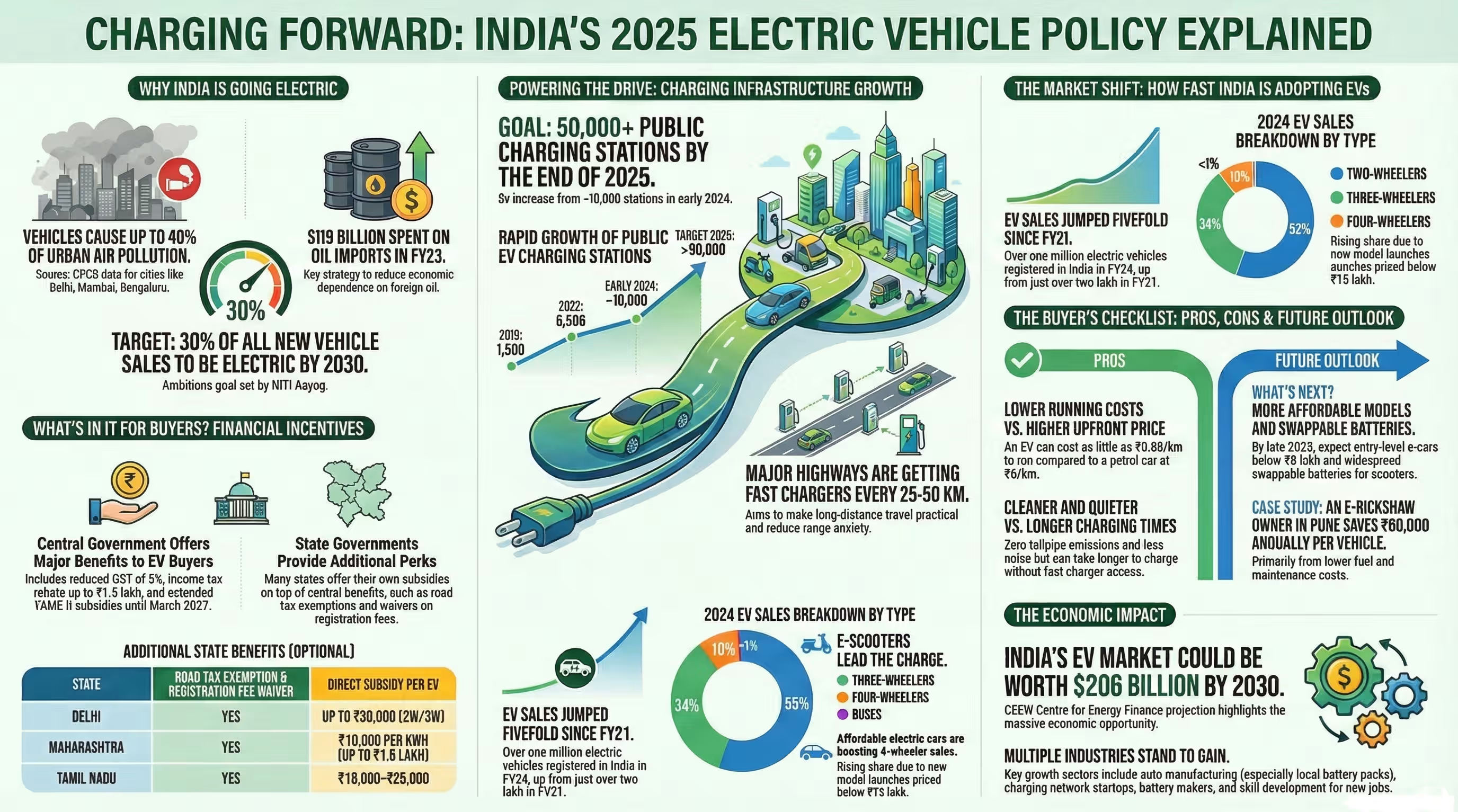
India’s EV market is projected to grow at a CAGR of 49% between 2022 and 2030, with the government targeting 30% EV penetration by 2030.
The introduction of production-ready solid state batteries could:
- Lower the overall cost of EV ownership
- Enhance the performance of two-wheelers and three-wheelers, which dominate Indian roads
- Bolster consumer confidence in EV technology
“Battery costs account for up to 40% of an electric vehicle’s total price in India.”
3. Enhanced Safety Features
Solid state batteries are inherently safer than traditional lithium-ion batteries, as they use a solid electrolyte instead of flammable liquid electrolytes.
“Incidents of battery fires in India have raised concerns about EV safety, making this innovation particularly relevant for Indian consumers.”
The risk of fire or explosion is significantly reduced, which could improve public perception and regulatory support for EVs in India.
4. Potential for Local Manufacturing and Job Creation
The readiness of this technology opens up opportunities for local manufacturing partnerships in India. Government initiatives like ‘Make in India’ and the Production Linked Incentive (PLI) scheme for advanced chemistry cell batteries can enable domestic production.
“India aims to achieve 50 GWh of battery storage manufacturing capacity by 2030.”
Establishing solid state battery factories could create thousands of direct and indirect jobs, fostering economic growth.
5. Support for Renewable Energy Integration
India’s push towards renewable energy—targeting 500 GW of non-fossil fuel capacity by 2030—requires robust storage solutions. Solid state batteries promise:
- Higher efficiency in grid-scale storage
- Greater cycling stability
- Reduced maintenance costs
“Efficient storage is key to managing India’s solar and wind power output, which is often intermittent.”
6. Environmental Impact and Sustainability
Solid state batteries often use less toxic and more environmentally benign materials compared to conventional batteries. Their longer life cycle also means reduced e-waste, a growing concern in India.
“India generated over 1.6 million tonnes of e-waste in 2021, much of it from discarded batteries and electronics.”
Wider adoption of this technology could play a role in achieving India’s sustainability goals.
7. Accelerating India’s Technological Leadership
By embracing next-generation battery technology, India stands to enhance its position as a global leader in clean energy and advanced manufacturing. Early adoption and local innovation can drive exports and attract global investment.
“India is expected to become the world’s third-largest automotive market by 2026.”
Solid state batteries could position Indian manufacturers at the forefront of both domestic and international markets.
, Donut Lab’s production-ready solid state battery technology arrives at a crucial time for India’s energy and mobility sectors. With its potential to transform EV adoption, boost local manufacturing, and support renewable energy integration, this breakthrough could accelerate India’s journey towards a sustainable, technologically advanced future.
Sources
Original Source
google.com - Read original
Quotes
- Publishing Domain: google.com
- Published Date: 2026-01-05T13:30:00+05:30
- Original URL: Read original (news.google.com/rss/articles/CBMi4gFBVV95cUxQeUFfWUw1aHFoMUI1ZUxwQ2RTVzB2R… …)
Editorial Check
- Originality: 65 / 100 — The summary presents news about Donut Lab’s solid-state battery reaching production readiness, which is a notable development but similar announcements have been made by other companies in the battery technology sector. The phrasing is generic and does not introduce unique analysis or exclusive details.
- Helpfulness: 55 / 100 — The summary provides a basic notification of the event but lacks specifics such as technical advancements, production timelines, or implications for the industry. It would be more helpful with additional context or details about the technology and its impact.