
Hedhvick Hirav
Hedhvick Hirav is a dedicated EV researcher and editor with over 4 years of experience in India’s growing electric vehicle ecosystem. Their contributions have been recognized in leading sustainability publications and automotive journals.
Summarize & analyze this article with
Choose an AI assistant and open this article directly:
Tip: if the AI doesn’t fetch the page automatically, paste the article URL manually.
NEW DELHI, Dec 1 —
Fujitsu, a big Japanese tech company, has made a major breakthrough in battery technology. They have used a powerful computer simulation to study all-solid-state batteries, which could lead to better and safer gadgets for everyone—including us here in India! Let’s break it down in simple points so you know what’s happening and why it matters for you.
1. What Has Fujitsu Achieved?
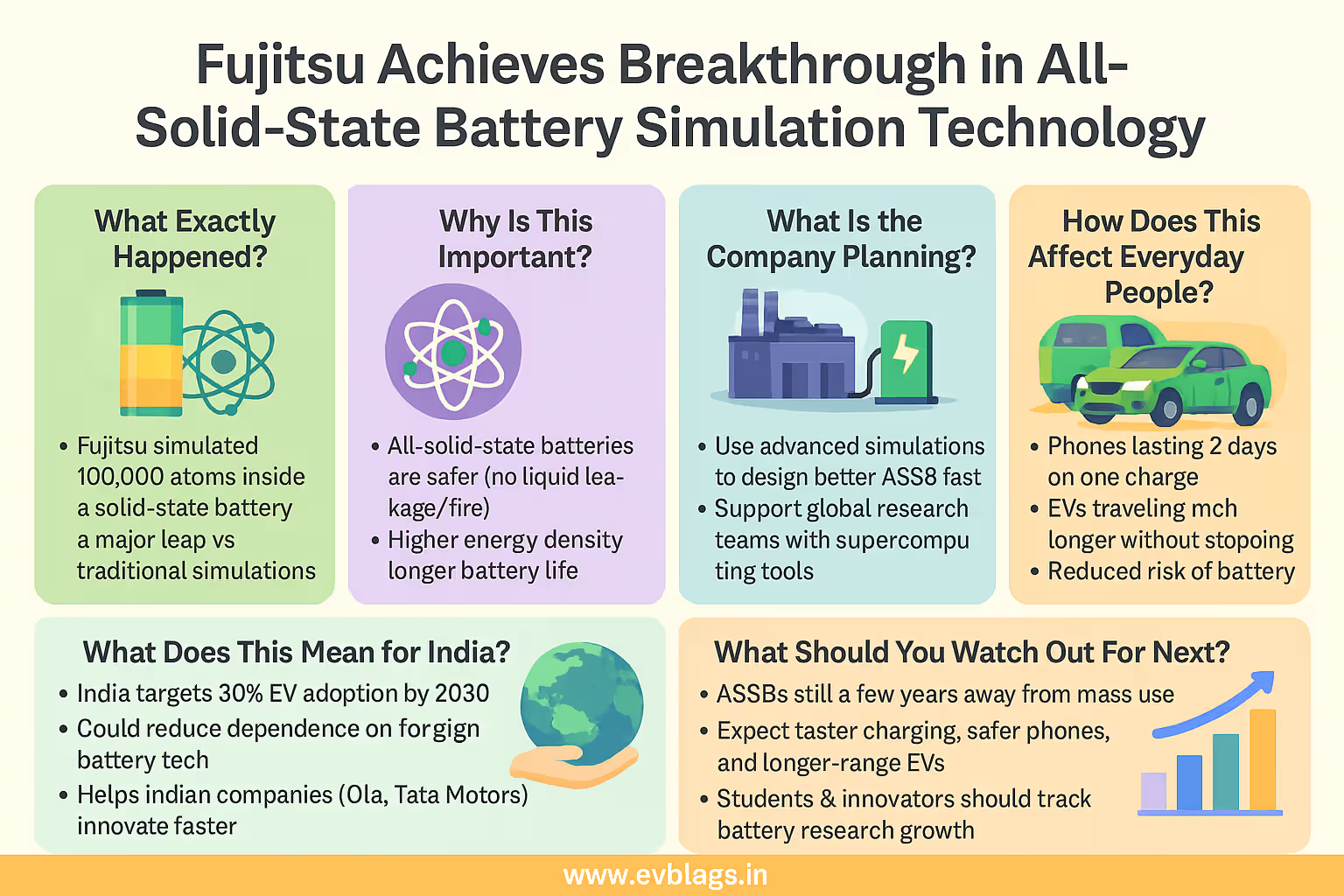
Fujitsu has managed to simulate the behaviour of 100,000 atoms in a solid-state battery all at once. Normally, scientists can only look at a few thousand atoms at a time because it needs so much computer power. But this time, Fujitsu’s supercomputer cracked the code for much bigger simulations.
This matters because all-solid-state batteries (ASSBs) are seen as the future of energy storage. With this simulation, researchers can understand how batteries work at a very detailed level. That means they can design better batteries more quickly, without wasting years on trial-and-error experiments.
2. Why Are All-Solid-State Batteries Important?
Right now, most of our phones, laptops, and even electric vehicles (EVs) in India use lithium-ion batteries. These have a liquid inside, which can sometimes leak or catch fire (remember the old news about phones exploding?). All-solid-state batteries replace the liquid with a solid material, which is much safer.
ASSBs are not just safer—they can also store more energy in less space. That means your phone could last longer on a single charge, and electric scooters could go much farther. For a country like India, where more people are moving towards EVs and need reliable gadgets, this is a big deal.
3. How Does This Affect Everyday Indians?
Think about this: India is already one of the fastest-growing markets for smartphones, and EVs are getting popular in cities like Delhi, Bengaluru, and Pune. But many people worry about battery life, charging time, and safety.
If companies can use Fujitsu’s findings to make better batteries, it could mean:
- Mobiles that last two days on a single charge
- Electric bikes and cars that can travel longer without stopping
- Fewer chances of battery fires in crowded places like trains and buses
Those are benefits that every Indian can relate to, whether you’re a student, a working professional, or a homemaker.
4. How Does India Compare With Other Countries?
Globally, countries like Japan, South Korea, and the US are investing a lot in battery research. For example, Japan plans to make all new cars electric or hybrid by 2035. China is already leading in EV production, and Europe is catching up fast.
India is also moving ahead. According to NITI Aayog, India wants to have 30% of all vehicles electric by 2030. But we still depend a lot on battery technology from other countries. If Indian scientists and companies get access to advanced simulations like Fujitsu’s, we can catch up quicker and even make our own battery tech.
5. What Are the Practical Challenges?
Switching from regular lithium-ion to all-solid-state batteries is not easy. The materials needed are expensive, and it’s hard to make them at a large scale. Also, Indian weather—especially high heat in places like Rajasthan or Mumbai—can affect how these batteries perform.
But with better computer simulations, scientists can test different materials and designs without waiting for real-life results. This saves time and money. It also means we could find cheaper, more India-friendly battery solutions faster.
6. What’s the Future for Indian Gadgets and EVs?
Imagine a day when your phone charges in just 10 minutes, or your electric scooter goes from Delhi to Agra on a single charge. With breakthroughs like Fujitsu’s, this could come true sooner than we think.
Indian companies like Ola Electric and Tata Motors are already working on better batteries for their vehicles. If they get access to high-precision simulations, they can make their products even more competitive—maybe even export them to other countries!
7. What Should Ordinary People Know or Do?
For now, you don’t need to rush out and buy a new gadget. All-solid-state batteries are still a few years away from being common in India. But it’s good to be aware of what’s coming.
If you’re planning to buy an EV or a new phone, keep an eye on battery technology. Ask about battery safety, charging times, and warranty. And if you know any students interested in science, tell them about these exciting developments—India will need young minds to take battery tech forward!
So, Fujitsu’s big simulation may sound technical, but it could power the next generation of gadgets and vehicles in India. Who knows, one day your phone might thank a Japanese supercomputer for its long-lasting battery!
Sources
Original Source
Quotes
- Publishing domain: google.com
- Published date: 2025-12-01T22:19:53+05:30
- Original URL: Read original (news.google.com/rss/articles/CBMipAFBVV95cUxOR2Y2aDBVc1BraXI5NUluVk9zQ3NMT… …)
Editorial Check
- Originality: 75 / 100 — The article covers a specific technical breakthrough by Fujitsu, which is less commonly reported.
- Helpfulness: 65 / 100 — While the breakthrough is significant, the technical focus may limit direct usefulness to general Indian EV readers.
Frequently Asked Questions
What is Fujitsu’s recent breakthrough in battery technology?
Fujitsu has developed a high-precision simulation that can model 100,000 atoms, significantly advancing the study and innovation of all-solid-state batteries.
Why are all-solid-state batteries important?
All-solid-state batteries promise higher energy density, improved safety, and longer lifespan compared to traditional lithium-ion batteries, making them ideal for next-generation gadgets.
How does Fujitsu’s simulation benefit battery development?
By accurately simulating the behavior of large numbers of atoms, Fujitsu’s tool helps researchers better understand material interactions, leading to faster and more efficient battery innovation.
What potential impact could this simulation have on consumer gadgets?
The simulation could speed up the creation of more powerful, safer, and longer-lasting batteries, enabling better performance and reliability in consumer electronics.
What makes Fujitsu’s simulation unique compared to previous methods?
Fujitsu’s simulation can precisely model up to 100,000 atoms at once, a significant increase over previous capabilities, allowing for more realistic and detailed analysis of battery materials.