
Hedhvick Hirav
Hedhvick Hirav is a dedicated EV researcher and editor with over 4 years of experience in India’s growing electric vehicle ecosystem. Their contributions have been recognized in leading sustainability publications and automotive journals.
Summarize & analyze this article with
Choose an AI assistant and open this article directly:
Tip: if the AI doesn’t fetch the page automatically, paste the article URL manually.
NEW DELHI, Nov 5 —
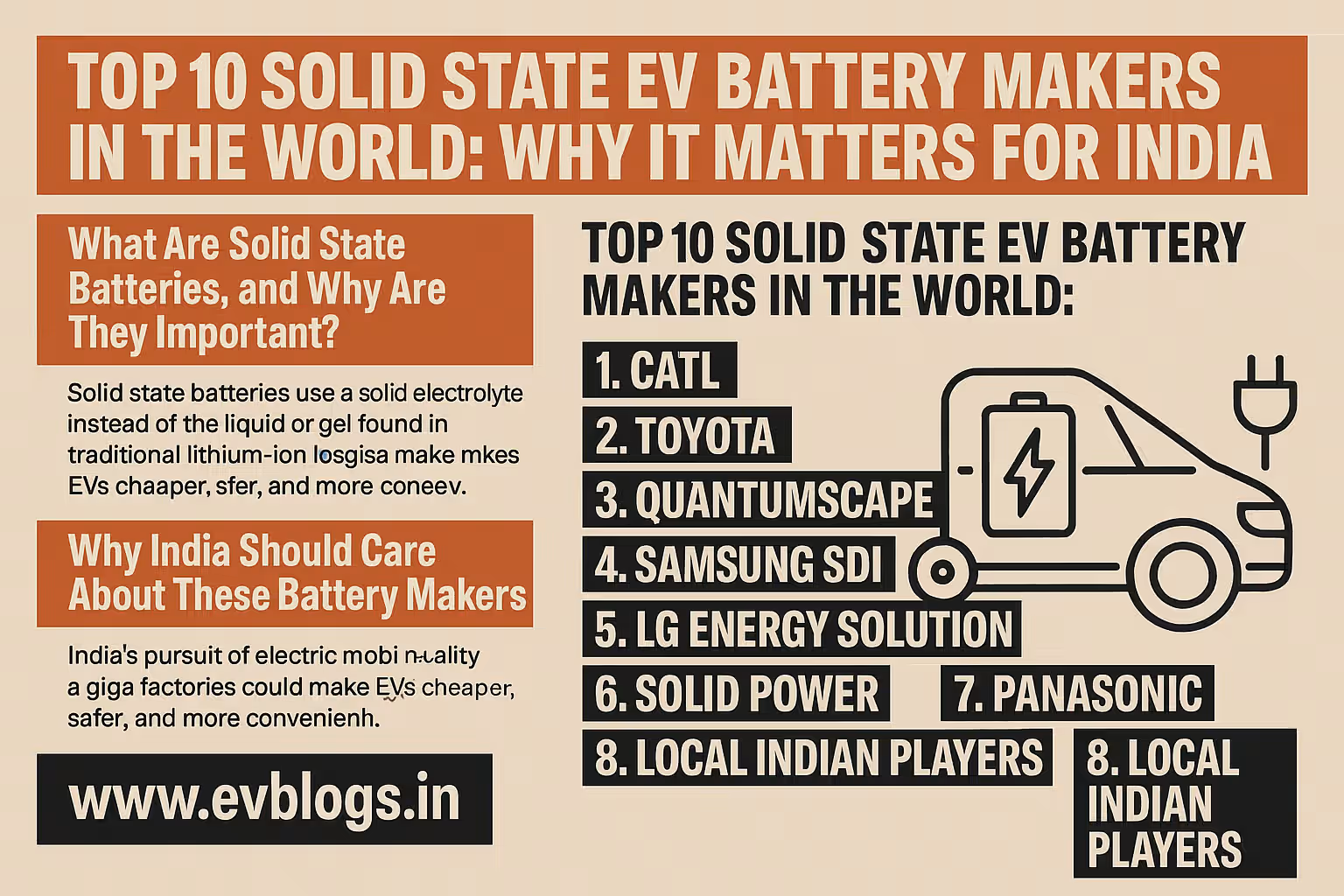
Electric vehicles (EVs) are slowly but surely becoming a common sight on Indian roads. But have you heard about solid state batteries? These are the next big thing in EV technology. People say they are safer, charge faster, and can last longer than the normal lithium-ion batteries we see today. If you are curious about which companies are leading the race, here’s a simple list of the top 10 solid state EV battery makers in the world, and why it matters for India.
1. What Are Solid State Batteries, and Why Are They Important?
Solid state batteries use a solid electrolyte instead of the liquid or gel one found in traditional lithium-ion batteries. This change makes them less likely to catch fire, more durable, and quicker to charge. Some experts say solid state batteries can offer up to 500-800 km on a single charge – much more than the 300-400 km you get with most EVs today.
For a country like India, where people worry about charging infrastructure and battery life, this is big news. Imagine taking your EV from Delhi to Jaipur or Mumbai to Pune without stopping for a recharge!
2. Why India Should Care About These Battery Makers
India is pushing hard for electric mobility. The government’s FAME II scheme already gives subsidies for buying EVs, and many states like Maharashtra and Delhi offer extra incentives. But battery cost and safety are still big concerns for buyers.
If solid state batteries become common, Indian EVs could get cheaper, safer, and more convenient. The Ministry of Heavy Industries also announced plans to set up giga factories for advanced battery manufacturing under the Production Linked Incentive (PLI) scheme, with an outlay of ₹18,100 crore. That means more jobs and more local innovation in battery technology.
3. CATL: The Chinese Giant Leading the World
Contemporary Amperex Technology Co. Limited (CATL) is the world’s largest battery maker. Based in China, CATL is already supplying batteries to brands like Tesla, BMW, and Hyundai. They have invested billions in solid state battery R&D and are expected to start mass production soon.
Why does CATL matter to India? Many Indian companies import battery cells and components from China. As CATL ramps up production, Indian EV makers like Tata Motors and Ola Electric may also get access to cheaper, better batteries.
4. Toyota: The Japanese Innovator
Toyota is a big name in hybrid and electric vehicles. The company has spent over a decade working on solid state battery technology and plans to showcase its first car with a solid state battery by 2026. Toyota claims its battery will offer 1,200 km range and charge from 10% to 80% in just 10 minutes!
Japanese technology is respected worldwide, and Indian automakers often collaborate with Japanese partners. For example, Maruti Suzuki could benefit from Toyota’s innovations in the future, making EVs more attractive for Indian families.
5. QuantumScape: America’s Rising Star
QuantumScape is a US-based startup backed by Volkswagen and Bill Gates. The company’s prototypes have shown promising results, with batteries lasting longer and charging faster than standard lithium-ion options.
QuantumScape’s work is closely watched by the automobile industry. If their batteries become mainstream, expect to see global carmakers introduce these in India as well, boosting confidence in EVs for long-distance travel.
6. Samsung SDI: South Korea’s Tech Powerhouse
Samsung SDI is already a big supplier of EV batteries worldwide. They are investing heavily in solid state battery technology, aiming for commercial production by 2027. Samsung’s focus is on safety, longer battery life, and higher energy density.
Indian EV brands like Mahindra and Hyundai may benefit from Samsung SDI’s advancements, especially as South Korea and India strengthen their trade ties. Plus, more reliable batteries could help Indian cities tackle pollution by encouraging more people to switch to electric cars.
7. LG Energy Solution: Another Korean Leader
LG Energy Solution is another South Korean company making waves in the battery sector. They have announced plans to bring solid state batteries to market by 2026, and already supply batteries to global brands like General Motors and Ford.
With their global presence, LG could partner with Indian manufacturers to boost local production. According to a 2023 NITI Aayog report, India’s EV battery market could be worth $15 billion by 2030, and global players like LG will play a major role in this growth.
8. Solid Power: Backed by Ford and BMW
Solid Power is a US-based company, supported by Ford and BMW. They have developed solid state battery prototypes that offer double the energy density of present lithium-ion batteries.
The company is aiming for mass production by 2027. Indian companies like Tata and Mahindra, who have global partnerships, may explore collaborations to bring such advanced batteries to the Indian market. This can make Indian EVs more competitive abroad too.
9. Panasonic: Trusted and Reliable
Panasonic has been making batteries for decades and is a major supplier for Tesla. The Japanese giant is also working on solid state batteries, with commercial rollout expected around 2028.
Panasonic’s focus on reliability and safety is good news for Indian consumers, who care about after-sales service and long-term maintenance. As more Indian families consider EVs, trust in battery technology will be a key factor.
10. Local Indian Players: Hoping to Catch Up
India is not far behind in this race. Companies like Tata Chemicals, Amara Raja, and Exide are investing in research and local production of advanced batteries. IIT Madras and other institutions are working on solid state prototypes. The government’s push for “Atmanirbhar Bharat” (self-reliant India) means we may soon see homegrown solid state batteries.
For example, Amara Raja has already announced a new giga factory in Telangana, aiming for 16 GWh annual capacity by 2027. As technology matures, expect more Indian companies to join the global league.
11. What This Means for EV Buyers in India
So, what does all this mean for you and me? In the next few years, expect EVs with longer range, faster charging, and safer batteries. Prices may come down as manufacturing scales up and more players enter the market.
Already, the number of EVs on Indian roads has crossed 20 lakh (2 million), according to the Ministry of Road Transport and Highways. With solid state batteries, even more people may be convinced to make the switch, helping India reduce pollution and save on fuel imports.
12. Final Thoughts: The Road Ahead
Solid state batteries are not just a high-tech dream anymore. With so many top companies investing in the technology, mass adoption is just a matter of time. For Indian consumers, this means better choices, safer vehicles, and a greener future.
Keep an eye out! The next big thing in electric mobility could be just around the corner, and India is gearing up to be a major player in this global revolution.
Sources
Original Source
Official Sources
Quotes
- Publishing domain: google.com
- Published date: 2025-11-05T13:30:00+05:30
- Original URL: Read original (news.google.com/rss/articles/CBMifEFVX3lxTE11R3NCS3dwbGFRYmR6dlI3R2hLbG11e… …)
Editorial Check
- Originality: 30 / 100 — The article is a standard listicle summarizing well-known manufacturers.
- Helpfulness: 60 / 100 — Useful for readers seeking a quick overview of leading solid-state battery companies.
Frequently Asked Questions
What are solid state EV batteries?
Solid state EV batteries use a solid electrolyte instead of the liquid or gel electrolytes found in traditional lithium-ion batteries, offering improved safety, energy density, and longevity.
Why are solid state batteries important for electric vehicles?
Solid state batteries are important for EVs because they can provide longer driving ranges, faster charging times, enhanced safety, and potentially lower costs in the long run compared to conventional batteries.
Who are some of the leading manufacturers of solid state EV batteries?
Some leading manufacturers include QuantumScape, Solid Power, Toyota, Samsung SDI, and CATL, among others featured in the top 10 list.
How do solid state batteries differ from traditional lithium-ion batteries?
Unlike traditional lithium-ion batteries that use liquid electrolytes, solid state batteries use solid electrolytes, which reduces the risk of leaks and fires and can increase energy density.
When are solid state EV batteries expected to become widely available?
While several manufacturers are making significant progress, mass production and widespread adoption of solid state EV batteries are expected to begin in the next few years, possibly by the mid-to-late 2020s.