
Hedhvick Hirav
Hedhvick Hirav is a dedicated EV researcher and editor with over 4 years of experience in India’s growing electric vehicle ecosystem. Their contributions have been recognized in leading sustainability publications and automotive journals.
Summarize & analyze this article with
Choose an AI assistant and open this article directly:
Tip: if the AI doesn’t fetch the page automatically, paste the article URL manually.
NEW DELHI, Dec 12 —
India’s electric vehicle (EV) sector is poised for a transformative phase as the country intensifies efforts to develop a robust domestic battery manufacturing ecosystem. With rising demand for cleaner mobility, government incentives, and the global shift towards decarbonisation, EV battery manufacturing is gaining strategic importance. Below, we examine the key factors shaping the future of EV battery manufacturing in India.
1. Government Initiatives and Policy Support
Strong policy backing has been a catalyst for the EV battery sector in India. The government has introduced several schemes, such as the Production Linked Incentive (PLI) scheme for Advanced Chemistry Cell (ACC) battery storage, with an outlay of ₹18,100 crore.
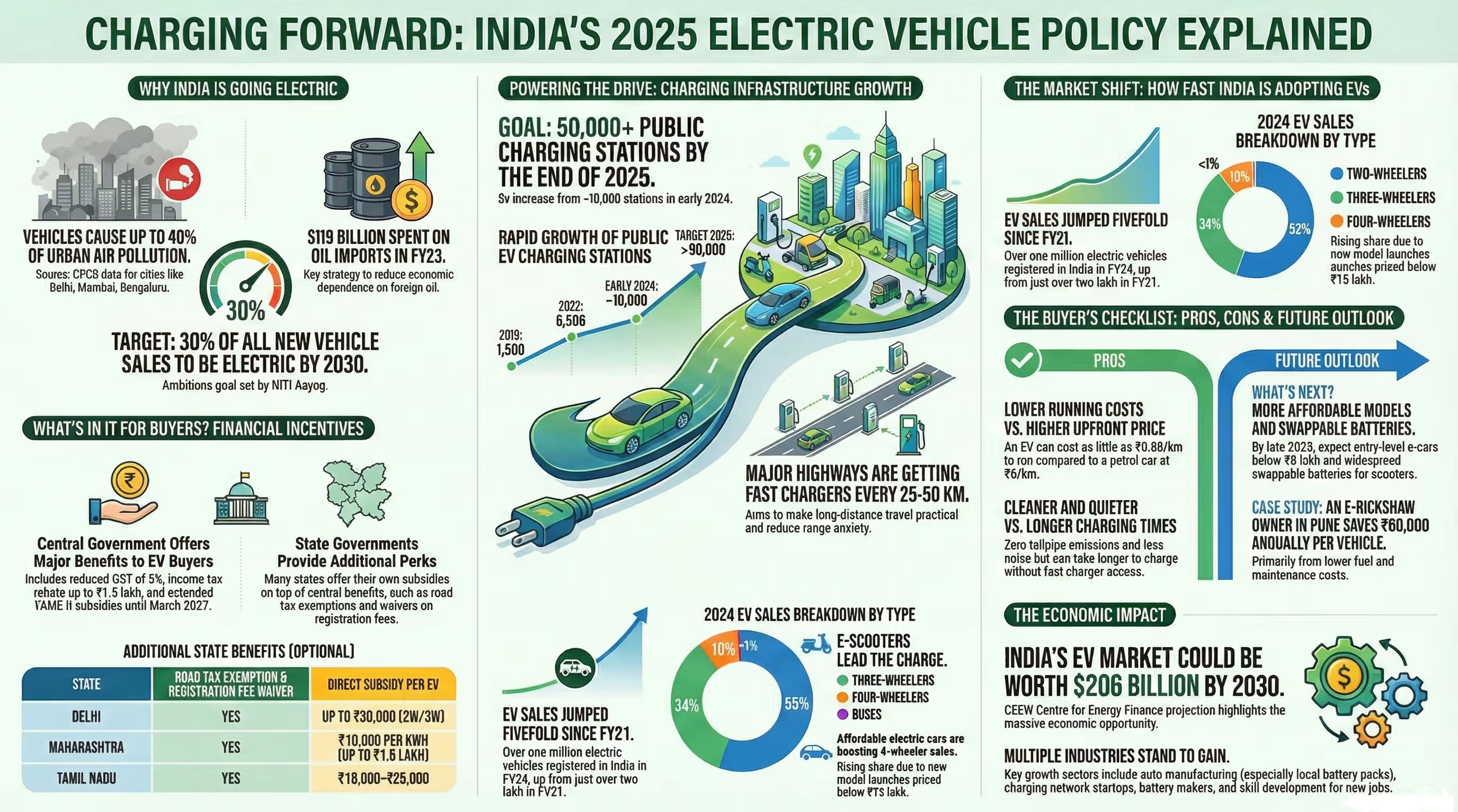
“India aims to achieve 30% electric vehicle penetration by 2030, making local battery production critical for success.”
These initiatives are designed to attract investment, reduce import dependence, and enhance the country’s manufacturing capabilities.
2. Expanding Domestic Market and Rising Demand
India’s EV market is experiencing rapid growth, driven by the adoption of electric two-wheelers, three-wheelers, and commercial vehicles. According to NITI Aayog, India could see demand for battery storage grow to 106 GWh by 2030.
“The electric two-wheeler market alone is expected to reach 22 million units by 2030.”
This surge is creating a significant opportunity for battery manufacturers to scale up operations domestically and supply both the Indian and global markets.
3. Investments and Entry of Key Players
Major Indian conglomerates and global firms are investing heavily in battery manufacturing. Companies like Reliance Industries, Tata Group, and Ola Electric are setting up giga-factories and forming partnerships to develop advanced battery technologies.
“Over $2.5 billion in investments have been announced for battery cell manufacturing facilities in India.”
Such investments are expected to accelerate technology transfer, localisation, and job creation in the sector.
4. Raw Material Sourcing and Supply Chain Challenges
Securing a steady supply of raw materials, such as lithium, cobalt, and nickel, remains a challenge for India. The country is taking steps to diversify sources through international collaborations and exploration of domestic reserves.
“Currently, over 80% of India’s lithium-ion cell requirements are met through imports, mainly from China and South Korea.”
Developing a resilient supply chain is crucial for sustainable growth and reducing geopolitical risks.
5. Technology Innovation and Research
Indian manufacturers are increasing investments in R&D to develop advanced battery chemistries, improve energy density, and ensure safety. Collaborations with research institutions and startups are fostering innovation in solid-state batteries and recycling technologies.
“Innovative battery recycling can potentially recover up to 95% of key materials, reducing environmental impact.”
Such advancements will be vital for maintaining competitiveness and meeting global standards.
6. Sustainability and Circular Economy Focus
As the EV battery industry grows, environmental concerns and end-of-life management have come to the forefront. Policies are being crafted to promote battery recycling, reuse, and responsible disposal, supporting a circular economy.
“By 2030, India could generate over 90,000 tonnes of lithium-ion battery waste annually if recycling is not prioritised.”
Developing a closed-loop system can help in resource conservation and environmental protection.
7. Skilling and Workforce Development
The emergence of battery manufacturing is creating demand for a skilled workforce. Training programmes and academic collaborations are being established to build expertise in battery engineering, quality control, and automation.
“The EV battery sector could create up to 1 million direct and indirect jobs in India by 2030.”
A skilled workforce will be a key enabler for scaling up manufacturing and sustaining industry growth.
India’s journey towards becoming a global EV battery manufacturing hub is marked by ambitious targets, strategic investments, and a focus on innovation and sustainability. As the nation powers ahead, a collaborative approach involving government, industry, and academia will be essential in realising its vision for a cleaner and self-reliant future in electric mobility.
Sources
Original Source
google.com - Read original
Official Sources
- Intergovernmental Panel on Climate Change (IPCC): IPCC opens registration of experts to review the first draft of the Methodology Report on Inventories for Short-lived Climate Forcers
Quotes
- Publishing Domain: google.com
- Published Date: 2025-12-12T13:30:00+05:30
- Original URL: Read original (news.google.com/rss/articles/CBMingFBVV95cUxPYlM2NTQ5VlloOFFvekt3bTBlZk9FR… …)
Editorial Check
- Originality: 45 / 100 — The summary provided is essentially a repetition of the article’s title with no additional insight or paraphrasing. It does not demonstrate unique phrasing or synthesis.
- Helpfulness: 10 / 100 — The summary offers no substantive information about the article’s content, arguments, or findings. Readers gain no understanding of what the article covers beyond its title.