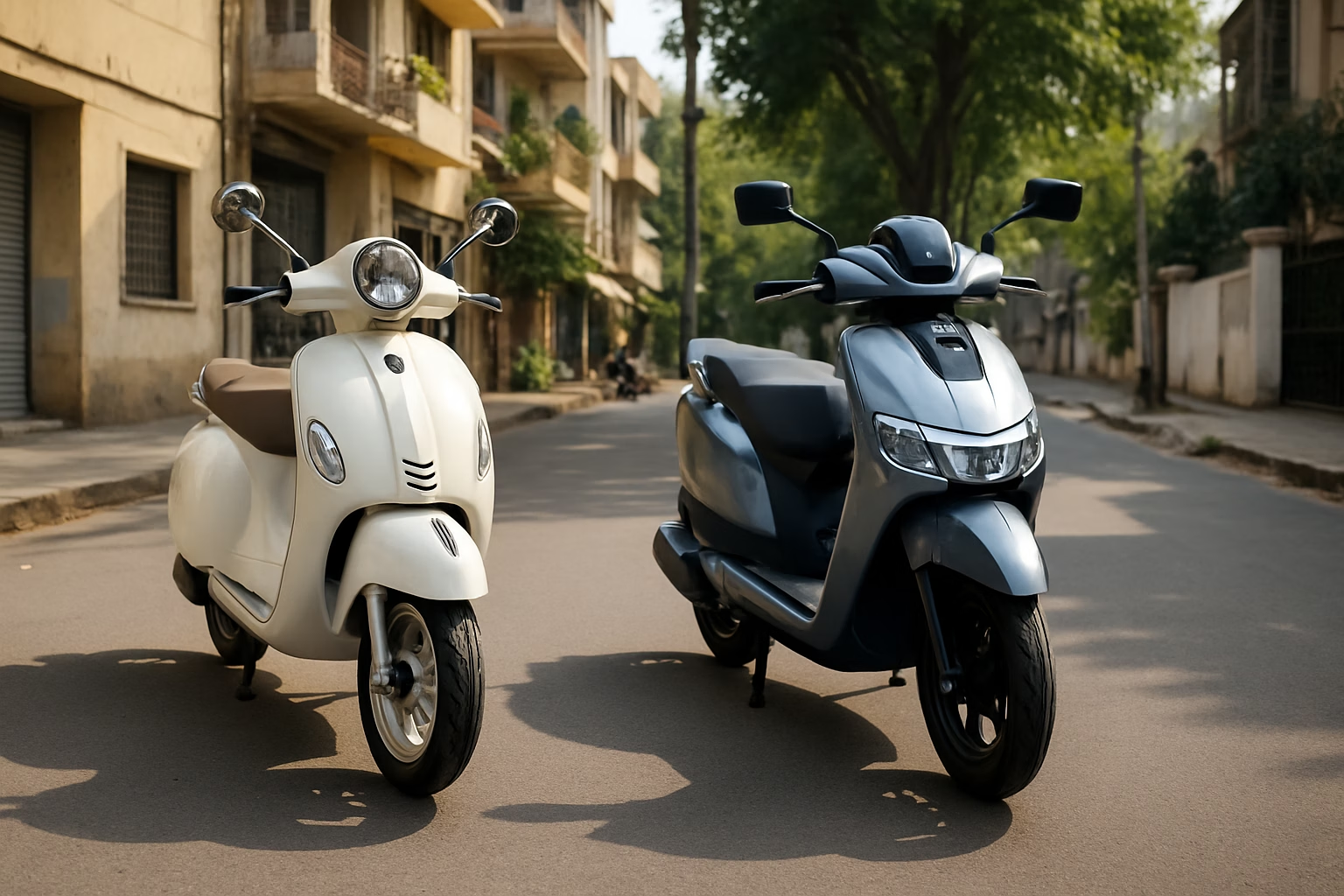

This comparison used to be about specs. It is not anymore. The Ola S1 Pro still crushes the Bajaj Chetak on paper, with more range, more power, and far more speed. But in 2026 the question buyers actually ask is different: which one will still be running, and still be serviceable, three years from now? On that question the answer has flipped, and the sales charts show it. In March 2026, Bajaj sold 46,246 Chetaks to Ola’s 10,117, a 4.6 to 1 gap (DriveSpark ).
So I am going to give you both sides honestly: where the Ola genuinely wins, and why most buyers are now choosing the Chetak anyway. Lab range and real range are kept separate throughout.
My quick verdict: Buy the Ola S1 Pro if you want the most performance and range per rupee and you have a reliable Ola service centre nearby. Buy the Bajaj Chetak if you want a scooter you can trust and get serviced anywhere, which is most people.
Specs at a Glance
| Spec | Ola S1 Pro Gen 3 (4 kWh) | Bajaj Chetak 3501 |
|---|---|---|
| Ex-showroom price | Rs 1,49,860 | Rs 1,47,293 |
| IDC / ARAI range | 242 km | 153 km |
| Real-world range | ~169 km (owner reports) | ~100-120 km |
| Battery | 4 kWh | 3.5 kWh |
| Peak power | 11 kW | 4 kW |
| 0-40 km/h | 2.7 sec | ~3.2 sec |
| Top speed | 125 km/h | 73-80 km/h |
| Body | Plastic panels | Metal (steel) |
| Boot space | 34 litres | 35 litres + 5 L glovebox |
| Fast charging | Yes (Hypercharger) | No (home only, by design) |
| Service touchpoints | ~600, shrinking | 4,000+ (Bajaj network) |
Prices ex-showroom, mid-2026. Sources are linked through the sections below.
Price and Variants
The two top variants land within Rs 3,000 of each other, around Rs 1.47-1.50 lakh (BikeWale Ola , BikeWale Chetak ). But the ranges spread differently. The Ola S1 Pro Gen 3 runs from a 3 kWh at about Rs 1.30 lakh up to a 5.2 kWh at Rs 1.75 lakh. The Bajaj Chetak runs from the entry 3001 at Rs 1.11 lakh to the fully-loaded 3501. For the same money, the Ola gives you dramatically more performance, and the Chetak gives you a metal body and a bigger service safety net. That is the whole comparison in one sentence.
Range: Lab vs Real
The Ola wins range comfortably, but not by as much as the brochure says. The 4 kWh claims 242 km IDC; owners report around 169 km in Eco, roughly a 30% shortfall (evindia.online ). One honest note: I could not find a controlled, independent 2026 range test of the Gen 3 specifically, so treat 169 km as a solid owner-reported figure, not a lab-verified one.
The Chetak 3501 claims 153 km ARAI and owners see a real 100-120 km in the city (ZigWheels owner reviews ). So the Ola gives you roughly 40-50 km more real range per charge. If your daily ride is long, that matters. If you commute 30-40 km and charge at home, both are more than enough.
Performance: No Contest
The Ola is in a different league here: 11 kW of peak power, 2.7 seconds to 40 km/h, and a 125 km/h top speed against the Chetak’s 4 kW and 73-80 km/h (Ola official , Autocar India ). If you want a scooter that feels genuinely fast and can hold highway speeds, the S1 Pro is the only choice between these two.
The Chetak answers with character rather than numbers. Its hub motor delivers smooth, predictable, unintimidating power, and owners consistently praise the comfort and the braking. It is the calmer, more mature ride.
Build Quality: The Metal Body Question
The Chetak’s headline feature is its steel body, where the Ola uses plastic panels. Owners notice it:
“solid metal body hai jo baaki plastic scooters se isko alag aur majboot banati hai” (the solid metal body makes it stand apart and feel stronger than other plastic scooters) by Shadab, 3.2/5, BikeDekho
Both scooters carry an IP67-rated battery, so both handle monsoon rain. The metal body does not make the Chetak waterproof, that is the battery rating’s job, but it does give it a more solid, planted feel and likely better long-term panel durability. It is a genuine, if often overstated, advantage.
The Software Trap: Ola’s MoveOS Paywall
Here is something no rival comparison mentions, and every Ola buyer should know. Ola’s MoveOS+ software is free for the first three years, after which features can sit behind a paid subscription of up to Rs 10,000 per three years, reportedly affecting modes and conveniences owners assumed they owned (EVFY ). The Chetak has no such ongoing software charge. When you compare ownership cost over five years, factor that subscription in. A scooter you have to keep paying to keep full-featured is not the bargain it looks like on day one.
Known Problems: Be Honest About Both
Ola’s issues are partly at the regulatory level, which is rare and serious. The CCPA opened an investigation after 10,644 consumer complaints (Business Today ), SEBI began probing a sales-data discrepancy (Inc42 ), and the company is cutting its store count from around 4,000 toward 550 (Business Standard ). Owners feel the service strain:
“The service is totally bad, for normal servicing it takes months to repair.” by Bhavesh Bhandari, 1.0/5, BikeWale
The Chetak is not problem-free either, and I will not pretend otherwise. There is a documented auxiliary-battery fault where the scooter goes fully immobile and even the handle lock seizes, reported by one owner three times in four months (BikeDekho ). And Bajaj’s service can be slow on parts:
“My scooter was stuck in the service center for 2 months due to no spare parts. No calls were answered, no updates given.” by Kishore Sagar, 2.0/5, BikeWale
The difference is scale and nature. Ola’s problems are systemic and regulatory; the Chetak’s are individual faults within a more stable company.
Charging and Service
The Ola supports fast charging through its exclusive Hypercharger network, listed at around 288 stations (a figure dated October 2024 on Ola’s own page, likely higher now but not independently confirmed) (Ola Hypercharger ). The Chetak has no DC fast charging at all, by Bajaj’s deliberate choice to protect the battery, so you plan around a 3-hour home charge. For overnight chargers that is fine; for mid-day top-ups it is a real limitation.
Service is where the Chetak pulls decisively ahead. It rides on Bajaj Auto’s existing dealer network of 4,000-plus touchpoints that also service petrol two-wheelers (Chetak ). Ola runs around 600 standalone EV centres and is shrinking that footprint. In a Tier 2 or Tier 3 city, a Bajaj dealer is far more likely to be near you. One caveat: Bajaj reach does not always mean EV expertise, so confirm your local dealer handles Chetak battery and BMS issues.
The Market Has Already Decided
If you trust the wisdom of buyers, the verdict is loud. Bajaj’s market share doubled from 11% in FY2024 to 22% in early FY2027, while Ola’s collapsed from 35.5% to under 10% over the same window (Autocar Professional , Inc42 ). The Chetak has crossed 7.27 lakh cumulative sales. Buyers did not abandon Ola because of specs. They left because of service and trust. That is the most important data point on this page.
What Owners Say
“All time best, best range 170km. Value for money, no maintenance cost, fast charger, best ev charger segment.” by Shrikant, 5.0/5, BikeDekho
“Chetak has the best comfort and best braking among all other ev scooters, it has a decent range of 105 km.” by Rushank, 5.0/5, ZigWheels
The split is clear: Ola owners love the performance and range when the scooter works, Chetak owners value the comfort, build, and peace of mind.
Who Should Buy Which
Buy the Ola S1 Pro if: you want the most performance and range for the money, you ride long daily distances, you want fast charging, and you have a dependable Ola service centre near you. Go in knowing the MoveOS subscription and service record.
Buy the Bajaj Chetak if: you want a solid metal-bodied scooter, the widest service reach, no software subscription, and the reassurance of a stable company. This is the lower-risk choice for most buyers and the one the market is picking.
Frequently Asked Questions
Which is better, Ola S1 Pro or Bajaj Chetak? For raw performance and range, the Ola. For dependable ownership, service reach, and resale trust, the Chetak. Most buyers in 2026 are choosing the Chetak, and the sales gap shows it.
What is the real-world range of the Ola S1 Pro Gen 3? Owners report around 169 km in Eco for the 4 kWh against a 242 km IDC claim. A controlled independent test of the Gen 3 was not available at the time of writing.
Does the Bajaj Chetak support fast charging? No. Bajaj deliberately leaves out DC fast charging to protect the battery. The 3501 charges 0-80% in about 3 hours at home.
What is the MoveOS+ subscription? Ola’s software suite is free for three years, after which some features can require a paid subscription of up to Rs 10,000 per three years. Factor it into long-term ownership cost.
Which has the better service network? The Chetak, by a wide margin, because it uses Bajaj’s 4,000-plus dealer network. Ola runs around 600 EV centres and is reducing its store count.
My Final Verdict
The Ola S1 Pro is the better machine on paper and remains the pick if performance and range are your priority and you have solid Ola service nearby. But for most people the Bajaj Chetak is the smarter buy in 2026: a metal body, the widest service network in the country, no software subscription, and a company on the way up rather than in retreat. When buyers are choosing it 4 to 1, that is not brand loyalty, it is hard-won trust.
For more, see my Ather 450X vs Bajaj Chetak and Simple One vs Ather 450X comparisons, plus the best electric scooters under 2 lakh .
Prices and specifications are as of June 2026 and sourced from the manufacturers and publications linked above. Real-world range varies with rider weight, terrain, weather and riding mode. Confirm the current on-road price and warranty at your dealer before buying.