
Hedhvick Hirav
Hedhvick Hirav is a dedicated EV researcher and editor with over 4 years of experience in India’s growing electric vehicle ecosystem. Their contributions have been recognized in leading sustainability publications and automotive journals.
Summarize & analyze this article with
Choose an AI assistant and open this article directly:
Tip: if the AI doesn’t fetch the page automatically, paste the article URL manually.
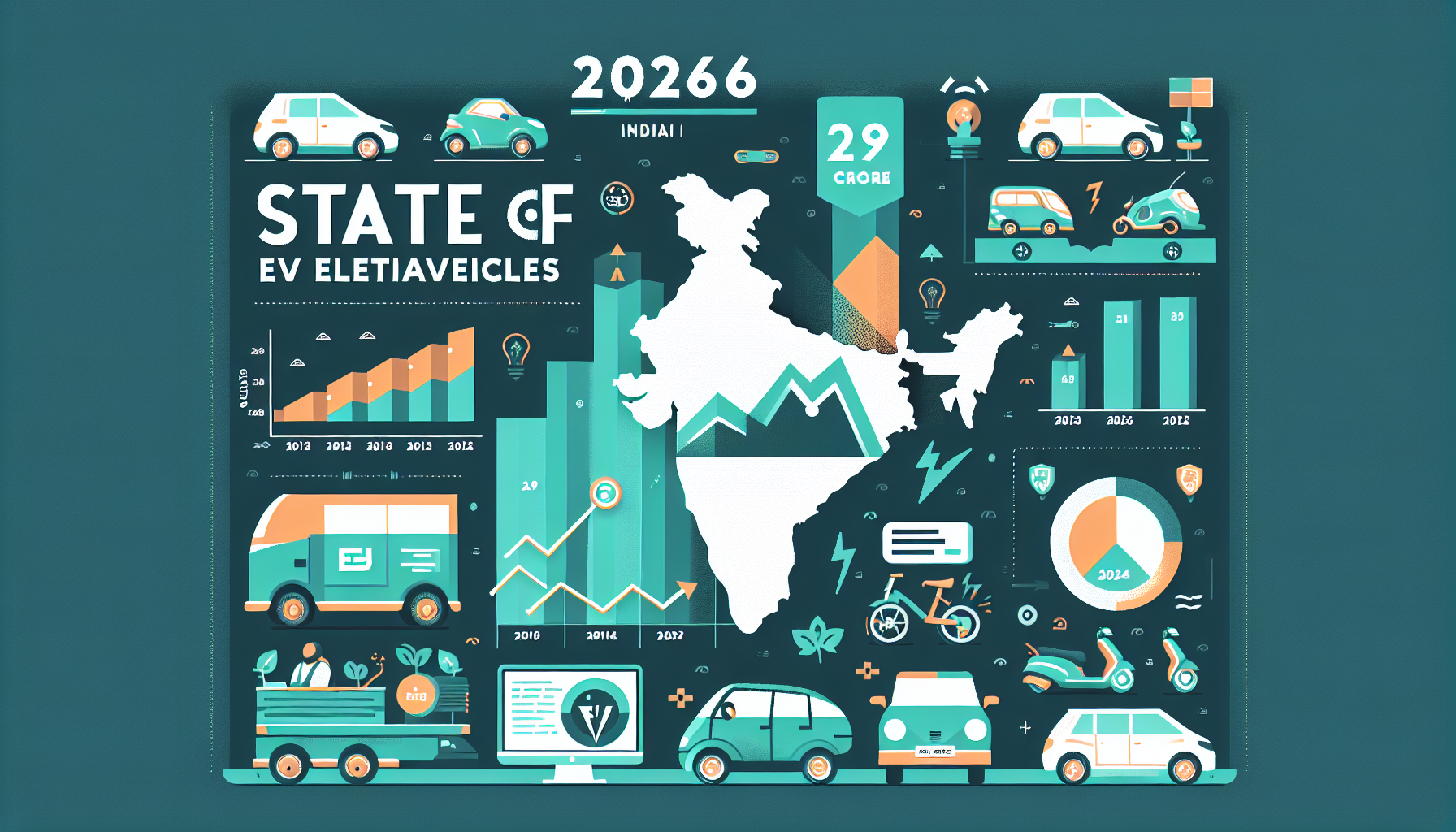
India’s EV market crossed 2.39 crore total registrations as of March 2026. Sales grew 24.7% year-on-year in 2025 — the fastest growth since the FAME II push of 2022. Two-wheelers still lead with a 17.8% EV penetration rate, and three-wheelers have crossed the 55% mark.
This page tracks all the key numbers in one place. Updated monthly.
EV Sales by Segment — 2025 vs 2024
| Segment | 2024 Sales | 2025 Sales | Growth | EV Share |
|---|---|---|---|---|
| Two-Wheelers | 10.77 lakh | 13.08 lakh | +21.4% | 17.8% |
| Three-Wheelers | 7.05 lakh | 9.12 lakh | +29.4% | 55.3% |
| Passenger Cars | 99,000 | 1.24 lakh | +25.3% | 2.4% |
| Electric Buses | 3,800 | 5,200 | +36.8% | 1.9% |
| Light Commercial Vehicles | 18,400 | 24,100 | +31.0% | 3.1% |
| TOTAL | 18.62 lakh | 23.22 lakh | +24.7% | ~8.5% |
Three-wheelers lead on penetration at 55.3% — largely e-rickshaws and cargo EVs for last-mile delivery. Passenger cars remain low at 2.4% but are accelerating with new launches from Tata, MG, Hyundai, and Maruti all targeting the sub-₹15 lakh bracket.
Year-on-Year EV Sales Trend (2020–2025)
| Year | Total EV Sales | YoY Growth | Key Driver |
|---|---|---|---|
| 2020 | 1,56,000 | — | Early 2W adoption |
| 2021 | 3,29,000 | +111% | Post-COVID mobility shift |
| 2022 | 10,20,000 | +210% | FAME II push, fuel price spike |
| 2023 | 15,70,000 | +54% | New model launches |
| 2024 | 18,62,000 | +18.6% | Subsidy rationalisation |
| 2025 | 23,22,000 | +24.7% | PM E-DRIVE + state schemes |
2022 was the breakout year — EV sales tripled as petrol crossed ₹110/litre and FAME II subsidies brought 2W EVs within ₹5,000–10,000 of equivalent petrol scooters.
Top States by EV Adoption (2025)
| Rank | State | EV Registrations | Top Segment |
|---|---|---|---|
| 1 | Uttar Pradesh | 3,92,000 | E-Rickshaw |
| 2 | Maharashtra | 2,87,000 | 2-Wheeler |
| 3 | Karnataka | 2,41,000 | 2-Wheeler |
| 4 | Tamil Nadu | 1,98,000 | 2-Wheeler |
| 5 | Rajasthan | 1,72,000 | E-Rickshaw |
| 6 | Gujarat | 1,65,000 | 2-Wheeler |
| 7 | Delhi | 1,59,000 | 2-Wheeler |
| 8 | Madhya Pradesh | 1,43,000 | E-Rickshaw |
UP leads in absolute volume driven by e-rickshaws. Karnataka and Maharashtra lead in 2W and 4W EV penetration rates. For state-specific subsidy details, check the full list of EV subsidies across all 36 states.
Charging Infrastructure in India (March 2026)
| Metric | Count | Notes |
|---|---|---|
| Public charging stations | 25,200+ | BEE + state-installed |
| Fast DC chargers (50kW+) | 8,400+ | Highways + city hubs |
| ATHER Grid points | 2,800+ | Ather-exclusive network |
| Tata Power EZ Charge | 5,600+ | Multi-brand public |
| Home chargers installed | 9.8 lakh+ | Registered AC units |
| Expressway corridors covered | 42 of 44 | Every 25 km target met |
India still has a charging gap in Tier 2 and Tier 3 cities — public charger density falls below 1 per 10 sq km outside metros. The government’s 2030 target of 1 million public chargers needs ~1.2 lakh new installations per year. Current pace is ~8,000/year.
Policy & Subsidy Stack 2026
| Scheme | Budget | Benefit Per Vehicle |
|---|---|---|
| PM E-DRIVE (Central) | ₹10,900 Cr | ₹5,000–1,50,000 |
| FAME II (Central) | ₹11,500 Cr | Closed — absorbed into PM E-DRIVE |
| Maharashtra EV Policy | ₹930 Cr | ₹25,000 (2W), ₹1 lakh (4W) |
| Delhi EV Policy 2.0 | ₹500 Cr | ₹5,000 scrap bonus + road tax waiver |
| Karnataka EV Policy | ₹1,000 Cr | ₹5,000–25,000 per vehicle |
| Tamil Nadu EV Policy | ₹500 Cr | ₹15,000 (2W), ₹50,000 (4W) |
| Gujarat EV Policy | ₹1,500 Cr | ₹20,000 (2W), ₹1.5 lakh (4W) |
Combined central + state subsidies can total ₹2–3 lakh for electric cars in high-incentive states like Gujarat. Use the EV Subsidy Calculator to check your exact benefit.
Top 7 EV Trends in India — 2026
1. Battery-as-a-Service (BaaS) expanding fast Bounce Infinity and Sun Mobility are growing battery swap networks to 50+ cities. BaaS cuts upfront vehicle cost by 20–30%, removing the biggest barrier for price-sensitive buyers.
2. LFP batteries replacing NMC in 2W/3W Lithium Iron Phosphate chemistry offers better thermal safety at Indian temperatures, longer cycle life, and 15–20% lower cost. Ola, Ather, and TVS have all shifted new models to LFP.
3. Used EV market emerging Spinny, Cars24, and OEM-certified pre-owned programs are entering the EV resale space. A healthy used market signals maturity and brings down the effective entry price for first-time EV buyers.
4. Fleet electrification deadlines approaching Zomato, Swiggy, and Amazon India have committed to 100% EV delivery fleets by 2026-27. This is creating large-scale demand for sub-₹1 lakh cargo EVs and e-bikes.
5. Highway charging now standard NHAI mandates EV charging at all new highway service areas. 42 of India’s 44 expressway corridors now have chargers every 25 km — making inter-city EV travel viable.
6. Vehicle-to-Grid (V2G) pilots underway BESCOM in Karnataka is running India’s first V2G trial with 100 EVs, allowing bidirectional charging. If scaled, it could stabilise the grid while giving EV owners passive income.
7. EV insurance premiums dropping As claim data matures and battery replacement costs fall, insurance premiums for EVs have dropped 15–20% in 2025. EV insurance is now within 10% of equivalent ICE vehicle premiums.
2026 Outlook — What to Expect
- Total EV sales projected at 28–30 lakh units in FY2026-27
- Electric 2W penetration to cross 22% of new registrations by December 2026
- 6 new EV models expected at sub-₹15 lakh from Tata, MG, BYD, and Maruti
- Solid-state battery pilot vehicles from Ola Electric and TVS by Q3 2026
- At least 5 states to mandate EVs for government fleet procurement above 100 units
India is on track to become the world’s 3rd largest EV market by volume by 2028, behind only China and the USA. — JMK Research, 2025
Frequently Asked Questions
How many EVs are registered in India? Over 2.39 crore electric vehicles are registered in India as of March 2026, according to the VAHAN dashboard. Two-wheelers account for approximately 60% of the total.
Which state has the highest EV adoption in India? Uttar Pradesh leads in absolute registrations (driven by e-rickshaws). Karnataka and Maharashtra lead in electric two-wheeler and four-wheeler penetration rates among personal vehicle buyers.
What is the EV market share in India in 2025? Overall EV share across all vehicle segments was approximately 8.5% of new registrations in 2025. Two-wheelers reached 17.8%, three-wheelers crossed 55%, and passenger cars stood at 2.4%.
What is the government subsidy on electric vehicles? The central PM E-DRIVE scheme offers ₹5,000–1,50,000 depending on vehicle type. State subsidies add ₹2,500–1,50,000 more. Total benefit can reach ₹2–3 lakh for 4W EVs in states like Gujarat and Maharashtra.
Is India’s EV charging infrastructure ready? Highways are well-covered with 25,200+ public chargers as of early 2026. Tier 2 and Tier 3 cities still have gaps. India needs to add roughly 1.2 lakh new public chargers per year to hit its 2030 target.
Download the Full Report
The complete India EV Market Report 2026 includes all statistics, state-wise data, charging infrastructure numbers, policy details, and trend analysis in a single PDF — ready for presentations, research, or business planning.
Data sources: VAHAN Dashboard, MoRTH Annual Report, JMK Research 2025, BEE charging infrastructure data, state EV policy documents. Last updated: April 2026.