
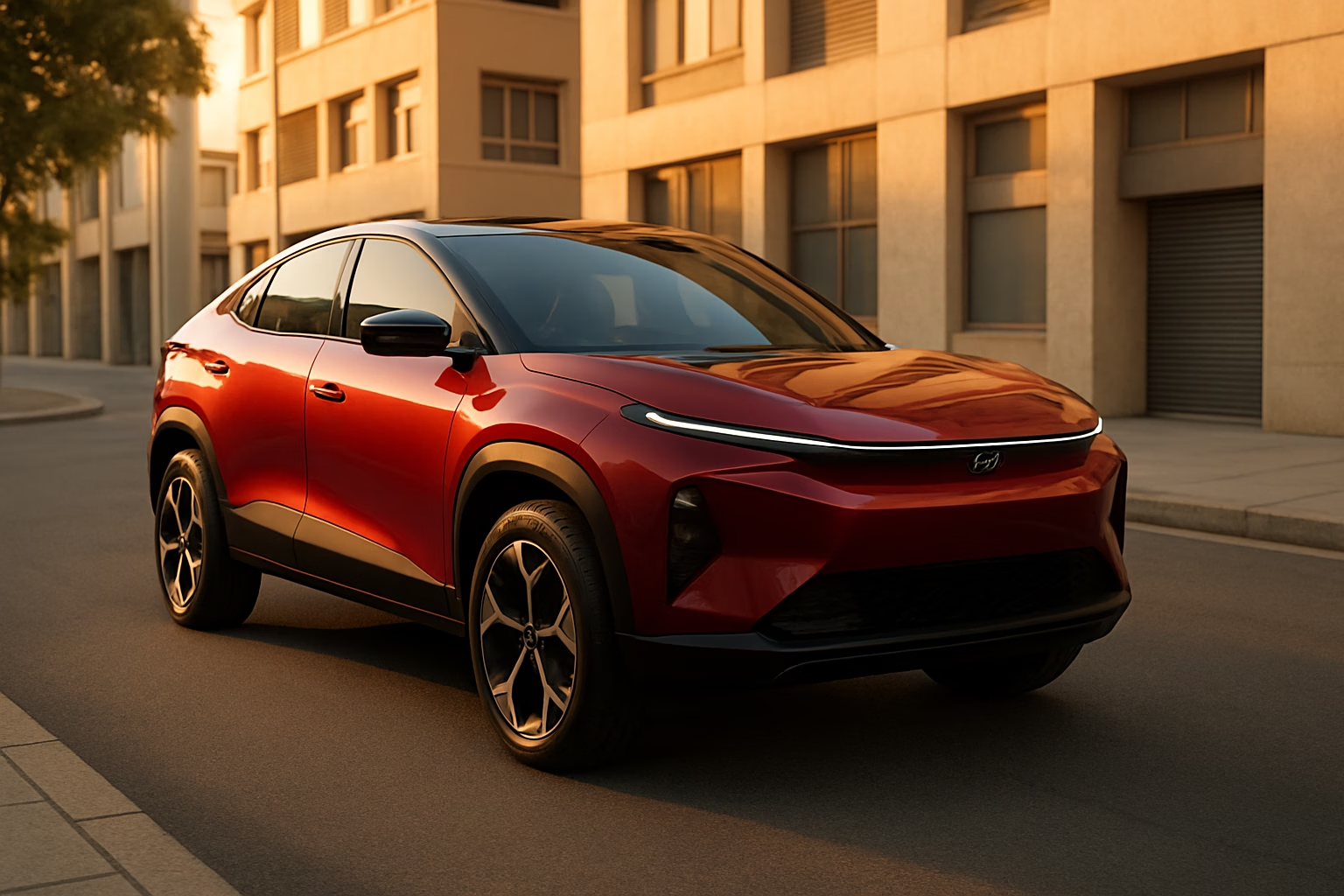
India’s most style-forward electric SUV finally has pricing that makes sense. The Tata Curvv EV Series X, launched on May 4, 2026, dropped the base price by Rs 2.25 lakh to Rs 16.99 lakh — making it the most affordable entry point in the electric coupe-SUV segment.
I’ve been tracking the Curvv EV since its launch in August 2024, reading through three independent long-term reviews, multiple owner accounts, and two head-to-head range tests. Here’s what you actually need to know before putting down a booking amount.
What Changed with the Series X Update (May 2026)
The Series X isn’t just a name change. Tata made meaningful improvements:
- Price cut of Rs 2.25 lakh on the base variant (now Accomplished X 55 at Rs 16.99 lakh)
- 45 kWh battery discontinued — only the 55 kWh variant remains on sale
- New features: Rear ventilated seats (a first for this car), dual-zone climate control, rear window sunshades, and cup holders in the rear armrest (yes, the original Curvv EV launched without rear cup holders)
- Safety standardised: 6 airbags, ESC, TPMS, and 360-degree camera now come standard across all three variants
- New colour: Nitro Crimson red
The Accomplished X 55 is the value-buy trim. The Empowered X 55 adds ADAS (Level 2) and a few more features at Rs 19.19 lakh. The Dark edition at Rs 19.49 lakh is mostly cosmetic.
Variants and On-Road Prices (May 2026)
| Variant | Ex-showroom | On-road Bangalore | On-road Chennai |
|---|---|---|---|
| Accomplished X 55 | Rs 16.99 lakh | Rs 19.23 lakh | ~Rs 18.00 lakh |
| Empowered X 55 | Rs 19.19 lakh | Rs 21.71 lakh | ~Rs 20.00 lakh |
| Empowered X 55 Dark | Rs 19.49 lakh | Rs 22.04 lakh | ~Rs 20.30 lakh |
The gap between Bangalore and Chennai prices is significant. Karnataka ended its EV road tax exemption on April 1, 2026 and now charges 8% on vehicles priced Rs 15-22 lakh. That adds roughly Rs 1.35 lakh to the Accomplished X 55’s on-road cost in Bangalore.
Tamil Nadu, by contrast, extended its 100% road tax exemption on EVs until December 31, 2027 (The Federal ). Buyers in Chennai effectively pay ex-showroom plus insurance — nothing more.
On PM e-DRIVE subsidies: The Curvv EV doesn’t qualify. The PM e-DRIVE scheme (Rs 10,900 crore outlay, notified September 2024) covers only two-wheelers, three-wheelers, electric buses, and trucks — not private passenger cars. There’s no central government subsidy on the Curvv EV right now.
Specs at a Glance
| Spec | Value |
|---|---|
| Battery | 55 kWh lithium-ion |
| MIDC certified range | 502 km |
| Real-world range (tested) | 330–365 km |
| Motor output | 167 PS (165 bhp), 215 Nm |
| Drive type | Front-wheel drive, single motor |
| 0–100 km/h | 8.6 seconds |
| Top speed | 160 km/h |
| DC fast charge (10–80%) | 40 min claimed / 47 min tested |
| AC charge (7.2 kW wallbox) | 7.6 hours (10–100%) |
| Boot space | 500 litres |
| Frunk | 11.6 litres |
| Safety rating | 5-star Bharat NCAP |
| V2L output | 3.3 kVA |
| V2V output | 5 kVA |
| Battery warranty | Lifetime (HV battery) |
Real-World Range — What Three Independent Tests Show
Tata claims 502 km on the MIDC cycle. That number is measured under controlled lab conditions and isn’t what you’ll see on the road. Here’s what independent tests found:
| Test | Conditions | Range achieved | Efficiency |
|---|---|---|---|
| Autocar India vs Creta Electric (source ) | City + highway mixed | 365 km | 6.64 km/kWh |
| Autocar India vs Mahindra BE 6 (source ) | City + highway mixed | 365 km | 6.64 km/kWh |
| MotorBeam 6-month long-term (source ) | Real ownership, mixed | 330 km average | 6 km/kWh |
| Autocar India long-term 7,300 km (source ) | Real ownership | Over 350 km usable | 5.2 km/kWh overall |
The honest number to plan around: 330–365 km per full charge in mixed city and highway driving. If you’re on the highway at sustained speeds, that drops further — one independent reviewer documented 183 km at continuous highway speeds (Kartick, Substack ).
In comparison, the Hyundai Creta Electric 51.4 kWh returned 432 km in Autocar India’s same mixed-conditions test, at 8.4 km/kWh — significantly more efficient per kWh. That’s a 67 km real-world gap despite the Creta having a smaller battery.
Charging — Times, Network, and the 26,000 Station Claim
The Curvv EV supports 70 kW DC fast charging. In a real-world test by CarDekho (source ), the car peaked at 65 kW — not the full 70 kW claimed — and took 47 minutes to go from 10–80%, versus the 40-minute claim.
On AC, a 7.2 kW home wallbox takes 7.6 hours for a full charge (10–100%). A standard 15A socket takes 17.5–21 hours.
Tata advertises “26,000+ charging stations” in its marketing. That figure includes home chargers installed by Tata Power at private residences. The Tata Power EZ Charge public network has 6,700+ public and semi-public charging stations across 690+ cities (Tata Power EZ Charge ) — still the largest charging network in India, but a very different number from 26,000.
The front-mounted charging port has been flagged by multiple long-term reviewers as a design issue at some DC fast-charge stations where the cable doesn’t reach comfortably.
What Real Owners Say
Positive feedback:
“Car is amazing, milage is also good…build quality top notch” — Anurag Kumar, 5/5, CarDekho, December 2025 (source )
“Very happy with the performance of curvv ev so far. Excellent driving comfort.” — Vasudeva, ZigWheels, February 2025 (source )
Problems reported:
“disappointed with the mileage…getting close to 300-320 max only” — Aastik Singh, 3/5, CarDekho, October 2025 (source )
“worst experience…5times hanging issue…thats not rectified” — Saravanan P D, 1/5, CarDekho, June 2025 (source )
“service is worst and no parts available…waiting for 1 month” — Khemraj Jangir, 2.7/5, CarDekho, January 2025 (source )
Overall user rating on CarDekho: 4.7/5 from 139 reviews. CarWale: 4.5/5 from 91 reviews. The high average rating suggests most owners are satisfied — but the service and software complaints are a recurring pattern, not isolated incidents.
Known Issues Before You Buy
These are documented across multiple independent long-term reviews and owner reports:
1. 12V auxiliary battery failure (safety-critical) Autocar India’s long-term reviewer experienced a complete car shutdown when the 12V auxiliary battery failed without warning. The fix required physically disconnecting and reconnecting the battery terminal. This issue also appears in Team-BHP owner discussions. Tata has not issued a recall or official fix.
2. Infotainment software hanging Multiple owners report the infotainment screen freezing or hanging, requiring hard resets. The issue was reported 5+ times by one owner with no resolution after service visits. Wireless CarPlay also requires factory resets in some cases.
3. Brake pedal feel MotorBeam’s long-term reviewer and the Kartick Substack review both independently describe the brake pedal as “wooden,” lacking progression, and grabby at the transition between regenerative and friction braking. This is a calibration issue, not a safety defect — but it takes getting used to.
4. Wheel alignment MotorBeam documented an alignment problem from day one of ownership that caused excessive front tyre wear. Severity is unclear across the broader owner base.
5. Rear seat headroom The sloping coupe roofline cuts into headroom for passengers above 5'10". This is a structural design choice and won’t be addressed in a mid-cycle update. If you regularly carry tall adults in the back, this is worth testing before buying.
6. Service delays Multiple owner reviews from late 2024 and early 2025 report parts unavailability at service centres, with wait times stretching to a month. Tata’s after-sales network has been playing catch-up with EV-specific parts.
Tata Curvv EV vs Hyundai Creta Electric
| Tata Curvv EV (55 kWh) | Hyundai Creta Electric (51.4 kWh) | |
|---|---|---|
| Base ex-showroom | Rs 16.99 lakh | Rs 17.49 lakh |
| Real-world range | 365 km | 432 km |
| Efficiency | 6.64 km/kWh | 8.4 km/kWh |
| Motor | 165 bhp | 171 bhp |
| Boot space | 500 litres | 433 litres |
| Rear space | Cramped (coupe roofline) | Better |
| Safety rating | 5-star Bharat NCAP | Global NCAP equivalent |
The Creta Electric wins on real-world range and rear-seat practicality. The Curvv EV wins on boot space, the coupe design, and V2L/V2V capability. If daily range and rear comfort matter more to you, the Creta is the smarter buy. If you want the distinctive styling and a larger boot, the Curvv makes sense.
Tata Curvv EV vs Mahindra BE 6
| Tata Curvv EV (55 kWh) | Mahindra BE 6 (59 kWh) | |
|---|---|---|
| Base ex-showroom | Rs 16.99 lakh | Rs 18.90 lakh |
| Real-world range | 365 km | 449 km |
| DC fast charge (10–80%) | 47 min (70 kW) | 20 min (175 kW) |
| Motor | 165 bhp, FWD | 228–281 bhp, RWD |
| 0–100 km/h | 8.6 seconds | Under 6 seconds (top variant) |
The BE 6 charges from 10–80% in 20 minutes versus the Curvv’s 47 minutes — a massive practical difference on road trips. It also has 84 km more real-world range and a proper rear-wheel drive setup. The Curvv costs Rs 1.91 lakh less at base, which matters. If charging speed and performance are priorities, the BE 6 is worth the premium.
Sales Reality Check
The Curvv EV had a strong start — 8,218 units in its first two months and a peak of 5,351 units in October 2024 (Autocar Professional ). By November 2025, monthly sales had dropped to 1,094 units. The MG Windsor EV and Hyundai Creta Electric took share through 2025.
The Series X price cut in May 2026 looks like a direct response to that decline. At Rs 16.99 lakh, the Curvv EV is now more competitive on price than it’s been since launch. Current waiting period is approximately 4 weeks for Series X variants.
Tata’s overall EV market share dropped from 70% in early 2024 to 36% by April 2025 (Rest of World ). Competition got real.
Who Should Buy the Tata Curvv EV
Buy it if:
- You want India’s most distinctive-looking EV and don’t want to see the same car everywhere
- Your daily commute is under 200 km and you can charge overnight at home
- Boot space matters — 500 litres is excellent for a car this size
- You live in Tamil Nadu and get the full road tax benefit
- V2L/V2V capability is useful to you (powering appliances, farm equipment, emergencies)
- The 5-star Bharat NCAP rating and lifetime battery warranty matter
Think twice if:
- You regularly do long highway drives — real-world highway range and 47-minute charge stops will frustrate you
- You carry tall adults in the back regularly — the coupe roofline genuinely hurts rear headroom
- Fast charging infrastructure on your route is limited — the BE 6’s 175 kW charging matters more on long trips
- You’re in Bangalore — the Karnataka road tax adds Rs 1.35 lakh over Chennai buyers
- Software reliability is important to you — the infotainment issues are real and not fully resolved
FAQ
What is the real-world range of the Tata Curvv EV? In independent tests by Autocar India, the Curvv EV returned 365 km in mixed city and highway conditions. Long-term owner averages range from 330–365 km. The MIDC-certified 502 km is a lab figure — don’t plan around it.
Which variant should I buy? The Accomplished X 55 at Rs 16.99 lakh is the best value trim. The Empowered X 55 adds ADAS and rear ventilated seats, which are worth it if you’re in hot climates.
Is there any subsidy on the Tata Curvv EV? No central government subsidy under PM e-DRIVE. Tamil Nadu offers 100% road tax exemption until December 2027. Karnataka removed its EV road tax exemption from April 2026.
How does the Curvv EV compare to the Hyundai Creta Electric? The Creta Electric returns 432 km real-world range vs the Curvv’s 365 km, and has better rear space. The Curvv EV wins on boot space (500 vs 433 litres), styling, and V2L capability.
What is the waiting period for the Tata Curvv EV Series X? Approximately 4 weeks as of mid-2026, based on 91Wheels data.
Does the Tata Curvv EV have a sunroof? Yes, a panoramic sunroof comes standard on the Empowered X 55 and Dark variants.
What is the battery warranty on the Tata Curvv EV? Tata offers a lifetime warranty on the high-voltage (HV) battery — this is one of the best battery warranties in the segment.