
I’ve spent the last few years living with electric vehicles in India, charging them at home, getting stranded once or twice, and watching the market grow from a curiosity into something my neighbours now ask me about. So when a first-time buyer asks me “what exactly is an electric vehicle, and should I get one?”, I don’t give them a brochure answer. I tell them how it actually works, what it really costs, and where it still falls short.
This guide is that conversation, written out. No jargon you can’t use, no sugar-coating the problems.
What actually makes an EV different from a petrol car
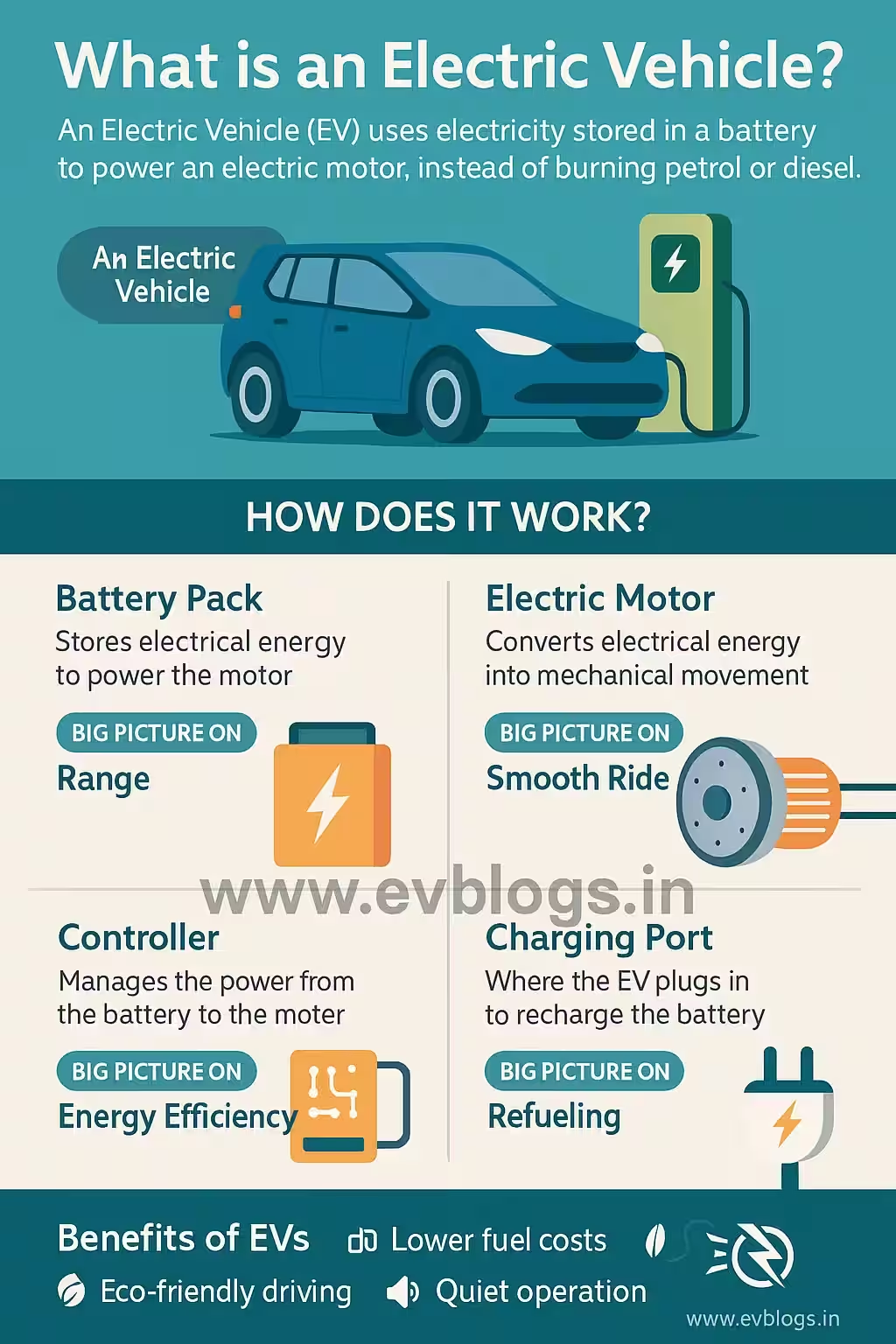
An electric vehicle is a vehicle that runs on an electric motor powered by a rechargeable battery, instead of burning petrol or diesel in an engine. You plug it in to refuel, the same way you charge your phone. There’s no exhaust pipe, no engine oil, and the ride is much quieter.
That’s the one-line version. Here’s what’s actually under the skin.
The battery is your fuel tank
The battery stores electricity measured in kilowatt-hours (kWh). A bigger kWh number means more range, the same way a bigger fuel tank means more kilometres. Most Indian EVs now use either lithium-ion or LFP (lithium iron phosphate) chemistry, with LFP becoming common because it’s safer and cheaper. A Tata Punch.ev with a 40 kWh pack stores enough energy to run a 100-watt bulb for around 400 hours (Electrical India ).
The motor is your engine
Most Indian EVs use a Permanent Magnet Synchronous Motor (PMSM) or a BLDC motor. The thing that surprises every first-time driver is the instant torque. An electric motor produces full pulling power from zero RPM, so the car or scooter feels snappy the moment you twist the throttle or press the accelerator (Dorleco ).
The controller and the BMS
Between the battery and the motor sits the Motor Control Unit. It converts the battery’s DC power into the AC the motor needs and decides how much power to send at any moment (Dorleco ). Working alongside it is the Battery Management System (BMS), which watches every cell’s voltage and temperature to protect against overcharging and overheating (PV Magazine India ). You’ll never touch either of these, but they’re the reason a modern EV is safe to leave charging overnight.
Regenerative braking - the car charges itself while you drive
This one took me a while to appreciate. When you lift off the accelerator or brake, the motor flips into reverse and becomes a generator, pushing energy back into the battery. A petrol car throws that energy away as heat in the brake pads. An EV recovers a chunk of it (91wheels ). It’s also why I get better range in stop-go city traffic than on the highway, which feels backwards until you understand regen.
Types of electric vehicles in India in 2026
People throw the word “EV” around loosely, so let’s separate the four types you’ll actually hear about.
BEV (Battery Electric Vehicle). Runs only on electricity, no petrol engine at all. This is what most people mean by “EV”. Examples on sale in 2026 include the Tata Punch.ev (Rs 9.69 to 12.59 lakh ex-showroom), the Tata Nexon EV (Rs 12.49 to 17.49 lakh), the MG Windsor EV , and on two wheels the Ather 450X and Ola S1 range.
HEV (Strong Hybrid). Uses a petrol engine and an electric motor, but you never plug it in. The battery charges itself through the engine and braking. The Maruti Grand Vitara Strong Hybrid (claimed 27.97 km/litre) and Honda City e:HEV are examples (CarDekho ). Important point for buyers: a strong hybrid is NOT treated as an EV for subsidy or registration benefits in India.
PHEV (Plug-in Hybrid). Has a bigger battery than an HEV plus a charging port, giving you 50 to 80 km of pure electric range before the petrol engine kicks in. As of mid-2026, mass-market PHEVs are almost absent in India, and they get no central subsidy (e-AMRIT ).
FCEV (Fuel Cell, hydrogen). Generates electricity from hydrogen and emits only water vapour. In India these exist only in government pilots under the National Green Hydrogen Mission, so ignore them as a buyer for now (e-AMRIT ).
For a first-time buyer, the choice is almost always between a BEV (true EV) and a strong hybrid. If you can charge at home, a BEV will cost far less to run. If you can’t charge at home and you do long highway trips, a strong hybrid is the easier life.
What it actually costs to run an EV in India
This is where the EV case is strongest, and the numbers aren’t close. Let me work through a real example for a typical urban commuter doing 1,200 km a month.
Petrol in Delhi sat at Rs 102.12 per litre on June 26, 2026 (Goodreturns ), and Mumbai was higher at Rs 111.21 (BusinessToday ). Home electricity in Delhi runs around Rs 7 per unit on the standard domestic slab (NoBroker ).
Petrol car (Tata Nexon petrol, real-world 14 km/litre): 1,200 km needs about 85.7 litres, which is Rs 8,740 a month, or Rs 7.14 per km.
Electric car (Tata Nexon EV, real-world 7.5 km per kWh): 1,200 km needs about 160 units, which is Rs 1,120 a month at home, or Rs 0.93 per km.
That’s roughly Rs 7,620 saved every month, about Rs 91,440 a year, on fuel alone. Even if you charge entirely at public DC fast chargers (Rs 18 per kWh at networks like Tata Power), your cost per km is about Rs 2.40, still two-thirds cheaper than petrol (Carbike4u ).
Maintenance - what you skip and what you still pay for
An EV drivetrain has around 20 moving parts against roughly 2,000 in a petrol engine, so a lot of routine servicing simply disappears. You skip engine oil and filters, spark plugs, the timing belt, the fuel filter, the exhaust and catalytic converter, and the clutch.
You don’t escape maintenance entirely. You still replace the 12V auxiliary battery every 3 to 4 years, flush brake fluid every couple of years, rotate tyres more often (EVs are heavier and the instant torque wears rubber faster), and change the cabin filter.
A mainstream EV’s annual service runs about Rs 3,500 to Rs 9,000, against Rs 9,000 to Rs 18,000 for a comparable petrol car (Ride N Repair ). Over five years, the same source pegs total running cost for a Nexon EV at Rs 1.14 to 1.44 lakh versus Rs 4.78 to 5.42 lakh for the Nexon petrol. The fuel saving does most of that work, but lower servicing helps.
Charging your EV in India
This is the part you need to think hardest about before buying, harder than range.
Home charging - AC slow charging
Every new EV comes with a 3.3 kW portable charger. Plug it into a properly wired socket and it’ll fill a Tata Punch.ev (30 kWh) in 9 to 10 hours, or a Nexon EV (45 kWh) in 11 to 12 hours (Autocar India ). That sounds slow until you realise you’re asleep for all of it. Plug in at night, full by morning.
Want it faster? A 7.4 kW wall-box roughly halves those times (Punch.ev in about 5 hours), but it costs Rs 20,000 to 35,000 installed and only makes sense if you drive 100+ km daily or run two EVs.
A basic home setup beyond the free bundled charger costs Rs 10,000 to 20,000, covering a proper 32A breaker, an RCCB, an earthing pit, and an electrician’s labour (EV-Wala ). Don’t skip the earthing pit. It’s a safety item, not an upsell.
The apartment problem - know this before you buy
If you live in a flat in an older building with shared basement parking, home charging gets complicated. RWAs can’t legally block a charger in your own allotted spot, but some city fire departments now restrict chargers to ground or first-basement level, and many older buildings have no spare electrical capacity (EVTech.News ). New building codes mandate that 20% of parking be EV-ready, but that doesn’t help an existing building. If you can’t sort out a dedicated charging point, be honest with yourself: you’ll be living on public chargers, which costs more and takes planning.
Public charging - DC fast charging
Public DC fast chargers bypass the car’s onboard charger and push high-power DC straight into the pack. A 25 to 50 kW unit gets a mid-size EV to 80% in 45 to 60 minutes. Newer 60 to 100 kW chargers do it in 25 to 40 minutes. The 2026 Punch.ev facelift can take 20 to 80% in about 26 minutes on a compatible charger (Cartoq ).
Here’s the public network picture as of 2026 (GreenTax.in ):
| Network | Points | Cost per kWh | Open to all? |
|---|---|---|---|
| Tata Power EZ Charge | 5,500+ | ~Rs 17 | Yes |
| Statiq | 10,000+ | Rs 18 to 22 | Yes (aggregator) |
| ChargeZone | 800+ DC fast | Rs 20 to 22 | Yes |
| Ather Grid | 1,200+ | Free | Ather scooters only |
India crossed 12,000+ public charging stations by early 2026, dense in Delhi NCR and Bengaluru but still thin in smaller towns. On primary highways, chargers are now spaced within about 50 km of each other.
Range - the certified number versus what you actually get
This is where a lot of first-time buyers feel cheated, so let me be blunt. The big range number on the brochure is the ARAI or MIDC certified figure, measured in a lab at a steady temperature with no AC, no headlights, and gentle speeds. Real Indian driving has none of those luxuries.
My rule of thumb: expect 65 to 75% of the certified figure in mixed city-highway use. Here’s what Autocar India actually measured against the claimed numbers (Autocar India ):
| Vehicle | ARAI claimed | Tested real-world | Gap |
|---|---|---|---|
| Tata Tiago EV (24 kWh) | 275 km | 187 km | -88 km |
| MG Windsor EV (38 kWh) | 332 km | 308 km | -24 km |
| Tata Nexon EV (45 kWh) | 489 km | 350 km | -139 km |
| Hyundai Creta Electric LR | 473 km | 432 km | -41 km |
| Mahindra BE 6 (79 kWh) | 682 km | 449 km | -233 km |
Notice how uneven the gap is. The MG Windsor EV gave up only 24 km, the best real-world retention in its class, while the Mahindra BE 6 lost a brutal 233 km. The lesson isn’t “EVs lie about range”, it’s “judge an EV by its tested figure, not its sticker”. On scooters it’s the same story: the Ola S1 Pro is claimed at around 170 km but Autocar India tested 127 km in Normal mode and 102 km in Sport (Autocar India ).
Government subsidies and tax benefits in 2026
The incentive picture changed a lot in the last two years, and a fair bit of what’s online is out of date. Here’s what’s actually true in mid-2026.
PM E-DRIVE (the central scheme)
PM E-DRIVE replaced FAME II in October 2024 with a Rs 10,900 crore budget (PM E-DRIVE official site ). For electric two-wheelers it gives Rs 2,500 per kWh, capped at Rs 5,000 per vehicle, and the deadline was extended to July 31, 2026 (Autocar India ). It’s applied automatically as an upfront discount through an Aadhaar-linked voucher, so there’s no separate form to fill.
The point that trips up most car buyers: private electric cars get no direct cash subsidy under PM E-DRIVE. The scheme covers two-wheelers, three-wheelers, buses, and trucks, not private four-wheelers.
The GST advantage
EVs are taxed at 5% GST with no cess. Petrol and diesel cars carry an effective 29 to 50% once cess is added (GreenTax.in ). On a Rs 15 lakh car, that gap alone is worth several lakh rupees, and it’s the single biggest financial reason an EV car makes sense despite the higher sticker price.
State road tax and subsidies
Several states waive road tax and a few still give a purchase subsidy. Maharashtra exempts road tax until 2030 and Rajasthan offers up to Rs 1.5 lakh on four-wheelers (EVSelect.in ). But Gujarat rolled its consumer subsidy back, Uttar Pradesh let its exemption lapse in October 2025, and Delhi’s 2025-26 policy was still in draft form as of June 2026. Treat any subsidy claim in an article older than three months as suspect, and confirm the current position at your RTO before you register.
One more thing buyers ask about: the Section 80EEB income tax deduction of Rs 1.5 lakh on EV loan interest is not available for new loans taken after March 31, 2023 (ClearTax ). If someone tells you to factor it into a 2026 purchase, they’re working off old information.
A practical buying checklist for first-time EV buyers
Here’s the order I’d actually go through with a friend.
- Work out your daily range honestly. The average Indian commute is 30 to 60 km a day. Target an EV with at least double that in real-world (tested, not ARAI) range. If you do 50 km a day, treat 100 km tested as your floor.
- Sort out charging before you sort out the car. Do you have a dedicated parking spot? Can you run a 32A circuit to it? Does your society allow it? If any answer is no, you’re a public-charging buyer, and that changes which car makes sense.
- Count the service centres in your city. Tata has the widest EV service network in India, with Mahindra, MG, and Hyundai solid in cities. For newer or imported brands, find the nearest authorised centre before you commit.
- Understand the battery warranty. The industry standard is 8 years or 1.6 lakh km with a 70% State of Health floor, meaning the brand fixes or replaces the pack free if capacity drops below 70% in that window (VahanBazaar ). It’s transferable on all the major brands, which matters for resale.
- Think in total cost, not sticker price. The EV usually costs Rs 1.5 to 4 lakh more up front, but the fuel and service savings typically break even in 4 to 5 years.
- Go in with eyes open on resale. Average EV depreciation in India runs about 14% a year, with wide variation, and there’s still no universal battery health certificate (Business Standard ). Buy a brand with a strong network and a transferable warranty, and resale gets easier.
Honest cons - where EVs still fall short
I recommend EVs to most people, but I won’t pretend they’re perfect.
- No home charging is a real dealbreaker for apartment dwellers. Sort this first.
- Higher upfront cost of Rs 1.5 to 4 lakh, even if the TCO offsets it later.
- Highway trips need planning. You can’t carry a can of electrons. Map your route on an app like ChargeZone or PlugShare and charge to 80 to 100% before a long run.
- Public charger reliability outside metros is patchy. Having a charger on the map doesn’t mean it works that day. In tier 2 and tier 3 towns this is still frustrating.
- Battery replacement is expensive out of warranty (Rs 5.5 to 9 lakh for a Nexon EV pack), though few owners hit this inside the 8-year window (AllAboutEVs ).
So who should buy? If you have home charging and drive mostly in the city, a BEV is an easy yes. The running-cost saving alone justifies it. If you have no home charging and regularly do long highway runs from a smaller town, wait, or look at a strong hybrid instead. Be honest about which one you are.
FAQ
What is the difference between a BEV and a hybrid car? A BEV runs only on electricity and you plug it in. A hybrid uses both petrol and electricity, and the battery charges itself through the engine and braking, so you never plug it in. A BEV never visits a petrol pump, a hybrid never visits a charger.
Can I charge an EV at home in India? Yes, if you have a dedicated parking spot and can install a 32A circuit with proper earthing. A basic setup costs Rs 10,000 to 20,000 beyond the bundled charger. If you live in a rented flat or an apartment without assigned parking, it’s much harder, so check this before buying.
How much does it cost to charge an electric car in India? At a Delhi home tariff of about Rs 7 per unit, a 40 kWh car costs around Rs 280 for a full charge and goes roughly 300 km. At a public DC fast charger (Rs 18 to 25 per unit) the same charge costs Rs 720 to 1,000.
Why is real-world range always less than the ARAI figure? ARAI certifies range in a lab with no AC, a flat road, and a controlled temperature. Real driving adds AC, hills, traffic, and higher speeds. Expect 65 to 75% of the certified number in actual use.
What happens if I run out of charge on the road? You can’t carry spare electricity, so a dead battery means roadside assistance or a tow to the nearest charger. Most Indian EV brands now offer 24/7 roadside assistance. The practical fix is to plan trips with a buffer and never let the charge hit zero.
Is it safe to charge an EV in the rain? Yes. EV ports and connectors are built for outdoor use, and Indian EVs carry IP-rated battery packs. The only caution is not to charge while standing in flood water, which is a general electrical safety rule, not an EV-specific one.
What is the government subsidy on electric cars in India in 2026? There’s no direct central cash subsidy on private electric cars under PM E-DRIVE, which covers two-wheelers, three-wheelers, buses, and trucks. For cars, the real benefits are the 5% GST (versus 29 to 50% on petrol cars) and state road tax waivers, with a few states like Maharashtra and Rajasthan adding direct incentives.