
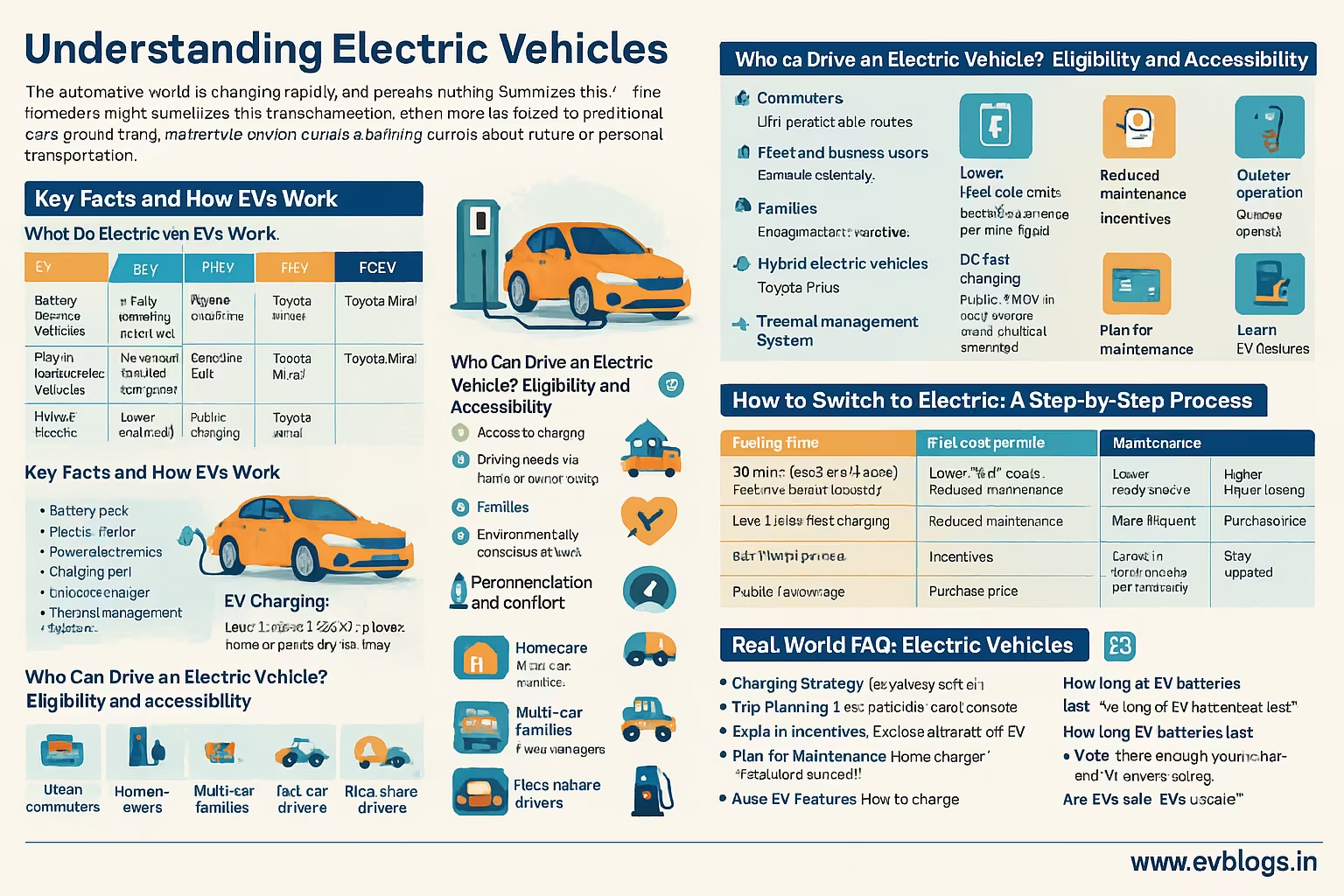
If you are reading this, you have probably noticed how fast electric vehicles have moved from a curiosity to a normal sight on Indian roads. The neighbour charging a scooter overnight, the silent auto that pulls away from the signal, the white Nexon EV in the office car park. This guide explains what an EV actually is, how it works, and the practical things an Indian buyer needs to know in 2026, with real numbers and sources rather than hype.
What Is an Electric Vehicle?
An electric vehicle is any vehicle that uses one or more electric motors for propulsion, drawing energy from a rechargeable battery instead of burning petrol or diesel. Press the throttle and electricity flows from the battery to the motor, which turns the wheels. There is no engine, no gearbox in the traditional sense, no fuel tank, and no tailpipe. That is the whole idea in one sentence: you replace a tank of fuel with a battery, and an engine with a motor.
In India, “EV” covers everything from a 2 kWh electric scooter like the Ola S1 Air to a 79 kWh family SUV like the Mahindra XEV 9S. The capacity of that battery, measured in kilowatt-hours (kWh), is the rough equivalent of your fuel tank size: more kWh means more range.
The Types of EVs You Will See in India
Not everything called “electric” is the same. Here are the categories that matter, from fully electric to barely electric (NITI Aayog e-AMRIT ).
- Battery Electric Vehicle (BEV): runs purely on a battery and motor, zero tailpipe emissions. This is what most people mean by “EV”. Examples on sale in India: Tata Nexon EV, Tata Tiago EV, Mahindra BE 6, Ather 450X, Ola S1 Pro.
- Plug-in Hybrid (PHEV): has both a battery you can plug in and a petrol engine, so it runs on electricity for a short range then switches to fuel. Rare and pricey in India today.
- Strong Hybrid (HEV): has a small battery and motor charged by the engine and braking, not by plugging in. It can crawl short distances on electricity. Examples: Toyota Urban Cruiser Hyryder Hybrid, Maruti Grand Vitara Hybrid, Honda City e:HEV.
- Mild Hybrid: a small 12V or 48V motor that assists the engine and improves fuel use by roughly 5 to 10%. It cannot drive on electricity alone. Maruti’s Smart Hybrid is the common example.
- Fuel Cell EV (FCEV): makes its own electricity from hydrogen. Still at the pilot stage in India, with a Toyota Mirai trial under the National Green Hydrogen Mission (DD News ).
When this guide says EV, it means a BEV unless stated otherwise.
How a Battery EV Actually Works
You do not need to be an engineer, but four parts are worth knowing.
- The battery pack: a set of lithium-ion cells in a sealed casing, usually mounted low under the floor. It stores the energy and is the most expensive single component.
- The motor: converts electricity into motion. EVs deliver full torque from a standstill, which is why even a humble electric scooter feels quick off the line.
- Regenerative braking: when you lift off or brake, the motor runs in reverse as a generator and feeds energy back into the battery. It recovers range and reduces brake wear, which is why EV brake pads last so long (91wheels ).
- Charging: you refill the battery from a wall socket, a home wallbox, or a public charger. More on that below.
That is the entire system. Fewer moving parts than a petrol vehicle is a big reason EVs need less maintenance.
The India 2026 Picture: How Mainstream Are EVs Now?
Very. In FY2026 India sold about 24.5 lakh electric vehicles, up 25% year on year, taking EV penetration to roughly 8.3% of all new vehicles (JMK Research , Autocar Professional ). The split tells the real story:
- Electric two-wheelers: about 14 lakh units, around 6.5% of all two-wheelers sold.
- Electric three-wheelers: about 8.3 lakh units, an extraordinary 60.9% of all three-wheelers. The humble e-rickshaw is now the majority choice, driven by economics, not subsidies.
- Electric cars: about 2 lakh units, growing 84% in a single year even without a purchase subsidy.
So if you are wondering whether EVs are a safe, established choice, the answer is yes for scooters and three-wheelers especially, and increasingly so for cars.
Government Incentives in 2026
The current national scheme is PM E-DRIVE, which replaced FAME II, with a Rs 10,900 crore outlay (DD News ). What it means for you in 2026:
- Two-wheelers get a demand incentive of Rs 2,500 per kWh, capped at Rs 5,000 per vehicle, only for models with advanced batteries priced under Rs 1.5 lakh ex-factory. The two-wheeler window runs to 31 July 2026 (ClearTax ).
- Electric cars get no purchase subsidy under PM E-DRIVE. Their advantage comes from tax.
- GST on battery EVs is just 5%, against 28% plus cess on petrol cars (ClearTax ).
- Road tax and registration waivers exist in many states but vary widely. This is where a lot of your real saving sits, so check your own state. We track these in our state subsidy guides, for example the popular Uttarakhand EV subsidy page .
Charging Explained
There are two speeds. AC charging (home wallbox or a regular socket) is slower and gentler on the battery, ideal for overnight top-ups. DC fast charging at public stations is much quicker but costs more and, used daily, ages the battery a little faster.
India had roughly 27,700 public chargers as of 2026, of which only about 8,414 are DC fast chargers, working out to about one public charger for every 235 EVs (Bolt.Earth ). That ratio is still thin, which is why home charging matters so much. The costs:
- Home charging: roughly Rs 6 to 9 per unit, which works out to about Rs 1 to 1.50 per km.
- Public DC fast charging: roughly Rs 18 to 26 per unit, or about Rs 3.50 to 5.50 per km.
The practical takeaway: an EV makes the most financial sense when you can charge at home or work. If you would depend entirely on public fast chargers, the running-cost advantage shrinks.
Running Cost: EV vs Petrol
This is the number that wins people over. Charging at home, most EVs cost about Rs 1 to 1.50 per km against Rs 5.50 to 8 or more for a petrol vehicle (carbike4u ). Over a year of city commuting that difference adds up to real money, and it is the single biggest reason India’s three-wheeler segment went majority-electric on its own.
A fair word of caution: the upfront price of an EV is usually higher, so your break-even depends on how many kilometres you drive a year and whether you can charge cheaply at home. The more you drive, the faster an EV pays back.
Range: The Claimed Number vs What You Actually Get
Every EV quotes a certified range, ARAI for cars or IDC for two-wheelers. Treat it as a best-case lab figure. A useful rule of thumb is to expect about 70% of the certified number in real Indian conditions, with AC on and normal speeds (Down To Earth ). Autocar India’s tests show how much it varies by model:
| Model | Certified range | Tested range | Shortfall |
|---|---|---|---|
| Tata Tiago EV (24 kWh) | 275 km (ARAI) | 187 km | 32% |
| MG Windsor EV | 332 km (ARAI) | 308 km | 7% |
The MG came within 7% of its claim, the Tiago fell 32% short (Autocar India ). So do not buy on the brochure figure alone. Look for an independent real-world test of the exact model you want.
Honest Pros and Cons
The pros:
- Much lower running cost, roughly Rs 1 to 1.50 per km at home.
- Smooth, quiet ride with instant torque and no gear changes.
- Low maintenance: no oil changes, no clutch, and regen braking that makes pads last far longer.
- Lower tax (5% GST) and, in many states, road-tax waivers.
The cons:
- Higher purchase price, so the saving takes time to recover.
- Charging access is still patchy if you cannot charge at home.
- Real range is well below the certified claim, especially with AC.
- Resale value and used-EV pricing are still maturing, partly because buyers worry about battery health (Business Standard ).
Myths vs Facts
“EVs catch fire easily.” Global data says the opposite. EV fires are far rarer than petrol-car fires. Swedish data put it at roughly 0.004% of EVs versus 0.08% of petrol vehicles, making EV fires somewhere between 50 and 100 times less likely (EVFY ). The early Indian scooter fires that made headlines were tied to specific design and quality faults, not to EVs as a category.
“You cannot ride an EV in the monsoon.” You can. EV batteries sold in India carry an IP67 rating, which means they are sealed against dust and short water immersion, so normal rain and waterlogged streets are fine (Shriram GI ). Deep flooding is a risk for any vehicle, EV or petrol.
“Range anxiety makes EVs impractical.” For daily city use, where most people drive 30 to 50 km, this is overblown. For long highway trips it is a real planning consideration, but the charging network is growing fast (Bolt.Earth ).
“The battery will die in a few years and cost a fortune.” Modern lithium-ion packs degrade slowly, typically losing a small percentage of capacity per year, and most carry warranties of 8 years or more. Replacement is expensive, but it is rarely needed within a normal ownership period.
Examples of EVs On Sale in India (June 2026)
These are examples to anchor the price bands, not a ranked buying guide.
- Budget electric scooter: Ola S1 Air, from Rs 84,999 ex-showroom with 85 to 165 km IDC range (BikeWale ).
- Budget electric car: Tata Tiago EV, Rs 5.84 lakh to Rs 9.99 lakh, with a tested 187 km (CarWale ).
- Family electric SUV: Tata Nexon EV, Rs 12.49 lakh to Rs 17.49 lakh, with up to a claimed 489 km on the long-range battery (Tata Motors ).
If you are shopping two-wheelers, our guides to the best electric scooters under 1.5 lakh and the longest-range electric scooters go deeper. For families, see the best 7-seater electric cars .
Frequently Asked Questions
Is it safe to charge an EV during the monsoon in India? Yes. EV charging systems are designed with multiple safety cutoffs, and the battery is IP67-sealed. Use a proper earthed socket or wallbox and avoid charging while standing in water.
How much does it cost to charge an electric car at home in India? Roughly Rs 6 to 9 per unit of electricity, which comes to about Rs 1 to 1.50 per km. A full home charge of a small EV costs far less than a single litre-equivalent of petrol travel.
What is the difference between IDC range and actual range? IDC and ARAI figures are lab-certified best cases. Real-world range in Indian heat, traffic, and with AC on is usually around 70% of the claim, sometimes less.
Should I buy a strong hybrid or a battery EV right now? If you can charge at home and mostly drive in the city, a battery EV gives the lowest running cost and tax. If you do frequent long highway trips and cannot charge easily, a strong hybrid removes range worry while still saving fuel.
Do EVs get road tax exemption in all states? No. It varies by state, and the waiver is one of the biggest real savings. Check your state’s EV policy before buying.
What happens if I run out of charge on a highway? The same as running out of fuel: you need a tow or a portable charge. Plan trips around the charging map, keep a buffer, and the situation is rare with sensible planning.
How long does an EV battery last? Most modern packs are warrantied for 8 years or more and degrade slowly. Replacement is costly but rarely needed within a typical ownership span.
The Bottom Line
An electric vehicle is no longer an experiment in India. With EVs at 8.3% of new sales, three-wheelers gone majority-electric, and running costs a fraction of petrol, the case is strong, especially if you can charge at home. The honest caveats are a higher upfront price, real range below the brochure, and a charging network that is still filling in. Weigh those against your own driving and charging situation, and for most city buyers the maths now points toward electric.
Figures are as of June 2026 and sourced from the government, industry research, and the publications linked above. Prices, subsidies, and charging costs vary by city and state, so confirm current details before buying.