
Battery thermal management is the system that keeps an EV’s battery pack inside its safe temperature window, roughly 15C to 35C. It matters more in India because summers regularly cross 45C, and that sustained heat speeds up battery degradation and raises the risk of thermal runaway and fire.
Key takeaways
- Battery thermal management (BTMS) keeps lithium-ion cells inside their safe window of roughly 15C to 35C.
- Heat is the main enemy: it speeds up degradation and, in extreme cases, can trigger thermal runaway and fire.
- Parts of India regularly cross 45C in summer, so the pack often starts hot before you even ride.
- The four cooling methods are passive air, forced air, liquid cooling, and phase-change or immersion cooling.
- Liquid cooling holds a steadier pack temperature than air cooling, which matters most during fast charging in our climate.
- Cooling hardware only works when a good battery management system tells it when to act.
What does battery thermal management actually do?
Battery thermal management, often shortened to BTMS, is the system that keeps the cells inside their safe temperature window of roughly 15C to 35C. It pulls heat away when the pack is working hard or charging fast, and in colder regions it can warm the pack so it accepts charge safely. Most of the attention in India goes to the cooling side, for obvious reasons.
Push lithium-ion cells much hotter than that window and chemistry starts working against you. Let them sit cold and they lose usable range temporarily.
The brain making these calls is the battery management system, which reads cell temperatures and decides when to throttle power, slow charging, or trigger cooling. If you want the full picture of how that controller works, I’ve written about the battery management system for electric vehicles separately.
Why is heat the real enemy for EV batteries?
Heat is the real enemy because it does two damaging things to a pack: it speeds up degradation and it raises fire risk. Both get worse in India’s sustained high temperatures, which is why thermal management is treated as a safety feature here, not just a performance one.
First, degradation speeds up. Heat accelerates the chemical side reactions that age a cell, so a pack that spends its life baking at 45C ambient loses capacity faster than one kept cool. That’s range you paid for, quietly disappearing. I covered the mechanics of this in detail in my piece on battery degradation in electric vehicles .
Second, and more seriously, heat raises fire risk. If a cell overheats badly enough it can enter thermal runaway, a chain reaction where one cell heating up sets off its neighbours. According to Energetica India , weak passive air cooling is a known contributor to EV fire risk, which is exactly why better thermal management is treated as a safety feature, not just a performance one.
Now layer in our conditions. Parts of India regularly cross 45C in summer. A bike or scooter left in the sun on tar can sit well above that. The pack starts hot before you’ve even ridden, and that’s the gap a good cooling system has to close.
How do the EV cooling methods compare?
There are four broad cooling approaches: passive air, forced air, liquid cooling, and phase-change or immersion cooling. They rise in cooling strength and cost in roughly that order, and they’re not equal. Here’s how I weigh them.
| Cooling method | How it works | Cooling strength | Cost | Best fit |
|---|---|---|---|---|
| Passive air | Pack sheds heat to surrounding air, no fans | Weak | Lowest | Low-power, small packs |
| Forced air | Fans push air over cells | Moderate | Low | Budget two-wheelers |
| Liquid cooling | Coolant circulates through plates or channels | Strong | High | Cars, fast-charging EVs |
| Phase-change / immersion | Material absorbs heat or cells sit in fluid | Strong, even | Highest | High-performance, emerging |
Air cooling is cheap and simple, which is why so many affordable Indian scooters use it. The problem is that when the ambient air is already 42C, blowing 42C air over a hot pack doesn’t help much. Liquid cooling carries heat away far more effectively because liquid moves heat better than air, and it can hold the pack at a steadier temperature during fast charging. That steadiness is the part that matters for our climate.
Phase-change materials and immersion cooling sit at the cutting edge. They absorb large amounts of heat or surround cells in a non-conductive fluid for very even temperatures, though they add cost and complexity that mainstream Indian EVs haven’t widely adopted yet.
Why is thermal management harder on two-wheelers?
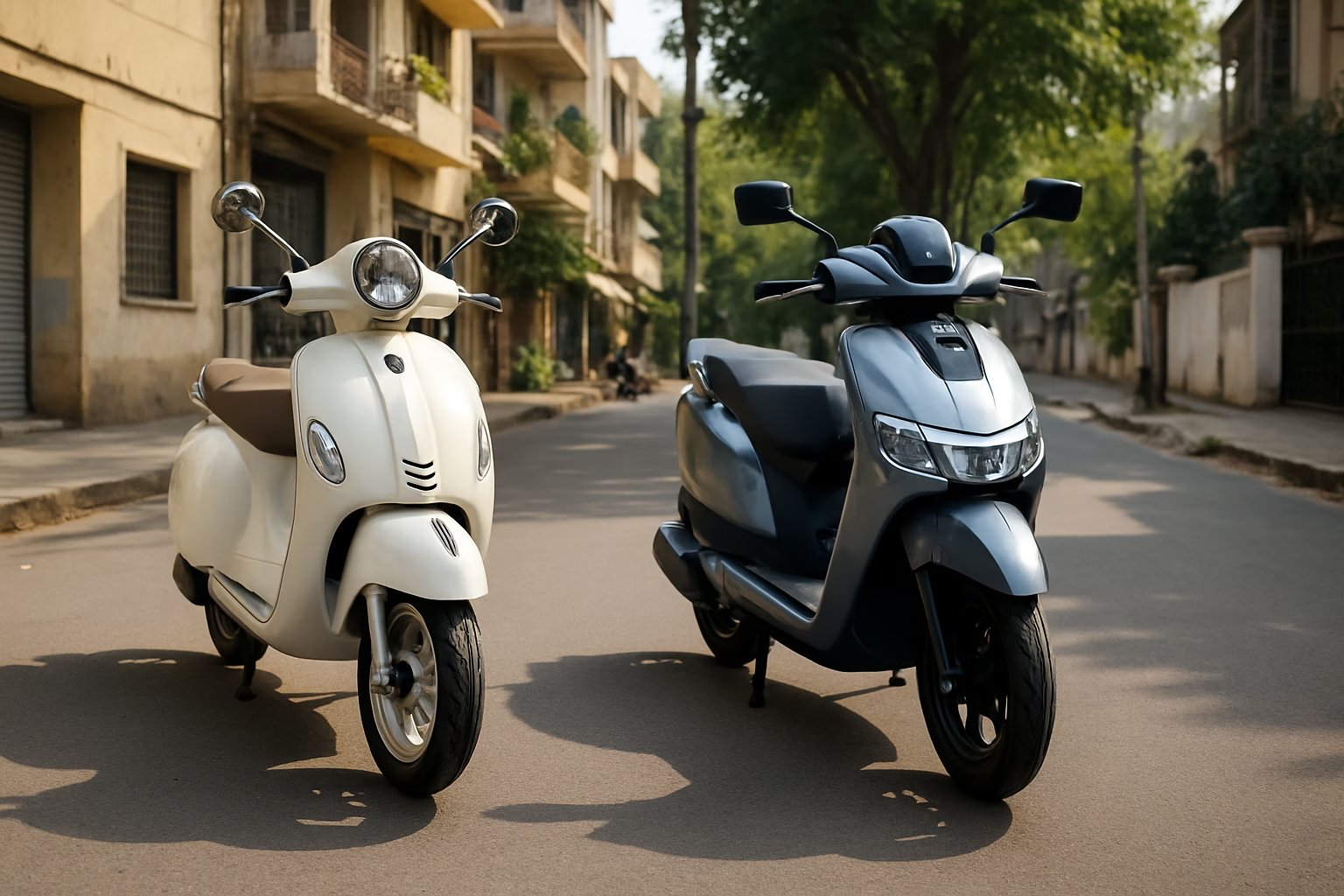
Thermal management is harder on two-wheelers because a scooter pack is small, tightly packed, and often sits low and exposed, leaving little room for elaborate liquid loops. Most BTMS research comes from the car world, but India runs on two-wheelers, so cold-climate car assumptions don’t carry over cleanly.
This is why I was glad to see a 2026 SAE India technical paper on a battery thermal management approach for two-wheeler EVs in Indian conditions . It signals that engineers are designing for our heat specifically rather than borrowing cold-climate assumptions. When you’re shopping, it’s worth asking how a scooter manages pack temperature. Some of the better-built options, like the ones I list in my best Ather electric scooters in India 2026 guide, treat thermal design as a priority rather than an afterthought.
What role does the BMS play in cooling?
The BMS is the software brain that tells the cooling hardware when to act, so even strong cooling is useless without it. Hardware cooling only works if something decides when to trigger it, and that’s the BMS again. As pv magazine India puts it, the BMS is the software brain behind EV performance and safety, and thermal protection is one of its core duties. It decides to slow charging when the pack is hot, cut power if a cell crosses a limit, and balance the load so no single cell overheats. Good cooling hardware with a weak BMS is like a strong AC with a broken thermostat.
How can I keep my EV battery cool as an owner?
You can keep your EV battery cooler by avoiding habits that stack heat: don’t fast-charge straight after a hot drive, park in shade, and don’t sit at 100% charge in the heat. You can’t redesign the cooling system, but these small habits genuinely slow heat-driven ageing. A few I follow:
- Don’t fast-charge right after a hard, hot drive. Let the pack settle first so you’re not stacking heat on heat.
- Park in shade whenever you can. Direct afternoon sun on a dark seat or panel cooks the pack underneath.
- Don’t leave the battery sitting at 100% in the heat. A full pack in high temperatures ages faster, so charge to around 80% for daily use.
- Watch for warnings. If your BMS flags high temperature or throttles power, take it seriously rather than pushing through.
None of this is dramatic. It’s just respecting that heat is the thing quietly deciding how long your battery lasts.
My take
Thermal management used to feel like a spec-sheet footnote. In India it isn’t. Our heat turns it into the difference between a pack that holds range for years and one that fades or, worst case, fails dangerously. When I compare EVs now, I look past the headline range and ask how the maker keeps the battery cool. In this climate, that answer tells you more than almost anything else on the brochure.
Frequently asked questions
Why do EV batteries overheat in India?
EV batteries overheat in India mainly because of the climate. Parts of the country regularly cross 45C in summer, and a scooter left on tar in the sun can sit well above that. The pack starts hot before you’ve even ridden, so cooling systems have a bigger gap to close than in cooler regions.
Is liquid cooling better than air cooling?
Liquid cooling is generally stronger than air cooling because liquid moves heat better than air, and it holds the pack at a steadier temperature during fast charging. Air cooling is cheaper and simpler, but when the ambient air is already 42C, blowing 42C air over a hot pack doesn’t help much. That steadiness is what matters in our climate.
How can I keep my EV battery cool?
You can’t redesign your EV’s cooling, but you can avoid stacking heat. Don’t fast-charge right after a hot drive, park in shade where you can, and avoid leaving the pack at 100% in high temperatures by charging to around 80% for daily use. Also take any BMS high-temperature warning seriously rather than pushing through.
What happens if an EV battery gets too hot?
If an EV battery gets too hot, degradation speeds up and range fades faster than it should. In extreme cases a cell can enter thermal runaway, a chain reaction where one overheating cell sets off its neighbours, which is a known contributor to EV fire risk. That’s why better thermal management is treated as a safety feature.
Sources
- Energetica India - Thermal management in EV batteries
- SAE - Battery thermal management approach for two-wheeler EVs, Indian case study
- pv magazine India - Battery management systems, the software brain
Last updated: 22 June 2026